
Ukraine registered 709 new companies with foreign owners from January to July 2026, 24% more than in the same months of 2024, according to an open-data analysis of the state company register. The count has now risen for two years in a row, yet it starts from a low base, because the full-year total for 2024 was 60% below the 2021 level. Market entry in Ukraine is therefore recovering after the disruption of 2022, although it has not yet returned to its earlier scale.
A board weighing entry needs more than the count, because the economics of a Ukrainian operation depend on the terms that apply after registration. Those terms cover the legal vehicle, the tax base, currency controls, staffing rules under martial law and access to the European Union (EU) market, and several of them changed between 2024 and 2026. Others already carry dates in 2027 and 2028, although most of them are not yet law. This article sets the entry data against those rules and separates what is in force from what is still a draft, a funding commitment or a stated goal, while the wider operating picture is covered in our guide to doing business in Ukraine.
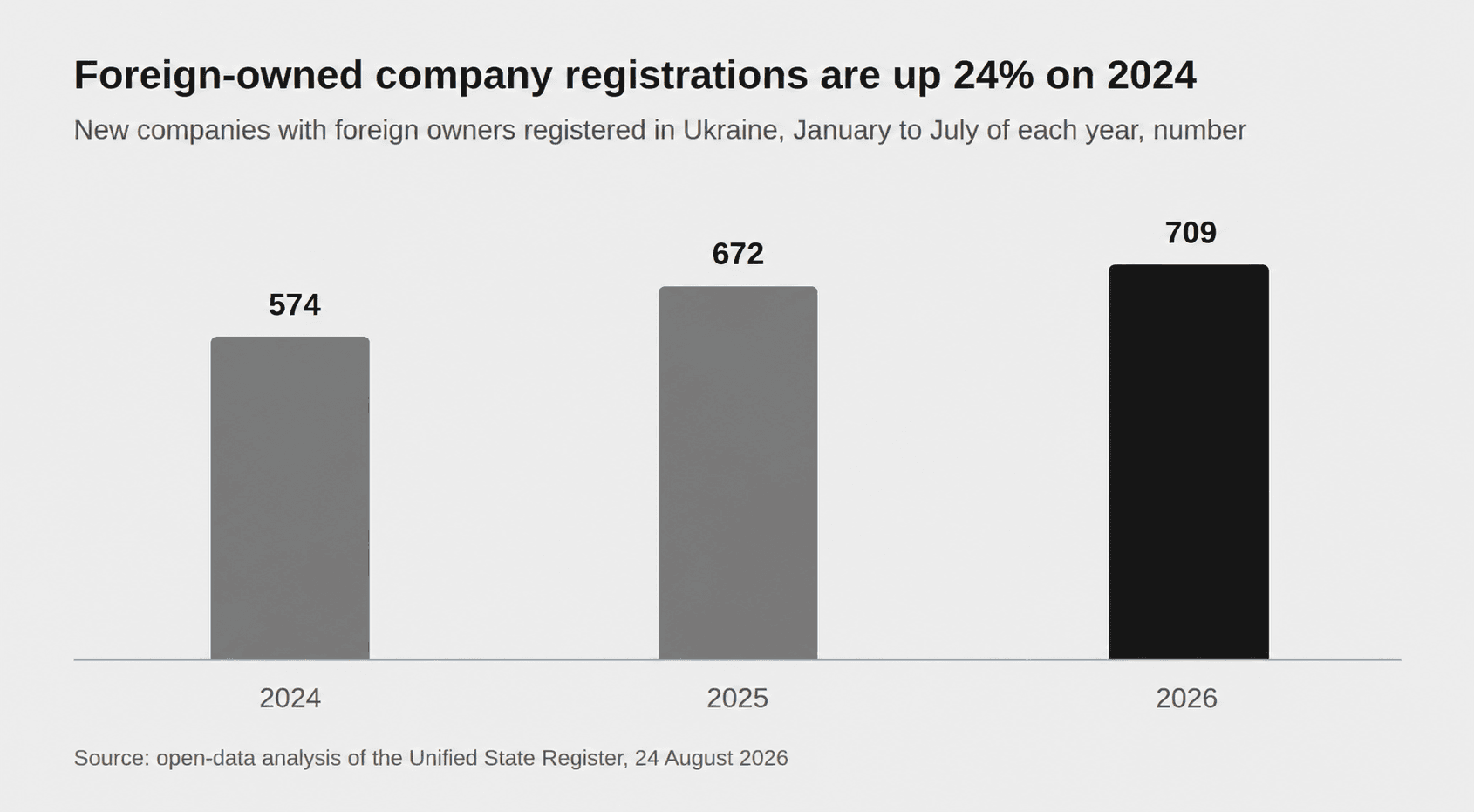
New companies with foreign owners registered in Ukraine, January to July of each year. Source: open-data analysis of the Unified State Register, 24 August 2026
How many foreign companies are entering Ukraine
In this article, market entry in Ukraine covers four observable routes. They are a new company with a foreign owner, a branch or representative office, the purchase of a Ukrainian company by a foreign buyer, and foreign direct investment (FDI) recorded by the National Bank of Ukraine (NBU). Exports to Ukrainian customers by foreign suppliers without a local presence are outside the scope of the analysis.
Registration counts come from the Unified State Register of legal entities, and the country of ownership is taken from the citizenship of the beneficial owners. The register did not operate from late February to late March 2022 and paused again from mid-December 2024 into January 2025, which lowers the counts for those periods. Data on mergers and acquisitions (M&A) come from a market review, published annually with interim editions, that counts completed and announced deals above USD 5 m. It also covers minority stakes and funding rounds, and deals of undisclosed value whose target has turnover above USD 10 m. FDI and deal values are nominal USD figures, UAH amounts are quoted without conversion, and the exchange-rate path is set out in the section on currency rules.
Registrations are recovering from a lower base
The longer series of foreign-owned registrations is only partly published. The register analysis for 2024 puts that year's total at 1,109 new foreign-owned companies, 24% below 2023, but gives the 2021 and 2023 levels only as percentage changes. A full-year figure for 2025 does not appear in any of the sources reviewed. The comparable series is the January to July window, which rose by 17% in 2025 and by a slower 6% in 2026.
The full-year figure for 2026 is a transparent estimate of our own, since no forecast for the rest of the year was found in the material reviewed. In 2024 the January to July window accounted for 51.8% of the annual total, and applying that share to the 2026 count gives about 1,370 new foreign-owned companies in Ukraine for the year (Source: UA Consulting). The estimate is conservative because the 2024 base includes the December register pause, and it would put 2026 about a quarter above 2024 and at roughly half of the 2021 level implied by the published decline.
The wider register shows a similar recovery that remains below the earlier level. A register analysis of July 2026 counts 19,758 new legal entities of all forms in the first half of 2026, the highest first-half figure in three years. The weekly registration pace at the end of 2025 was 717 legal entities, against 1,077 in 2021. Because these totals include non-profit bodies and condominiums, the share of foreign companies entering Ukraine among all new companies cannot be calculated on a like-for-like basis.
Who the new owners are and where they register
Owners from 65 countries set up companies in the first seven months of 2026, and the ranking has shifted markedly since 2024. Chinese owners almost tripled their count on a year earlier and moved into first place, ahead of Turkish owners, who had led over the full year 2024 with 201 companies. Poland, second in 2024, no longer appears in the top five. The sources studied do not explain the rise in Chinese registrations, and this article attributes no cause to it.
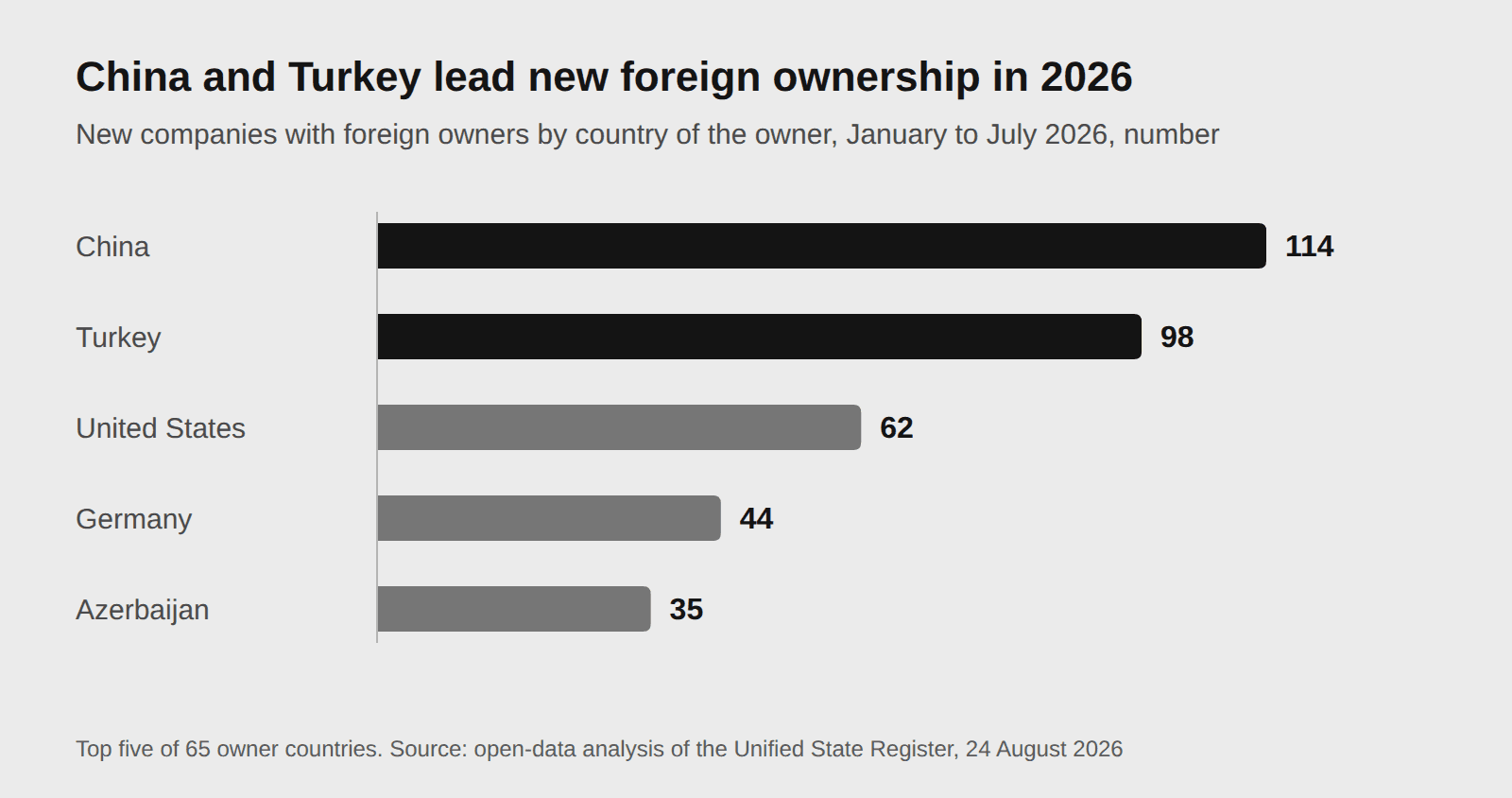
New companies with foreign owners by country of the owner, January to July 2026, top five of 65 countries. Source: open-data analysis of the Unified State Register, 24 August 2026
New entrants differ from the foreign companies already established in Ukraine. Among almost 3,000 foreign-owned companies with annual revenue of at least UAH 100 m, a March 2026 analysis of large businesses finds the largest group with owners in Cyprus, followed by Germany, the United States and the Netherlands. The National Bank estimates that 26.2% of FDI inflows other than reinvested earnings in 2024 were capital ultimately controlled by Ukrainian residents, and it names Cyprus, the Netherlands, Switzerland and Austria as the main routes for such flows. The country of a large company's owner is therefore a weak guide to the origin of its capital.
Half of the new foreign-owned companies registered in Kyiv, followed by Odesa oblast at 16% and Lviv oblast at 11%. The same three locations led in 2024, when the share of Kyiv was slightly lower. A registered address shows where a company is incorporated, which is not necessarily where it operates or employs staff.
By activity, wholesale trade accounts for 24% of the new companies, ahead of real estate and construction at 8% each and information technology at 6%. Wholesale also led in 2024, ahead of computer programming and real estate. Production is harder to see in these counts, because a single plant can carry large capital through one new company.
Acquisitions and capital flows
Acquisitions and equity deals bring fewer entrants but larger sums into the market. Foreign investors took part in 13 of the 63 deals counted in the 2025 M&A review, as many as in 2024, although the disclosed value of those deals fell by more than half. Later editions of the review revise earlier periods, which makes year-on-year comparisons provisional.
The first half of 2026 changed the picture for inbound investment. In the half-year edition of the same review, foreign investors took part in 10 deals worth USD 415 m, against 5 deals worth USD 26 m in the same period of 2025. The largest item, worth more than a third of that value, was a funding round for an online language-learning platform with Ukrainian founders rather than an acquisition. Values were disclosed for fewer than half of all deals in that period, and the reported totals understate activity.
Foreign direct investment moved in the opposite direction to registrations. Net FDI fell by about a third in 2025, and the whole decline came from lower reinvested earnings, while other inflows rose by USD 0.3 bn (Source: UA Consulting). The fall followed NBU decisions of 2024 and 2025 that allowed dividends on recent profits, and more than 940 companies had repatriated such dividends by December 2025. This link rests on timing alone, and the central bank treats reinvested earnings for 2022 to the first quarter of 2025 as estimates.
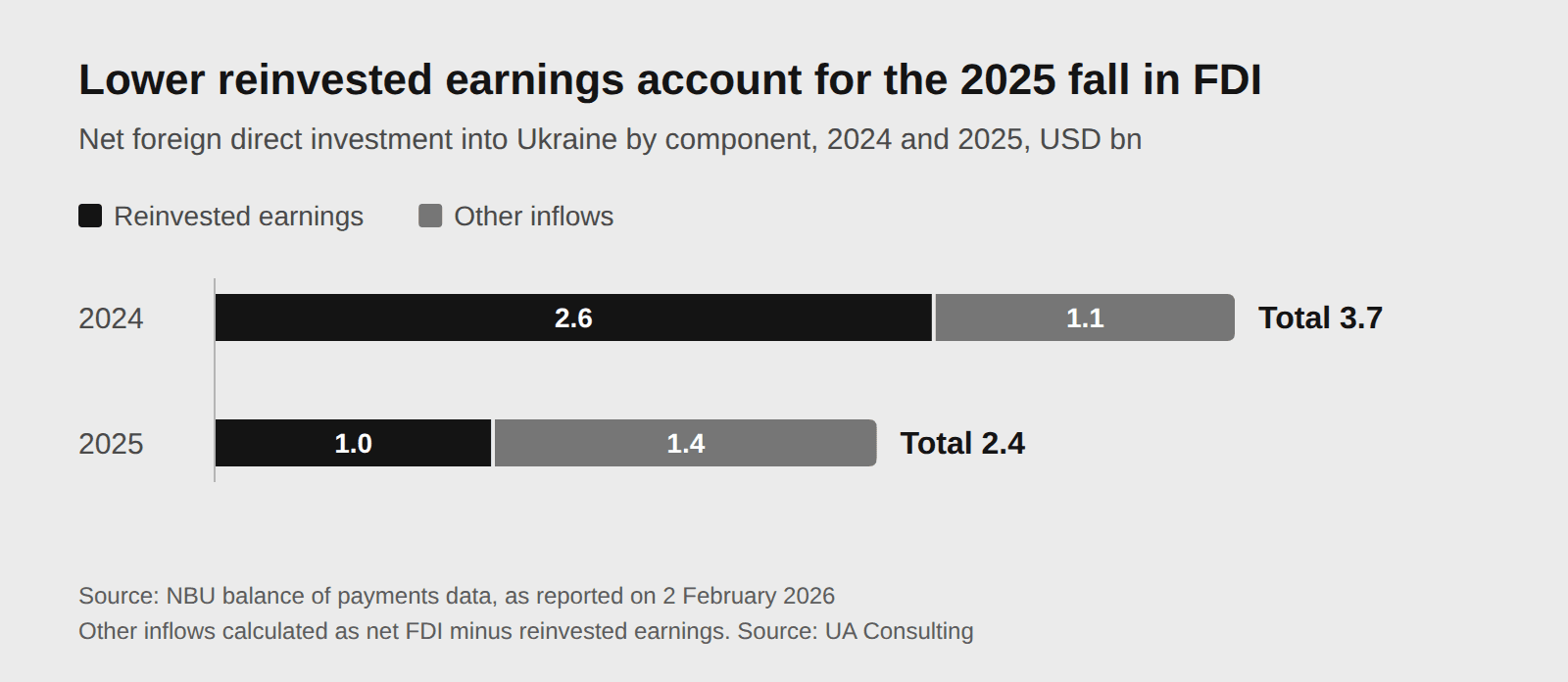
Net foreign direct investment into Ukraine by component, 2024 and 2025, USD bn. Source: NBU balance of payments data reported on 2 February 2026. Other inflows are net FDI minus reinvested earnings (Source: UA Consulting)
For an entrant, the data suggest that established investors are again taking profits out while other inflows have grown. A second NBU series, compiled on a different basis from the figures in the chart, puts FDI into Ukraine at USD 7.32 bn in 2021 and USD 2.60 bn in 2025. Reproductions of the quarterly data for 2026 disagree with each other, and no first-half total is given here. Whether a particular project can attract committed capital is a separate question, examined in our analysis of foreign direct investment in Ukraine.
Returning companies and the limits of the data
No public register of foreign companies that paused operations in 2022 and later resumed them was found in the sources studied, and neither was the number of registered branches and representative offices. Evidence on companies re-entering the Ukrainian market is therefore indirect. In surveys of member companies of an American business chamber, the share reporting full operations rose from 85% in January 2025 to 92% in June 2026, when 87% planned to keep or raise investment in 2026. Because respondents are established companies, the results describe incumbents and say little about first-time entrants.
What entering the Ukrainian market requires in 2026
A subsidiary registers in a day and a branch within a week
The most common corporate form in Ukraine is the limited liability company (LLC) under Law No. 2275-VIII, which requires no minimum capital and sets no limit on the number of participants. The official state services guide sets a 24-hour period for state registration and lists the service as free of charge. Online filing through the Diia portal is open only to Ukrainian citizens, and foreign founders file through a notary, an administrative service centre or by post. A foreign corporate founder must provide an extract from its home register, its ownership structure and the identity documents of its beneficial owners, legalised or apostilled and translated into Ukrainian. Since 28 August 2025, Law No. 4196-IX has closed the foreign enterprise, an older legal form for wholly foreign-owned businesses, to new registrations, and existing ones must convert into companies within three years.
The route for a branch or representative office changed on 3 September 2024, when Law No. 3257-IX moved their registration from the Ministry of Economy to state registrars. Registration now takes five working days for a fee of one subsistence minimum, UAH 3,330 in 2026, under the state service card for foreign subdivisions. A law-firm review of the reform puts the time under the old accreditation system at about 60 days. A representative office is not a legal entity, and if its activity goes beyond preparatory or auxiliary functions it is taxed as a permanent establishment, as the State Tax Service explains.
Disclosure rules for company owners have been simplified in several steps since 2022. Annual confirmation of beneficial owners was abolished from 29 December 2022, changes must be reported within 30 working days, and penalties for late filing are suspended under martial law. A new machine-readable format for ownership structures will apply only 90 days after martial law ends.
Restrictions that change the entry decision
Ukraine has no general regime for screening foreign investment in force. Draft Law No. 14062, which would introduce one, was registered in September 2025 and remained in committee in September 2026. An interdepartmental commission for this purpose was set up in February 2026, but no mandatory procedure applies yet.
The restrictions that do bind foreign investors target specific counterparties and assets. Cabinet Resolution No. 187 imposes a moratorium on obligations to Russian persons and on transactions in their assets, a group defined to include companies in which Russian persons hold 10% or more or are beneficial owners. Under Resolution No. 1178, public buyers may not purchase from companies linked in the same way to Russia, Belarus or Iran while martial law lasts and for 90 days after it. Foreigners and companies with foreign participants or beneficial owners cannot buy agricultural land, a restriction kept when Law No. 552-IX opened the farmland market in 2021.
Rules that depend on martial law
Foreign companies can register and operate under martial law, although part of the rulebook depends on it. Martial law was last extended by Decree No. 596/2026 for 90 days from 2 August 2026 to 31 October 2026, the 20th extension, which parliament approved in July. Several conditions that matter for entry lapse with it or shortly afterwards, including the labour rules of Law No. 2136-IX that allow employment contracts to be suspended, the pause on penalties for late ownership filings and the procurement exclusion. The NBU currency regime under Resolution No. 18 was introduced for the same period, although the central bank has been easing it gradually under its own conditions. Because martial law has no fixed end date and is extended in 90-day steps, the duration of these rules cannot be read from their text.
The tax terms of a foreign-owned company
A Ukrainian subsidiary in which legal entities outside the simplified tax system hold 25% or more cannot use that system under Article 291.5 of the Tax Code, and neither can a branch or a non-resident. A subsidiary of a foreign group therefore works under the general regime, with corporate income tax, value added tax (VAT) and payroll taxes. The 25% rule does not bar companies owned by foreign individuals, and the published register data do not split new foreign-owned companies by type of owner. The headline rates of the general regime have been stable since 2021, with one exception.
The military levy is the only headline rate that has changed since 2021
Headline rates of the general tax regime, 2021 and 2026
Tax | 2021 | 2026 |
|---|---|---|
Corporate income tax | 18% | 18% |
VAT, standard rate | 20% | 20% |
Personal income tax on salaries | 18% | 18% |
Military levy on salaries | 1.5% | 5% |
Employer social contribution | 22% | 22% |
Withholding tax on dividends to non-residents, before treaty relief | 15% | 15% |
Source: international tax summaries reviewed on 30 June 2026, State Tax Service on the military levy, state investment agency tax overview of 2024
The levy rose on 1 December 2024 under Law No. 4015-IX, and Law No. 4835-IX, signed in April 2026, keeps it in place for three years after the year in which martial law ends. The same 2024 law moved payroll tax reporting from quarterly to monthly from 1 January 2025. Sector rates moved further, with banks paying corporate income tax at 50% for 2026 and financial institutions other than banks and insurers at 25% since 2025, as international tax summaries note.
Withholding tax on dividends, interest and royalties can be reduced under more than 70 double tax treaties, whose count differs slightly between the lists of the Ministry of Finance and the State Tax Service. Treaty relief requires the recipient to be the beneficial owner, and the treaties with Belarus and Russia ceased to apply in December 2022 and January 2023 respectively. Since 1 January 2022, non-resident sellers of electronic services to Ukrainian consumers have had to register for VAT once their sales pass the registration threshold, which brings part of cross-border digital trade into the tax base without a local entity.
Incentive regimes and their take-up
Four opt-in regimes can reduce the tax bill, and their take-up differs widely. Diia City, open mainly to information technology companies since 2022, lets residents pay 9% on distributed profits instead of corporate income tax and applies a 5% personal income tax rate to staff, subject to headcount, pay and income criteria. Its register had 3,707 residents in early February 2026, after the list doubled during 2025. Defence City, in force since 5 October 2025 under Law No. 4577-IX, offers defence-industrial companies conditional exemptions from several taxes until 2036 or EU accession, whichever comes first. Take-up data for Defence City were not available in the material reviewed.
Industrial parks give participants a 10-year corporate tax exemption, conditional on reinvesting the saving, and relief from import VAT and customs duty on new equipment, as the state investment agency summarises. The register held 111 parks in January 2026 after the Cabinet removed inactive ones. At the end of the first quarter of 2025, before those removals, the Ukrainian National Office for Intellectual Property and Innovations found that 89% of registered parks had no participants. Site choice within this system is covered in our review of industrial parks and investment regimes.
The significant investment regime covers projects of at least EUR 12 m, a threshold cut from EUR 20 m in 2023, and offers tax, customs and infrastructure support. By 21 August 2026 the government had signed five agreements covering more than EUR 260 m of investment. Outside information technology, the available evidence points to broad terms and low take-up.
Currency rules and the return of dividends
Ukrainian law guarantees the transfer of profits abroad after tax under Article 12 of the Law on the Regime of Foreign Investment, but NBU Resolution No. 18 has restricted cross-border payments since 24 February 2022. The official exchange rate was fixed from that date, with one devaluation in July 2022, until 3 October 2023, when the NBU moved to managed flexibility. Easing since then has followed the central bank's strategy of June 2023, which ties each step to macroeconomic preconditions and sets no dates.
Currency rules for foreign-owned companies have eased step by step since May 2024
Selected NBU measures relevant to foreign-owned companies, by effective date, May 2024 to August 2026
Effective date | Measure |
|---|---|
4 May 2024 | Restrictions on payments for imported services lifted, dividends on profits from 2024 allowed up to EUR 1 m a month from 13 May |
10 May 2025 | Investment limit created for foreign currency paid into charter capital from abroad since 12 May 2025 |
6 August 2025 | Dividends on profits from 2023 allowed, investment limit usable for dividends above the monthly cap |
14 January 2026 | Borrowing limit created for new foreign loans at interest of up to 12% a year |
11 August 2026 | Investment limit and a limit matching donations to the armed forces made transferable within a group served by one bank |
Source: tax advisory alerts of May 2024, May 2025 and August 2025, a law-firm alert of January 2026 and the NBU decision reported on 11 August 2026
The monthly dividend cap itself has not changed since 2024, and no permission for dividends on profits earned before 2023 appears in the sources reviewed. Because the cap is set in euros, its value in local currency rises as the hryvnia weakens, and at the official rate of UAH 51.52 per EUR on 15 September 2026 it equalled about UAH 51.5 m of dividends a month (Source: UA Consulting). Larger amounts can move only through limits tied mainly to new equity or new foreign loans, in line with the principle of new conditions for new money that the NBU Governor set out in December 2025. It follows from the design of these limits, and not from any rule stated in law, that the way entry capital is brought in shapes how much can later be paid out. The mechanics of moving cash out of an operating company are traced in our article on control of a Ukrainian subsidiary.
The hryvnia has weakened steadily since the move to a flexible rate. Calculations from NBU daily rates put the average official rate at UAH 36.57 per USD in 2023 and UAH 41.69 in 2025, and the rate stood at UAH 44.62 per USD on 15 September 2026. Companies expect the depreciation to continue, and in a September 2026 survey of chief executives by a European business association they set their 2027 budgets at UAH 49 per USD.
Staff, power and the cost of money in 2026
Staff and pay
Staff planning is shaped by mobilisation rules that apply to every employer in the country. Since 1 September 2026, a private employer can as a rule reserve an employee only if it holds critical status and pays that employee at least three times the minimum wage, or UAH 25,941 a month. The threshold was 2.5 times under the rules introduced on 1 December 2024. Reservation is granted for the period of mobilisation under Cabinet Resolution No. 76, as amended in 2026. It normally covers up to half of an employer's staff liable for military service, with a lower pay multiple and higher shares for enterprises in territories of possible or active hostilities.
Pay has risen quickly in nominal terms since 2021. The average monthly wage was UAH 14,014 in 2021 and UAH 25,946 in 2025 in the official annual series, and the State Statistics Service of Ukraine reports UAH 32,243 for July 2026. These are averages for full-time employees, and the national series has gaps for 2022 and 2023 because publication was suspended under martial law.
Hiring from abroad is quick on paper but slower in practice. A work permit is issued within seven working days under the current rules, reformed in 2022, yet 42% of respondents in a June 2026 survey by a European business association needed three to six months to hire a foreign employee. The domestic labour pool has also been shaped by migration, and Eurostat counted 4.43 m people from Ukraine under temporary protection in the EU at the end of July 2026.
Power and logistics
Power supply remains a physical constraint on operations in 2026. Russian strikes damaged more than 9 gigawatts (GW) of generating capacity between October 2025 and early March 2026, by which time 3.5 GW had been partly restored, according to the Ministry of Energy. Restoring 6.2 GW before the coming winter is a government target, and repairs were still under way in June 2026.
Distributed generation has become part of the response, with about 900 megawatts commissioned over the same winter. Imports of energy-generating equipment are exempt from VAT and customs duty until 1 January 2029, as a tax alert on the December 2025 laws notes, and the state affordable loans programme was widened in January 2026 to finance distributed generation. Our analysis of energy resilience looks at how companies plan for outages at their own sites.
Goods move through the seaports and along overland routes to the EU. Seaports handled 82.2 m tonnes in 2025 and container volumes rose by about two thirds on 2024, according to the Ukrainian Sea Ports Authority. The EU Solidarity Lanes carried about 90% of imports and 95% of non-agricultural exports in July 2026, as European Commission data show. In its July forecast the NBU listed Russian attacks on logistics infrastructure, including the blockade of ports, among the factors holding back growth.
Interest rates, inflation and demand
The cost of borrowing in hryvnia has risen again since July 2026. The NBU cut its key policy rate to 15% at the end of January, then raised it to 15.5% on 30 July and to 16% on 17 September, citing persistent underlying price pressures. Its guidance is for the rate to stay at that level until the end of the first quarter of 2027.
Inflation has edged up during 2026, although it remains below the peaks of recent years. Consumer prices rose by 8.1% year on year in August 2026, according to the State Statistics Service. In its July Inflation Report the central bank forecasts inflation of 10% at the end of 2026 and a return to the 5% target by the end of 2028.
Consumer demand has held up despite higher prices and interest rates. Real retail turnover fell by 21.4% in 2022, recovered with growth of 17.0% in 2023 and has risen every year since, and the official retail series shows it 9.0% higher in January to July 2026 than a year earlier. For consumer-facing entrants, retail volumes are growing faster than overall output, which was close to its level of a year earlier in the first half of 2026.
How foreign companies enter and expand in practice
For companies deciding how to enter the Ukrainian market, the registration data point to a trading company as the most frequent first step, since wholesale was the leading activity among new foreign-owned companies in both 2024 and 2026. This is an inference from declared activity codes, because the published data do not separate sales subsidiaries from holding or service companies. For such entrants, the decisions that follow registration concern channels, pricing and partners, which our article on go-to-market strategy covers.
Production-led investment requires more capital, and recent examples come from companies already selling to or operating in Ukraine. A Swiss food group opened a vermicelli plant in Volyn oblast in April 2025 after investing EUR 43 m and, as a business news report states, expects the total for the site to reach EUR 70 m by the end of 2027. A Danish brewer launched a canning line worth more than EUR 12 m in May 2026, adding capacity at its Lviv brewery. A Finnish maker of connection systems for concrete construction, familiar to Ukrainian precast producers, set up a local subsidiary and a production and storage site in Bila Tserkva in 2024. The economics of such projects are set out in our analysis of local production.
Recent inbound acquisitions show the sums this route can involve. In 2025 an American agribusiness group bought the remaining shares in a Ukrainian oilseed processor for USD 138 m, the largest inbound deal of the year in the 2025 market review. In the first half of 2026 a Polish insurer agreed to buy the largest life insurer in Ukraine, a subsidiary of an American group, for about USD 100 m, as the half-year review records.
Transactions above the notification thresholds need clearance from the Antimonopoly Committee of Ukraine, which has 15 days to accept a filing and 30 days for a first-phase review, while a second phase can last up to three months under the competition law. Because a concentration may not be completed before approval, the review period sets the earliest closing date for an acquisition. Thresholds and timing are covered in our note on merger clearance, and target selection in our article on buying a company in Ukraine.
Partnership and distribution agreements do not appear as such in the company register, and no source reviewed gives the share of entrants that use them. The same gap applies to foreign suppliers that have no local entity and sell through Ukrainian distributors. When a partner route is chosen, the tests are covered in our analyses of partnerships and joint ventures and selecting a distributor. The choice among these routes for a specific company is outside what market-wide data can settle, and it is the focus of market entry and expansion advisory.
What is fixed and what is forecast for Ukraine market entry to 2031
Trade rules and EU accession
The trade terms between Ukraine and the EU changed on 29 October 2025, when the upgraded arrangement under the Deep and Comprehensive Free Trade Area (DCFTA) entered into force through Association Committee Decision No. 3/2025. It raised tariff-rate quotas for sensitive farm goods, including sugar to 100,000 tonnes a year, and reduced or eliminated duties on other agri-food products such as dairy, as the Council of the EU summarises. Ukraine must align its rules on animal welfare, pesticides and veterinary medicines with EU law by 31 December 2028, or the EU may suspend preferences for the products concerned, and the level of liberalisation will be reviewed in 2028.
Accession talks are formally open but only partly advanced. Ukraine has held candidate status since June 2022, and two of the six negotiating clusters opened in 2026, fundamentals on 15 June and external relations on 14 July. The internal market and competitiveness clusters, which cover most rules that apply to companies, remained unopened after Hungary kept its veto on 9 September 2026. Ukraine aims to close negotiations by the end of 2028, a goal the European Commission supports, while the EU has set no accession date.
The EU is already Ukraine's largest trading partner, although estimates of its weight differ by source. The European Commission's trade department puts the EU at around 65% of Ukraine's goods trade in 2025. An analysis of Ukrainian customs statistics shows the EU taking 57.8% of exports and supplying 46.7% of imports. Weighting these shares by the value of each flow puts the EU at about half of total trade on this basis (Source: UA Consulting). None of the sources studied explains the gap, and both figures are shown here with their origin.
Committed funding and risk cover
External funding is committed until the end of 2027 and underpins the state budget and public spending. The EU's Ukraine Facility for 2024 to 2027 had disbursed EUR 29.5 bn under its main budget pillar by mid-2026. Its investment framework had allocated EUR 8.5 bn of guarantees and grants by April 2026. The European Commission projects that these will mobilise EUR 25.7 bn of investment.
A second EU instrument, the Ukraine Support Loan of EUR 90 bn for 2026 and 2027, was finalised on 23 April 2026, with a third of it for budget support and two thirds for defence. Payments are tied to policy conditions, and the first budget-support tranche followed measures that included the extension of the military levy. Nearly EUR 15 bn had been paid out by 18 September 2026, according to the European Commission.
The International Monetary Fund (IMF) approved a four-year Extended Fund Facility of about USD 8.1 bn on 26 February 2026, and its conditions include most of the scheduled tax changes listed below. The World Bank's latest assessment puts recovery and reconstruction needs at almost USD 588 bn over the next decade. The government estimates that about 40% of that could come from the private sector, a potential share of the total, not a commitment.
Cover for political and military risks has widened since 2022. The World Bank Group's Multilateral Investment Guarantee Agency has issued USD 573 m of guarantees for Ukraine over that period. In June 2026 it signed a political-risk insurance framework with the United States International Development Finance Corporation for the reconstruction investment fund set up by the United States and Ukraine. On 17 September 2026 the government announced an expanded state programme of insurance against military risks, which adds Kyiv and Kyiv oblast to its high-risk areas and raises the cap on premium compensation from UAH 3 m to UAH 5 m per enterprise a year. The place of these instruments in a wider risk assessment is discussed in our analysis of political and operational risk.
Scheduled changes and their legal status
Several changes that affect operating costs already carry fixed or planned dates. Most of them follow from commitments to the IMF or from alignment with EU law, and the latest information found shows none of them fully enacted. The table sets out the latest legal status of each change found by 21 September 2026.
Most scheduled changes fall in 2027 and 2028
Tax, customs and labour changes with a fixed or planned start, latest status found by 21 September 2026
Change | Planned start | Status |
|---|---|---|
Tax on income earned through digital platforms | 1 January 2027 | Law adopted, unsigned on 9 September 2026 |
VAT on imported parcels up to EUR 150 | Not before 1 July 2027 | Bills passed first reading |
New Customs Code aligned with EU rules | 1 December 2027 | Bill passed first reading |
VAT for entrepreneurs on the simplified regime | 1 January 2028 | IMF commitment, law due by April 2027 |
Rules from the EU Anti-Tax Avoidance Directive | January 2028 | Ministry of Finance draft |
New Labour Code | Six months after martial law ends | Bill awaiting first reading |
Source: status of the platforms law, parcels bills, Customs Code bill, IMF structural benchmarks, tax summaries on the anti-avoidance draft, Labour Code bill
Two of these changes bear directly on common operating models. VAT for simplified-regime entrepreneurs would change the tax treatment of engaging staff who work as individual entrepreneurs, a practice the IMF notes is common, once their turnover passes a new VAT threshold that is still to be set. The parcels change would apply import VAT to low-value online sales from abroad, which would narrow the tax gap between cross-border sellers and local importers.
What the forecasts assume
State Statistics Service data show real gross domestic product (GDP) growing by 3.4% in 2021 and falling by 28.8% in 2022. Output then grew by 5.5% in 2023 and 3.2% in 2024, after which the pace slowed to 1.8% in 2025, a preliminary estimate published in March 2026. Foreign-owned registrations fell in 2024, when output grew, and rose in the January to July windows of 2025 and 2026, when growth slowed, which suggests that entry activity has not tracked output over this period.
In 2026, output was 0.6% lower in the first quarter and 0.4% higher in the second than a year earlier. The latest full-year forecasts run from 1.0%, the low end of the range in the IMF's July 2026 staff report, to 1.8% in the NBU's July forecast, with the World Bank's June forecast in between. On these figures, each forecast implies faster growth in the second half of the year than in the first.
For 2027 and 2028 the three institutions expect growth of between 2.8% and 4.5% a year, and the IMF's April outlook projects 3.6% for 2031. The forecasts rest on different assumptions about the security situation in Ukraine. The IMF baseline in the July staff report assumes that active hostilities end in 2026, and its downside scenario has the situation move gradually to a frozen conflict by the end of 2028. The NBU's July forecast instead assumes that attacks on infrastructure continue, as a summary of the forecast reports.
The Fund's baseline also has foreign direct investment rising from 1.3% of GDP in 2026 to 2.6% in 2027. No forecast of the number of foreign companies entering Ukraine after 2026 was found in the material reviewed, which leaves our 2026 estimate as the only forward figure for entry counts. For later years, the outlook for entrants rests on scheduled rules and committed funding, together with macroeconomic forecasts that depend on the security assumptions above.
Surveyed companies plan on current conditions lasting longer than the IMF baseline assumes. In the European business association's September survey, 98% of chief executives based their 2027 plans on the current security situation continuing. Only 3% planned new large-scale investment projects for 2027, against 20% a year earlier for 2026. This question differs from the one in the June chamber survey, which asked about the overall level of investment in 2026.
What the evidence says about entering Ukraine now
Market entry in Ukraine is legally open and growing again, and the estimate in this article puts new foreign-owned companies at about 1,370 in 2026, around half of the 2021 level. Branch registration and disclosure rules have become simpler since 2022, and the entry restrictions still in place are limited to counterparties linked to Russia, Belarus or Iran and to farmland. The terms that shape the economics of an entry now sit mostly outside company law, in currency limits and the rules on staff reservation.
The provisions that are set to change fall into two groups with different horizons. The first group rests on martial law and mobilisation, which have no set end date, and includes staff reservation, the temporary labour rules and the procurement exclusion. The currency regime with its dividend cap belongs to this group as well, even though the National Bank has already relaxed parts of it. The second group carries dates linked to IMF and EU commitments, most of them in 2027 and 2028. The military levy sits between the two, since it runs for three years after the year in which martial law ends.
For a board, the difference matters because the second group can be planned against published dates and a known legal status, while the first sets operating conditions for a period that is renewed in 90-day steps. The registration data show that foreign companies can enter Ukraine and how many are doing so. The end of the temporary rules that govern how profits leave the country and how staff are retained is not dated in any source studied, and that part of an entry case therefore rests on the board's own assumption about their duration.
UA Consulting supports companies entering, re-entering or scaling in Ukraine, from commercial assessment to executable launch planning. Speak with a senior advisor.