Merger control in Ukraine is too easily filed under late-stage paperwork, a clearance to be obtained once commercial terms are settled. For acquirers, investors and joint-venture partners, that habit has become a liability, because approval from the Antimonopoly Committee of Ukraine (AMCU) increasingly determines how a transaction is structured, sequenced and closed, not merely whether it is permitted. The more useful question is no longer whether AMCU approval is required, but whether the deal has been built, evidenced and timed in a way that can survive competition review. Ukraine is moving on three tracks at once. It is a wartime market that needs capital, an EU-accession candidate bringing its competition regime closer to European standards, and a reconstruction economy in which consolidation, public money, strategic infrastructure and ownership credibility increasingly intersect. Approached early, merger control can protect both the transaction and the buyer's standing in the market, whereas leaving it to the end can delay closing, force structural concessions or, in the more difficult cases, unwind a deal the parties had already agreed.
Why merger control in Ukraine is now a deal-strategy issue
For most of the past decade, a foreign investor could reasonably treat AMCU clearance as a formality, a filing made once terms were agreed, seldom refused and unlikely to change the shape of a deal, but that reading no longer holds. A substantial reform of competition law in Ukraine took effect on 1 January 2024, widening the regime's reach in some respects while tightening its procedure, and the EU-accession process is steadily moving the AMCU towards a more European, effects-based style of review. The European Commission's 2025 report on Ukraine records that the country has some level of preparation in competition policy, that further alignment with the EU acquis is still required, and that the number of decisions on concerted practices, abuse of dominance and mergers has risen. None of this turns clearance into an obstacle course, but it does change the posture a serious buyer should adopt. Where a regime is maturing, the quality of the filing, its market story and the credibility of the parties begin to carry weight, and treating approval as a legal appendix rather than a transaction workstream is the avoidable error.
When AMCU approval is typically required
The AMCU clears concentrations, a category that captures most change-of-control transactions, from mergers and acquisitions of control to asset deals and full-function joint ventures. Under the Law of Ukraine on Protection of Economic Competition, as amended from 2024, a concentration requires clearance before closing where either of two statutory threshold tests is met, subject to the detailed calculation rules and exemptions that surround them. The first is triggered where the combined worldwide assets or turnover of all parties exceed EUR 30 million and at least two parties each hold Ukrainian assets or turnover above EUR 4 million. The second applies where one party has Ukrainian assets or turnover above EUR 8 million and at least one other party has worldwide turnover above EUR 150 million. Two features of this framework regularly catch acquirers by surprise. Because thresholds are calculated at the level of the whole corporate group rather than the individual signing entity, the Ukrainian turnover or assets of an unrelated portfolio company can be enough to pull an otherwise modest deal into scope, which matters particularly for private-equity buyers and diversified groups whose Ukrainian footprint may sit far from the business being acquired. Equally, because the reformed second test no longer refers to the target, a filing can arise in some foreign-to-foreign transactions where the Ukrainian nexus rests with the acquirer's group rather than with the target itself. None of this substitutes for case-by-case analysis, and this article is not legal advice, but it explains why the question of whether a deal needs merger clearance in Ukraine rarely has a simple answer.
Where competition risk concentrates
Competition risk in Ukraine is not spread evenly across transactions. It concentrates where market power, sensitive sectors, public money and questions of ownership come together, and it is in those situations that early analysis earns its keep. The table below sets out the transaction circumstances that most often draw the AMCU's attention, and the practical response each one calls for.
Transaction situation | Why it draws AMCU attention | What it changes in deal strategy |
|---|---|---|
Foreign-to-foreign deal where the acquirer's group carries the Ukrainian nexus | A filing can arise even with no Ukrainian target | Map thresholds at group level before signing, not after |
Concentration in a priority sector such as fuel, energy, pharmaceuticals, ports and logistics or essential consumer goods | Closer substantive review, with remedies a real possibility | Build the market narrative and economic evidence early |
A party, controlling entity or beneficial owner with Russian or Belarusian links or sanctions exposure | Review may be blocked, delayed or materially complicated | Screen ownership and sanctions exposure before terms are agreed |
Establishment of a full-function joint venture | Clearance is required for full-function joint ventures | Design governance and control rights with merger control in mind |
Acquisition of a non-controlling minority stake without decisive influence | Less likely to be notifiable as a concentration after the 2024 reform, though governance rights and ancillary restraints still matter | Review veto rights, control rights, non-compete and exclusivity clauses before assuming no filing |
A target tied to reconstruction, donor funding or public procurement | Heightened policy attention to these markets | Factor procurement and state-aid context into structure and diligence |
Table sources are the Law of Ukraine on Protection of Economic Competition (as amended from 1 January 2024), the AMCU's enforcement priorities for 2026 and the Chambers Merger Control 2025 guide for Ukraine.
What the 2024 reform changed for transactions
The 2024 reform, enacted through Law No. 3295-IX, was designed to bring Ukraine closer to EU practice and to strengthen the AMCU, and four of its changes bear directly on how deals are planned. Removing the reference to the target in the second threshold extended the regime to acquirer-led transactions with a Ukrainian footprint, while a parallel change narrowed it at another edge, allowing a seller's Ukrainian turnover to be excluded where the target holds no Ukrainian assets and has not been active in the country. It confirmed that only full-function joint ventures require clearance, while non-full-function arrangements may still need approval for concerted practices, and it stopped treating non-controlling minority stakes as a separate type of concentration, removing a tranche of filings without removing the underlying questions of control and ancillary restraints. A further change gave AMCU investigations clearer time limits, generally three years with a possible two-year extension. Taken together, these changes resist a simple headline, because the regime did not so much become lighter or heavier as more demanding of judgement, rewarding early and well-evidenced analysis over a filing assembled once the commercial terms are already fixed.
EU alignment, wartime enforcement and sector scrutiny
EU accession is the structural force behind these shifts, and although its timetable is uncertain, its direction is not. As that alignment proceeds, the AMCU is increasingly expected to draw on European Commission practice when it defines markets and assesses competitive effects, and a further round of amendments is anticipated in 2026 and 2027, including a likely shift towards self-assessment for certain ancillary restraints. The OECD's December 2025 peer review of Ukraine's competition regime points in the same direction, urging stronger economic analysis and closer alignment with international standards, so that the reasoning behind a filing, the market definition and the evidence on competitive effects will carry increasing weight relative to the paperwork itself.
Wartime conditions then determine where that reasoning is tested most severely. The AMCU's enforcement priorities for 2026, as reported in competition-law commentary, point to the markets that matter most to a country at war and in reconstruction, among them fuel and energy, utilities, port and logistics services, pharmaceuticals and essential consumer goods, digital platforms, and reconstruction-related procurement. A transaction that looks commercially unremarkable can still draw close review if it changes who controls access to essential capacity, critical infrastructure, supply chains or reconstruction spending. The war sharpens this in a concrete way, because a number of Ukrainian markets now have fewer active suppliers than before, so a combination that would raise no concern in a deeper market can create a real overlap and a genuine question of market share. Consolidation in concentrated or sensitive sectors is therefore the most likely to face demanding review, and where a deal touches energy, utilities, transport or other infrastructure-linked assets, the competition analysis is best read alongside the wider investment and operating logic set out in Energy & Critical Infrastructure. Handled this way, a disciplined reading of the relevant market, of the kind that belongs in commercial due diligence in Ukraine, becomes part of the clearance strategy rather than a separate exercise.
Ownership, sanctions and the credibility test
Ukraine does not operate a formal foreign-investment screening regime, and the AMCU remains a competition authority rather than a national-security gatekeeper, so in principle it must clear a concentration that does not lead to monopolisation or a significant restriction of competition. In practice, competition review can no longer be separated cleanly from the credibility of the parties. Sanctions screening has become a standard part of transaction readiness. Where a party, or an entity that controls it, is subject to Ukrainian sanctions, the review may be rejected or halted, and Russian or Belarusian ownership links, sanctions exposure or opaque beneficial-ownership chains can become a material, and sometimes decisive, obstacle to closing, particularly in strategic or sensitive sectors. Defence-adjacent and critical-infrastructure transactions are likely to face closer ownership and policy scrutiny, and where the AMCU does prohibit a deal, the Cabinet of Ministers retains a public-interest override. The commercial consequence is that ownership transparency has become a source of execution certainty rather than a matter of good housekeeping. A buyer that can show a clean, well-documented structure and clearly identified beneficial owners tends to move through review faster and with more predictability than one carrying opaque holding chains or unresolved sanctions questions, and in a market where the identity of the acquirer is examined as closely as the assets being acquired, that difference feeds directly into timing and closing certainty.
How merger control shapes deal structure and timing
Because clearance conditions determine whether and when a transaction can complete, competition risk belongs in the deal documents, not only in the regulatory file. It shapes the conditions precedent and the long-stop date that hold a deal open while clearance is pending, the covenants that govern how the parties cooperate and how much information they may share before closing, including any clean-team arrangements and gun-jumping safeguards, the way approval risk is allocated between buyer and seller, and any remedies that may have to be offered to secure clearance. None of this can be retrofitted gracefully once terms are signed, which is why competition review belongs alongside the wider mergers and acquisitions transaction workstream from the outset rather than at the end. The difference between treating clearance as a late filing and running it as a workstream across the life of the deal is set out in the diagram below.
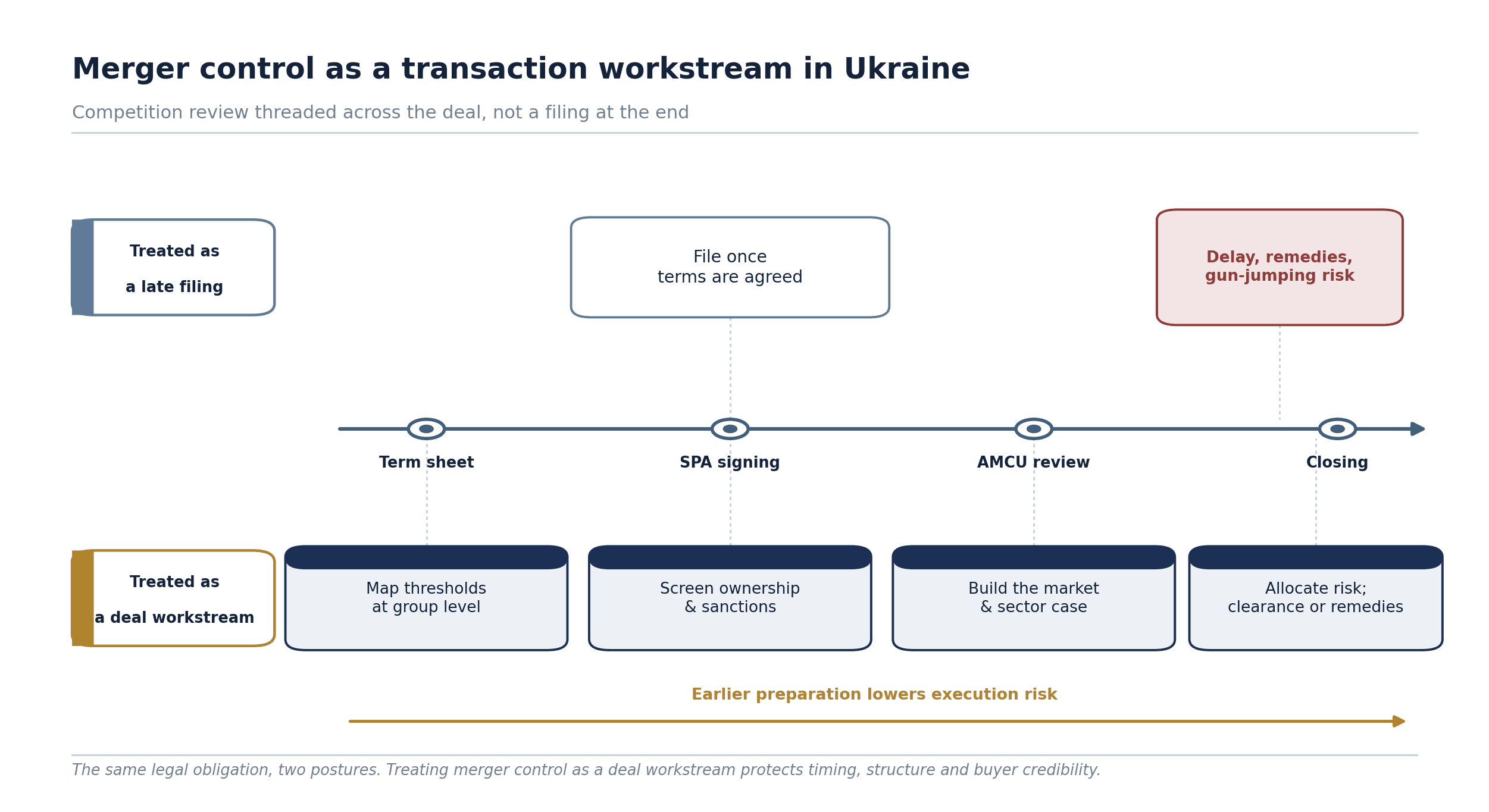
The discipline that follows is to run merger control in parallel with the commercial deal from the first draft of terms rather than as a downstream task. Before signing, or before launching a sale process, three kinds of groundwork tend to pay for themselves. The first is jurisdictional, mapping thresholds at group level, testing for a Ukrainian nexus even in a foreign-to-foreign deal, and screening ownership and sanctions exposure before negotiating positions harden. The second is substantive, forming an early view of the relevant markets, the parties' combined shares and any sector sensitivity that could invite remedies. The third is procedural, building the AMCU timetable into the deal calendar and settling in advance which party carries approval risk, rather than discovering the answer at closing. Where the transaction takes the form of a partnership or the acquisition of a state asset, these questions sharpen further, because the design of a joint venture in Ukraine and the terms of a privatisation bid interact directly with how the resulting concentration will be assessed.
The direction of travel
The trajectory is consistent even where the timetable is not. Antitrust in Ukraine is becoming more European, more procedurally disciplined and more exacting in the evidence it expects, while wartime and reconstruction pressures concentrate scrutiny on the markets where consolidation matters most. For investors and acquirers, the implication is not that transactions have become harder to close, since many still clear quickly and predictably once a filing is properly prepared, but that the decisive work has moved earlier in the deal. What looks approvable in principle is not always executable in practice, and the gap between the two is usually filled before signing, in how thresholds, ownership, the market case and approval risk are handled, rather than afterwards in a filing lodged in the hope that it holds. The real decision facing an investor or acquirer is therefore not whether Ukrainian merger control applies, but whether to engage with it early enough to shape the transaction, or late enough that it shapes the transaction for them. Treated as a strategic question rather than a closing formality, merger control in Ukraine becomes a test that a well-prepared buyer is equipped to pass, with its timing, its structure and its credibility intact.
If you are assessing an acquisition, a joint venture or a privatisation bid in Ukraine, UA Consulting can help test the competition dimension early, align AMCU clearance and merger-control timing with the way the transaction is structured, and identify the ownership, sanctions and execution risks that are better resolved before terms, capital and management attention are committed. To discuss a specific transaction in confidence, contact our advisory team.