Testing whether revenue, margins and growth assumptions can survive Ukrainian market reality
Commercial due diligence in Ukraine is most useful when it does something more demanding than confirm the seller's investment story, which is to test whether that story will still hold once the transaction closes. A target can present a coherent market, visible demand and a convincing track record, yet none of that establishes that its revenue, margins and growth will survive the change of ownership and the operating conditions that follow. The question that decides the outcome is therefore less whether the business looks attractive and more whether its performance is genuinely transferable and executable under Ukrainian conditions. That distinction carries particular weight at the moment, because foreign direct investment remains limited relative to the scale of Ukraine's capital needs, at about $1.4 billion in the first eight months of 2025, so the capital that does move is selective and has every reason to be sceptical. This article sets out how to run commercial due diligence in Ukraine as a test of performance realism, examining in turn whether demand is reachable, customers durable, channels controllable, pricing resilient and execution dependable before capital is committed.
Why commercial due diligence in Ukraine cannot stop at market size
Diligence on a Ukrainian target usually begins with the market, looking at its size, its growth and the scale of reconstruction demand. That work is necessary, but on its own it answers a different question from the one an acquirer actually needs answered, because market size describes an opportunity in aggregate and says little about whether a specific asset can capture a profitable and repeatable share of it.
The reconstruction need is real and substantial, estimated at about $587.7 billion over a ten-year horizon, yet that figure measures the scale of the need rather than accessible revenue for any single business. Much of that demand is uneven in ways that matter commercially. It is concentrated by region and by sector, with the heaviest needs in frontline oblasts and major metropolitan areas, so a target's exposure to the right geographies can matter more than the national total. Some of it is donor-funded or tied to public procurement and reconstruction priorities, which makes it accessible only through particular channels, permits, relationships or local execution capacity. Some of it is real but ceases to be profitable once logistics, payment terms and service obligations are taken into account. A business can therefore sit inside a growing market and still depend on demand that is fragmented, relationship-bound or reliant on a single buyer group.
The first discipline of commercial due diligence in Ukraine is to keep the market and the asset separate in the analysis. A market can be attractive while a particular asset within it performs poorly, and a deal priced on the health of the market will disappoint when it is later tested against the performance of the business that was actually bought.
The diligence question: what will still hold after ownership changes
In M&A due diligence in Ukraine, the value of a target lies in the performance that survives the transaction rather than in the performance it has already recorded. Historical revenue shows what the business achieved under its current owner, within its current relationships and under its current incentives. What the buyer actually acquires is the future cash-generating capacity of that business under new ownership, new governance and new capital discipline, and often under a changed perception among customers and partners who dealt with the previous owner.
A good deal of Ukrainian commercial performance is held in place by arrangements that do not automatically move with the shares. Sales built around a founder or a single commercial lead may weaken when that person leaves, and supplier terms or informal understandings can reset under new ownership. Access to public procurement may rest on a track record the acquirer does not inherit, and pricing power can soften where it depended in part on the seller's local standing. Because so many commercial relationships in Ukraine are personal and operating conditions change quickly, the gap between historical and transferable performance is typically wider than in a settled market, which is precisely why it has to be examined rather than assumed.
This is a different question from whether a project is worth building, which belongs to investment-project feasibility and is asked before a project exists. Commercial diligence asks whether an existing business will continue to perform after it changes hands. Separating those two kinds of performance explicitly tends to move value more than the headline numbers do, because it identifies how much of the recorded result the buyer can realistically expect to keep.
Five areas where Ukrainian commercial diligence should go deeper
Five areas repay closer scrutiny in a Ukrainian target than a standard diligence template tends to give them, because each is a point at which recorded performance can quietly fail to transfer.
The first is the quality of demand. What matters is not only how large the market is, but who actually buys, why they buy, how often they return and on what payment terms. Demand that is repeatable, pays reliably and remains accessible across disruption is worth considerably more than demand that is occasional, slow to settle or tied to a single procurement cycle or reconstruction programme, and that difference rarely shows in a headline revenue line.
The second is the concentration of customers and channels, understood as concentration of access rather than only concentration of revenue. A Ukrainian target may reach its market through a small number of distributors, regional dealers, procurement buyers, public-sector counterparties or key accounts, or through relationships that belong personally to the owner. This is particularly visible in consumer, retail and distribution, where the decisive issue is not only demand but who controls the route to the buyer, the data generated by the channel and the economics of cost to serve. Where the target does not control that relationship, the buyer may acquire reported revenue without acquiring durable control of the market that produces it.
The third is competitive position and pricing power, tested less by who the competitors are than by whether the business can hold or pass through price when local costs move. Logistics, energy, financing and service costs can all shift quickly. Under the National Bank of Ukraine's managed exchange-rate flexibility, the hryvnia moves with market conditions while the central bank smooths excessive fluctuations, so currency is a live cost variable rather than a settled assumption, and war-risk cover for movable assets and inland cargo, where EBRD-backed facilities are designed to widen availability, sits inside the landed cost of doing business. A margin that looks comfortable under today's conditions is only as strong as the target's ability to defend it under tomorrow's.
The fourth is dependency on partners and management. Performance that rests on the owner, a single commercial director, a key regional manager or one important distributor carries a transfer risk that a buyer needs to size precisely, since the question is which specific parts of sales, supplier terms, collections, pricing or procurement access would weaken if that person or partner were no longer in place. Where the dependency is material, the finding should not be recorded merely as key-person risk, but should shape retention, governance, staged payment or a partner-replacement plan.
The fifth is execution and working-capital resilience, which determines whether an attractive forecast can actually be financed and delivered. With the central bank's policy rate held at 15.5% since March 2025, working capital is expensive, and a target that depends on inventory, delayed customer payments, imports, energy-intensive operations or supplier prepayments can find that growth consumes cash faster than it generates it. Commercial diligence has to connect the revenue plan to the working capital and execution capacity behind it, because a forecast can be commercially convincing and still fail if the business cannot finance stock, absorb payment delays or serve customers reliably.
The common thread across all five areas is that the risk in Ukraine is rarely a shortage of information, but rather the reading of convincing information without testing what it quietly depends on.
Commercial diligence questions that change the investment view
Table: Commercial diligence questions that change the investment view
Area | Standard question | Better question in Ukraine | Why it matters |
|---|---|---|---|
Market demand | How large is the market? | Which demand is reachable and repeatable for this asset? | Large demand does not prove accessible revenue. |
Customers | Who are the main customers? | Which customers will remain after the deal, and on what terms? | Some demand is relationship-based or tied to a procurement cycle. |
Channels | What channels does the company use? | Who controls the customer relationship and the market intelligence? | Distributor dependency can weaken post-deal control. |
Pricing | Are the margins attractive? | Can margins survive logistics, currency, payment delay and service obligations? | Reported margin may not reflect future operating cost. |
Management | Is the team capable? | Which part of performance depends on the owner or one commercial lead? | Transfer risk can be material. |
Growth | Is the forecast realistic? | What must be true operationally for the forecast to hold? | Growth assumptions often hide execution constraints. |
Framework: UA Consulting.
The Performance Realism Framework
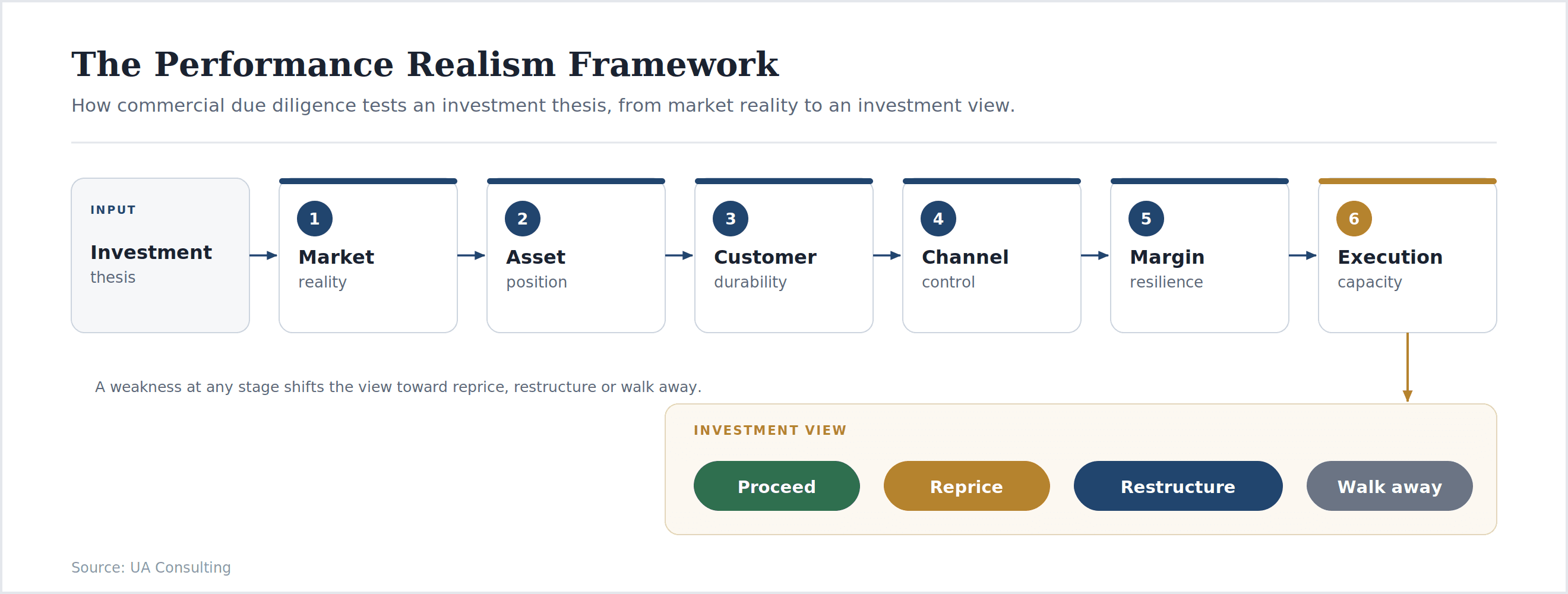
The same logic can be drawn as a single sequence. The Performance Realism Framework runs from the investment thesis through the tests that decide whether it holds, and ends in a view that can reshape the transaction rather than merely describe it. The same discipline governs investment due diligence in Ukraine whether the decision concerns an acquisition, a minority investment, a partnership or an asset-backed transaction, while a genuinely new or greenfield project raises the adjacent and earlier question of feasibility, namely whether the business case is credible before the project exists at all.
An investment thesis enters the sequence and is then checked against market reality, the asset's actual position, the durability of its customers, the degree of channel control it holds, the resilience of its margins and its capacity to execute, with each stage capable of strengthening the thesis or exposing a weakness in it. The output is not a binary decision to proceed or walk away, but one of four views, and in practice the two most valuable are usually to reprice or to restructure, because they convert diligence findings into concrete deal terms instead of leaving them as observations in a report.
Diagram:
When diligence should change the deal, not only the report
Commercial due diligence earns its place in a transaction only when it changes a decision, rather than when it produces a balanced report noting that the market is attractive and that some risks exist. The findings that matter are the ones that feed directly into the terms on which the deal is done.
In practice, they should shape the valuation and any earn-out or deferred consideration, the warranties and indemnities the buyer seeks, the working-capital target, the conditions attached to completion, and the plans for management retention, customer retention and integration. Where the target's access to its market depends on a particular distributor or a single individual, the appropriate response may be a retention package, a partner-replacement plan or a staged commitment rather than a single payment at closing. This is the stage at which diligence connects naturally to M&A transaction support and to investment and project advisory, since it is here that analysis becomes deal terms and investment conditions. Where the asset is already under financial stress, the same questions sharpen into the territory of distressed M&A, which brings its own integration and turnaround demands.
The value of commercial due diligence in Ukraine can be judged by a straightforward standard. If the work would not change the price, the structure or the decision to proceed, it has described the business rather than tested it, and the difference between the two is what protects the capital being committed.
From diligence to a decision
In Ukraine, commercial due diligence works less as a report on whether a market exists and more as a decision tool for judging whether a specific business will keep performing once the transaction exposes it to new ownership, tighter capital discipline and the realities of local execution. The market may be real, the story coherent and the historical numbers strong, and the asset can still underperform once the supports that produced those numbers are removed.
The most disciplined acquirers and investors reduce the exercise to three connected questions. They ask whether the market is real and genuinely reachable for this particular asset, whether its performance will transfer to a new owner, and whether the model can execute under Ukrainian conditions. A target that answers all three convincingly may deserve the capital on the table, while one that answers only the first is usually a candidate for a different price, a different structure or a decision to walk away rather than for the deal as originally proposed.
If you are assessing a Ukrainian acquisition target or investment, UA Consulting can help test whether the commercial case is transferable, structure the diligence questions that matter and identify the risks that should be resolved before capital, time and management attention are committed.