
For an investment project in Ukraine, feasibility is not proven by a financial model that shows an acceptable return. A model can be internally consistent and still describe a project that cannot be permitted, connected to the grid, built on schedule, financed on the assumed terms or operated at the cost it projects. A credible feasibility study in Ukraine therefore has to answer a more demanding question than whether the numbers work. It has to establish whether this specific project, with this funding route, partner model and execution plan, can actually be delivered under current conditions.
The purpose of feasibility work in Ukraine is therefore practical rather than procedural. It is not a document assembled to support a decision that has already been taken, but a decision test that establishes what must be true for the project to succeed and where it is most likely to fail before capital is committed. Approached this way, feasibility protects the investment case rather than decorating it.
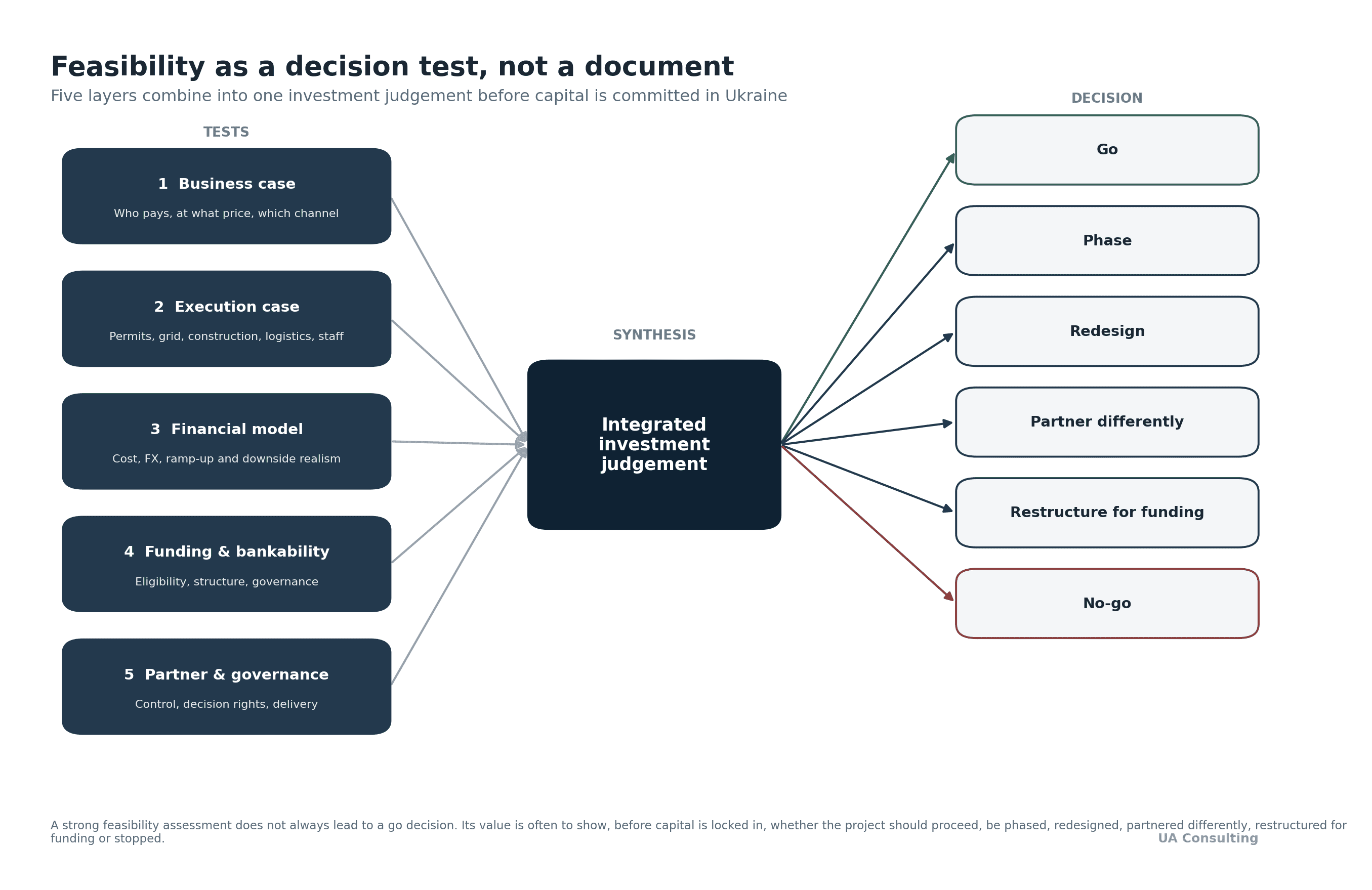
In Ukraine, five feasibility layers combine into one investment judgement, which points to a specific decision rather than a simple yes or no.
Why feasibility in Ukraine must go beyond the financial model
Most investment committees still treat feasibility as a modelling exercise built around market size, capital expenditure, operating cost and a set of return metrics. In a stable market that discipline is often enough, because the assumptions behind the model are broadly reliable. In Ukraine the same model can be technically correct and still misleading, because those assumptions have not been tested against the conditions that decide whether the project can be delivered.
The binding constraint in a Ukrainian project is rarely a single risk that a sensitivity table can capture. It is usually the sequencing between demand, land, permits, grid or utility access, procurement, construction, logistics, staffing, funding and operational readiness. A delay in any one of these rarely stays contained, and it quickly moves the timeline, raises the capital requirement, changes the funding profile and erodes the return. A project can be commercially reasonable in principle and still be execution-unready, while a project with modest headline returns can be highly attractive when demand is contracted, the delivery route is realistic and operational control is clear. This is what makes investment feasibility in Ukraine a matter of judgement rather than calculation. What separates a strong project from a weak one is rarely visible in the return metrics, and becomes clear only when the assumptions underneath the model are tested one by one, starting with the most basic of them, whether the project can turn a real need into paid revenue.
The business case: testing demand, price and revenue realism
The first thing feasibility should test is the commercial logic, and the useful question is narrower than it first appears. It is not whether Ukraine needs the product, asset, capacity or service in a broad sense. In many sectors that need is real. The question that decides revenue is who will actually pay, at what price, through which channel, under which contract structure and with what degree of demand certainty.
Headline market size is the weakest input in most Ukrainian business cases. Demand varies sharply by region, between areas that have absorbed displaced population and economic activity and those closer to the front where operating risk keeps buyers cautious, and it varies again by the difference between public and private buyers and by purchasing power that the war has reshaped. Contracted or clearly committed demand behaves very differently from assumed demand, and price acceptance is easy to overstate where import substitution or localisation forms part of the logic. Testing a business case in Ukraine means separating what the market could absorb from what this project can convert into revenue on realistic terms. Where those questions need to be examined in depth, commercial due diligence in Ukraine validates the market, customer and revenue assumptions that the feasibility view then carries into the wider investment case.
The execution case: what can break before the project becomes operational
Once the commercial case holds, the harder test begins, because a project that can sell is not yet a project that can be built and run. In Ukraine the feasibility gap usually sits in exactly this space, between investment approval and operational launch. A project can pass the investment committee, attract early interest from funders and look convincing on paper, and still struggle because the path from decision to operation was never examined with the same rigour as the return calculation.
Land and site readiness, permitting and approvals, and grid connection or utility access can each add months that a schedule built on nominal timelines never priced. Equipment procurement, import and customs handling, and the depth of a local construction market now competing with large-scale reconstruction demand determine whether the build stays on budget and on time. Logistics reliability, labour availability, the presence of a management team that genuinely exists, and security-related adjustments to design and operations shape both cost and continuity. Energy resilience has moved from a background assumption to a live design and cost question, since a project exposed to grid disruption may need on-site generation or storage simply to keep running. Working capital during ramp-up is routinely underestimated. None of this belongs in a separate risk appendix, because each item changes the schedule, the capital requirement, the way risk is allocated between the parties and, in the end, the return.
The financial model: turning tested assumptions into investment economics
The financial model matters, but it is not the feasibility study. It is the numerical expression of the feasibility logic, and it is only as credible as the assumptions feeding it. A reader at board level already understands net present value, internal rate of return, payback and sensitivity analysis. The question in Ukraine is not whether these are calculated correctly, but whether the inputs reflect delivery reality.
Credibility comes from testing the inputs that Ukrainian conditions tend to distort. Capital expenditure and contingency should reflect real local construction and equipment costs rather than generic benchmarks. Inflation, currency exposure and the imported share of the cost base need to be modelled explicitly, because revenue and costs rarely sit in the same currency. Ramp-up curves, working capital, the cost of debt and realistic delay scenarios usually move the outcome more than the terminal assumptions that receive most attention. Where grants, guarantees or concessional funding are assumed, the model should show what happens if they arrive later or on different terms. Sensitivity analysis earns its place only when it reveals which assumptions the investment case truly depends on and the point at which the project stops being viable and needs a different structure, rather than presenting a tidy band of outcomes around a number that has already been decided.
Funding and bankability: eligibility is not the same as feasibility
The scale of available finance can create a false sense of security, because the headline numbers are large enough to be read as a signal that capital will simply be there for good projects. The February 2026 Rapid Damage and Needs Assessment estimates recovery and reconstruction requirements at close to 588 billion US dollars over the next decade, and the European Union has built dedicated channels to draw private capital in behind public support. The Ukraine Investment Framework, part of the 50 billion euro Ukraine Facility, uses guarantees and blended finance to mobilise investment for Ukraine's recovery, reconstruction and modernisation.
The presence of these instruments does not make a weak project feasible. It raises the standard a project must meet. Guarantees, IFI participation and blended finance are released against credible project structure, sponsor quality, governance, procurement discipline, environmental and social standards, reporting capacity and clear risk allocation. Eligibility for a programme is only the first gate. A project still has to be bankable, executable and governable before the money moves, which is one reason disbursement often lags commitment. Structuring a project so that it can meet these conditions is where investment and project advisory work adds the most value, well before any application is submitted.
Partner, governance and local delivery risk
Even a project that is well modelled and well funded still has to be delivered on the ground, and in Ukraine that usually means depending on a local counterpart, whether a partner, a contractor, a utility, a distributor, an operating team or a project company. Feasibility has to test that dependency rather than assume it away. A local partner improves the case only when it adds real execution capacity. Access, introductions and market knowledge are genuinely useful, but they are not the same as the ability to deliver a site, control a budget or run an asset once it is built.
The questions that decide the outcome are more precise than a partnership discussion usually allows. Feasibility has to establish who controls the budget and the schedule, where decision rights actually sit and how disputes will be resolved, and who carries execution risk if the build runs late or the ramp-up disappoints. It has to be equally clear how delivery will be reported and who is answerable for it. Whether the investor holds a minority or a majority position, the alignment between investor, partner, funder and operator needs to be settled before capital is committed rather than renegotiated once problems appear. Partner selection, in other words, is not a relationship matter to be handled separately from the investment analysis. It belongs inside the feasibility judgement, because in practice it determines whether the project will be controlled or merely hoped for.
The feasibility test in one view
The five layers of a feasibility study for an investment in Ukraine are not sequential stages to be cleared and forgotten. They are tested together, and the value lies in seeing how a weakness in one changes the decision as a whole.
Feasibility layer | The question it must answer | What typically breaks it in Ukraine | Effect on the investment decision |
|---|---|---|---|
Business case | Who pays, at what price, through which channel, and with what demand certainty? | Headline market size mistaken for committed demand; regional and purchasing-power differences | Whether the model reflects real revenue rather than assumed revenue |
Execution case | Can the project be permitted, connected, built, supplied and staffed on schedule? | Grid connection, permitting, contractor depth, logistics, labour and security adjustments | Capital requirement, timeline, and the gap between approval and launch |
Financial model | Do returns survive realistic cost, currency, delay and ramp-up assumptions? | Optimistic capital expenditure and ramp-up; currency and import exposure; thin contingency | Whether the return is robust or dependent on best-case inputs |
Funding and bankability | Is the project eligible, structured and governable enough to be financed? | Eligibility confused with bankability; weak governance, procurement or reporting | Whether reconstruction finance or IFI support can actually be secured |
Partner and governance | Who controls budget, schedule and delivery, and who carries execution risk? | Access mistaken for capability; unclear decision rights and accountability | Whether local delivery is controlled or exposed |
What a credible feasibility study should deliver
What an investor or board should receive from feasibility work is decision material, not a bound report with a list of deliverables. A strong assessment pulls the separate tests into a single coherent view. It states the investment logic and the commercial assumptions that have actually been tested, and it makes the remaining uncertainties explicit through a project assumptions register rather than burying them. It grounds the numbers in a site and execution assessment, a permitting and regulatory map where relevant, and a validation of capital and operating costs against local reality. It sets out the funding and bankability position and the partner and governance arrangement, supported by a risk register in which each material risk carries a mitigation logic rather than a label. It closes with an implementation roadmap and a defined set of decision options.
The most important discipline is that the assessment does not assume a positive answer. A credible feasibility study often earns its value by showing that a project should be phased, redesigned, partnered differently, restructured for funding or delayed, rather than approved as presented. Knowing how to assess project feasibility in Ukraine includes knowing when the right recommendation is not to proceed in the current form.
When investors should test feasibility
Feasibility loses much of its value when it is left until the investment committee stage with major assumptions still untested. By then the investor has usually lost negotiating flexibility and may have committed to a structure that is difficult to change. The work is most useful earlier, at the points where decisions are still reversible.
In practice that means before entering Ukraine, before acquiring land or signing a joint venture, and before applying for IFI, donor or guarantee-linked funding. It means testing feasibility before board approval, before major procurement or engineering and construction commitments, and before scaling a pilot into a full build. It also applies to projects that have already stalled, where a disciplined reassessment is often what allows a stuck investment to be restructured rather than written off. In each case the purpose is the same, which is to test project feasibility while the investor still controls the outcome.
How UA Consulting supports investment-project feasibility in Ukraine
UA Consulting works with investors, corporates and owners to test whether a specific Ukrainian project is worth their capital, time and management attention before those are committed. The work covers the business case, the assumptions behind the model, the execution constraints that determine schedule and cost, the funding route and its conditions, and the partner and governance arrangements that decide whether delivery is controlled. The output is prepared as decision material for an investment committee or board, not as a generic study.
This sits naturally alongside UA Consulting's broader investment and project advisory work, its analysis of foreign direct investment in Ukraine and the deeper market, customer and revenue testing available through commercial due diligence in Ukraine. Together these allow the feasibility question to be answered in the context of the wider entry and investment decision.
Turning feasibility into a decision
The central feasibility question in Ukraine is not whether the opportunity is real. In many sectors it is. The harder and more valuable question is whether a specific investor, with a specific project, funding route, partner model and execution plan, can turn that opportunity into a functioning asset or business. A credible feasibility study in Ukraine answers that by connecting the business case, execution case, financial model, funding route and governance into one investment judgement, and by being honest about the answer it produces.
If you are assessing an investment project in Ukraine, UA Consulting can help test the business case, execution assumptions, funding route and implementation risks before capital, time and management attention are committed. That work can support an early go or no-go decision, a board-level investment case, a funding process or the redesign of a project that does not yet stand up. To discuss a specific project, contact the UA Consulting team.