Foreign direct investment in Ukraine is often discussed as though the scale of reconstruction, the depth of sector demand and the weight of donor attention were enough in themselves to establish the case for investment. In practice they are not, because those signals explain why the country holds investors' attention without showing whether a particular opportunity can be financed, governed and carried through to an operating result. The more useful question for a foreign investor is narrower and more demanding. It is not whether Ukraine offers opportunity, but which part of that opportunity is genuinely investable under current conditions, and what would have to be true for capital to move from interest to commitment. The visible opportunity is large, but the investable opportunity is considerably smaller, and the discipline that separates capital which works from capital which is stranded lies in telling the two apart before money and management attention are committed. This article treats foreign direct investment in Ukraine as a capital deployment decision rather than a market overview, and sets out how an investor can test whether a visible opportunity will survive structuring, risk allocation and the realities of local execution.
Why the visible opportunity is larger than the investable opportunity
The scale of the underlying need is well documented. The Fifth Rapid Damage and Needs Assessment, prepared by the Government of Ukraine, the World Bank, the European Commission and the United Nations, put recovery and reconstruction needs at about 587.7 billion US dollars over a ten-year horizon, close to three times the country's estimated 2025 nominal GDP. A figure of that size, reinforced by policy support and visible demand across housing, energy, transport and industry, explains why Ukraine sits high on the agenda of investors, funds and corporate strategy teams.
The difficulty is that a need on this scale is not the same as a portfolio of investable projects, and in Ukraine the distance between the two is unusually wide. A reconstruction requirement becomes an investment only when it acquires the features that capital depends on, meaning an identifiable buyer or revenue logic, a credible funding and financing path, workable governance and reliable counterparties, and a defensible way of allocating the risks involved. Much of what is visible in Ukraine has not yet been converted into projects that meet those conditions. As the OECD has argued, the recovery will depend heavily on mobilising domestic and international private capital, and that in turn requires the financing channels, risk-sharing mechanisms and governance structures that a large part of the visible opportunity does not yet possess.
For a foreign investor this distinction is the starting point of any serious assessment. Reconstruction demand and sector need are what draw capital toward Ukraine, but investability is what determines whether that capital can actually be deployed, and most of the work of an investment decision lies in closing the distance between the two.
What foreign investors need to test before committing capital
Once the difference between visible and investable opportunity is clear, the assessment narrows to a small number of tests, each of which can on its own determine whether a particular opportunity is worth pursuing. They are less a checklist than a sequence of questions an investor has to answer honestly before committing capital in Ukraine.
The first concerns strategic fit, and the relevant question is not whether a sector looks attractive in the abstract but why Ukraine specifically matters for this investor. The reason might be access to a large domestic market, a lower-cost production base within reach of the European Union, a position in a supply chain that Ukraine is well placed to serve, exposure to reconstruction-linked demand, or a platform for the wider region. Where the rationale is generic, and could be satisfied in several other markets, it rarely justifies the operating effort that Ukraine currently demands.
Bankability is the second, and it asks whether the project can attract and sustain capital rather than merely look attractive on paper. In practice this means financing that can be arranged, insurance that is available, governance and documentation that withstand a lender's or partner's scrutiny, and economics that survive stress. In Ukraine, bankability frequently depends on instruments that would be optional in a settled market, from guarantees and blended finance to political-risk and war-risk cover, a point returned to later in this article.
The third test is the architecture of risk, by which we mean not the volume of risk, which in Ukraine is self-evidently high, but the way it is distributed. War, regulation, currency, counterparties and execution each carry their own exposure, and a sound investment assigns every one of them an owner. Some risks the investor accepts and prices, some transfer to partners, and some are absorbed by insurance, guarantees or contractual structure. The risks that do the most damage are usually those left with no owner at all, unrecognised until they materialise.
Execution capacity is the fourth, and it is often where a confident investment thesis comes undone. A project has to be built, staffed, supplied and operated by people on the ground, which makes a capable local team, dependable contractors and suppliers, secured land and permits, functioning logistics and, increasingly, resilient power supply the true determinants of the timeline. Plans drawn up at a distance tend to underestimate how much of this has to be assembled locally, and how long that takes under wartime conditions.
The fifth test is value protection, since upside is only real if the investor can hold on to it. Under conditions of uncertainty, the arrangements that preserve value carry far more weight than they would in a stable market. Control over cash flows, rights to information, protection for minority positions, clearly defined exit routes and step-in rights are considerably easier to secure before commitment than to negotiate once capital is already at work.
Taken together, these tests move the decision away from the headline attraction of a sector and toward the mechanism by which an opportunity turns into value. Where a specific target or investment thesis then has to be examined in detail, that work belongs to commercial due diligence in Ukraine, which tests the asset itself rather than the market around it.
Where FDI opportunities in Ukraine differ by sector
Sectors in Ukraine differ not only in how attractive they appear but in the underlying logic of what makes them investable, and the same country-level risk translates into a very different set of questions from one sector to the next. Treating the market as a single investment case is one of the more common and expensive mistakes foreign investors make.
In energy and critical infrastructure, investability rests on regulation, access to the grid, the strength and durability of offtake arrangements, alignment with the international financial institutions that often anchor such projects, and the physical protection of assets that remain exposed to attack. The sector is capital-intensive and security-sensitive, and in few other areas does the way a deal is structured matter as much to whether it can proceed at all.
In agribusiness and food, the determining factors are more commercial than political. Logistics and export access, the economics of processing, the availability of working capital and exposure to commodity prices shape returns, and the investment logic is built around export routes and control of the value chain rather than around domestic demand alone.
Manufacturing and industrial projects turn on a different question again, namely whether production can be run reliably rather than merely located in Ukraine, which brings localisation economics, the cost and reliability of energy, the depth of the local labour market and supplier base, and the readiness of industrial sites to the centre of the analysis. Technology and digital business carry lighter physical exposure but depend far more on people, so value here rests on retaining talent, protecting intellectual property and sustaining delivery through disruption. Construction and building materials, by contrast, track the reconstruction cycle closely, and their prospects follow procurement schedules, regional patterns of demand, transport costs and the balance between public and private buyers.
Climate-aligned capital runs across several of these sectors and answers to its own set of requirements, which is the focus of sustainable and green investment in Ukraine. The common thread is that the investment question is specific to each sector, and any assessment conducted at the level of the country as a whole will misprice what sits beneath it.
From interest to an investable commitment
The considerations above can be brought together into a short set of questions that carry an investor from general interest to a structured commitment. The table below sets out what each question is really testing, why it carries particular weight in Ukrainian conditions, and the decision it should inform.
Investment lens | What it really tests | Ukrainian-specific question | Decision implication |
|---|---|---|---|
Sector exposure | Strategic relevance | Broad reconstruction need does not make every sector equally investable | Prioritise sectors where the investor has a genuine edge |
Investment structure | Financing and risk design | Capital may require guarantees, insurance, IFI alignment or staged deployment | Settle the structure before fixing valuation |
Local partner | Control and execution dependency | Local access adds value, but dependency can weaken governance | Define control, reporting and step-in rights |
Financing and insurance | Bankability and risk transfer | Private cover is thin, so foreign capital looks to political-risk insurance and guarantees | Secure cover and financing as part of the deal, not after |
Execution capacity | Operational deliverability | Energy, logistics, labour, permits and security shape real timelines | Phase the investment and test delivery before scaling |
Governance and control | Downside protection | Information, cash control and exit paths matter more under uncertainty | Build protection into the investment architecture |
Value realisation | Route to exit and return | Exit options are narrower and need to be planned early | Define the value-creation and exit path up front |
The framework in this table is UA Consulting analysis, informed by the RDNA5 assessment and OECD material published in 2026.
Applied in order, these questions guard against the most common way capital is lost in Ukraine, which is to settle a valuation before the structure that will actually protect it has been agreed.
The FDI Investability Framework
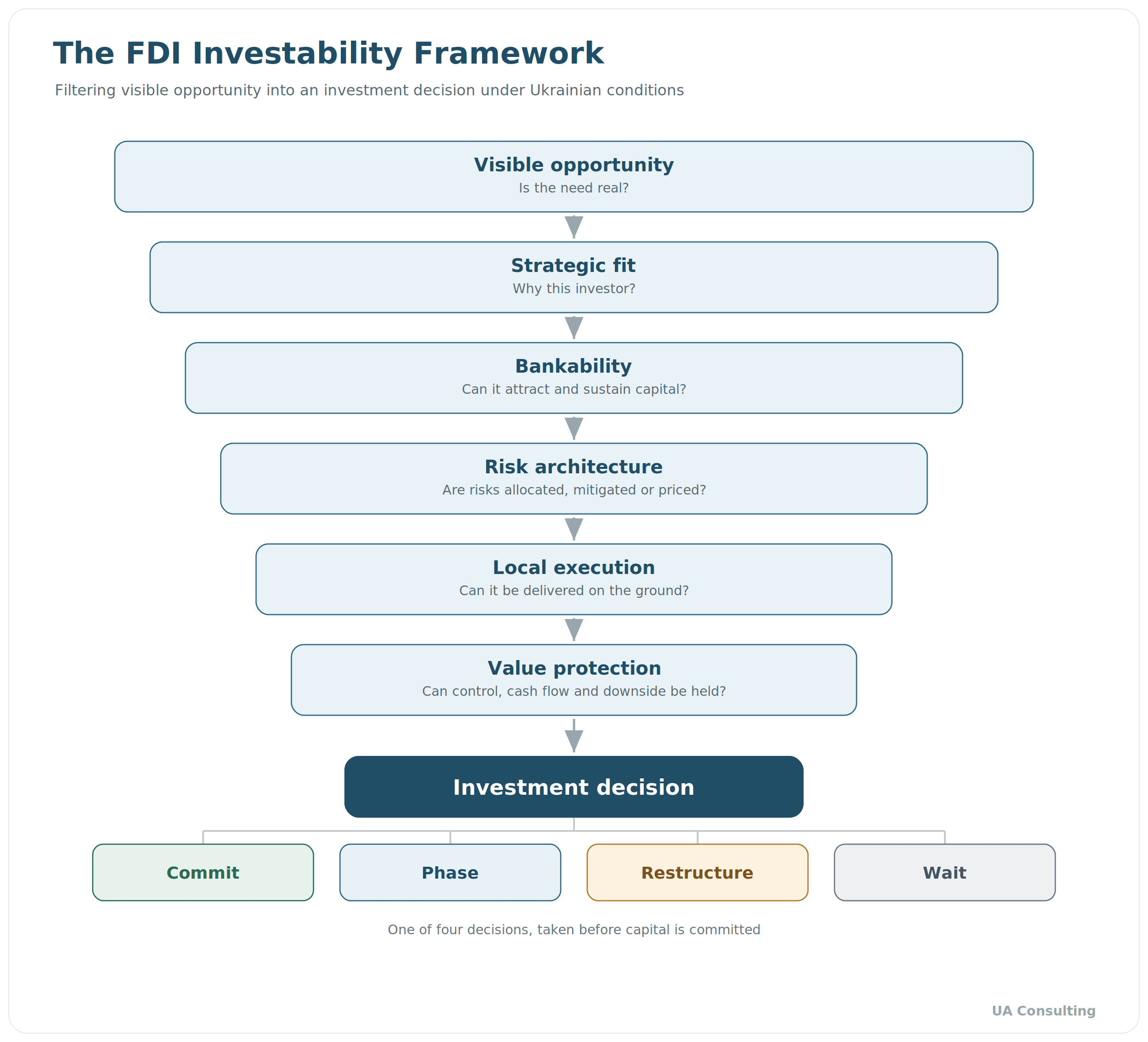
The same reasoning can be drawn as a filter rather than a funnel, because the aim is not to move an opportunity smoothly toward a close but to remove from consideration everything that cannot survive scrutiny. A visible opportunity is passed through the five tests in turn, and what reaches the end is not a simple yes or no but one of four considered outcomes.
An investor commits where the opportunity has survived every test and the case holds on strategic, financial, risk and execution grounds. Where the thesis is promising but the financing or the delivery has still to be proven, the sensible course is to phase the investment, committing against milestones rather than all at once. Where the underlying opportunity is real but its current form is not investable, the task is to restructure it, adjusting the terms, the partners or the allocation of risk until it becomes so. Where the essential conditions are simply not yet in place, the disciplined decision is to wait, holding a position without committing capital prematurely. Reaching one of these four conclusions deliberately, rather than defaulting into a binary choice to enter or stay out, is what separates considered capital from optimistic capital.
Why structuring matters as much as sector selection
For FDI in Ukraine, the decisive question is frequently not which sector to back but how the investment itself is structured, because structure determines how capital is exposed to risk and whether value can be protected once it is committed. A weak structure can undermine a position in an otherwise strong sector, while a well-designed one can make a difficult sector investable. For that reason experienced investors treat structuring as a primary strategic decision rather than a matter to be settled at closing.
The instruments involved are familiar, but they carry more weight in Ukraine than in a stable market. Deploying capital in stages against defined milestones limits exposure while a thesis is tested, and the choice between a joint venture, an outright acquisition, a greenfield build and a minority position sets how much control and risk the investor takes on. Protections at the shareholder level, together with rights to information and to step in when performance slips, keep governance intact as conditions change. Financing arranged through international financial institutions or donor programmes can do more than fund a project, since it often carries the risk mitigation that turns an otherwise marginal case into a bankable one.
War-risk and political-risk cover become material wherever physical exposure is real. Heightened risk has thinned the commercial insurance market in Ukraine, which has pushed foreign investors toward political-risk insurance, multilateral guarantees and the kind of purpose-built de-risking mechanisms that the OECD has examined as a way of unlocking reconstruction finance. The political-risk insurance framework agreed by the DFC and the World Bank's MIGA in mid-2026, established to support the U.S.-Ukraine Reconstruction Investment Fund and other projects, is a recent and concrete illustration of how such mechanisms are being extended to make private investment viable.
The practical consequence is that the first question in an investment decision is often not how much to commit but how to shape the exposure before any full commitment is made. When that question moves from framing into execution, it becomes the substance of investment and project advisory, which tests whether a commitment has been structured to deliver rather than simply to look attractive on paper.
The discipline that separates effective capital
None of this reduces to a simple choice between entering Ukraine early and waiting for stability to arrive. Waiting lowers certain risks, but it also forfeits access to the projects, partnerships and positions that will define the next phase of the market. Moving too quickly carries the opposite danger, since capital can be committed to an opportunity that is clearly visible yet not, in any practical sense, investable.
The more reliable discipline is a sequential one. An investor should first establish where Ukraine is genuinely relevant to its own strategy, and only then test whether the specific opportunity can be structured, financed, governed and executed before the decision is finalised. Those who do well in Ukraine are unlikely to be the boldest or the most cautious, but rather those who can tell the visible opportunity from the investable one and commit capital only where the second is real.
If you are assessing a foreign direct investment decision in Ukraine, UA Consulting can help test whether the opportunity is investable, executable and properly structured before capital is committed.