Ukraine remains an established contract manufacturing base for foreign customers, although the scale of this activity has changed considerably since 2021. Exports of manufacturing services on physical inputs owned by others, the balance-of-payments category that most directly captures this work, declined from USD 1,538 million in 2021 to USD 805 million in 2024. The market is therefore smaller than it was, but the aggregate tells only part of the story for a foreign company assessing production in Ukraine.
What matters increasingly is the capability of the individual manufacturer rather than the depth of the supplier market as a whole. Producers with established export processes, experienced teams and the ability to work to foreign specifications continue to serve international customers, but they need to be identified and assessed individually. For a foreign buyer, contract manufacturing in Ukraine is therefore less a question of choosing from a broad pool of interchangeable capacity and more a question of finding the right production partner and building the operating relationship around it.
For a company already weighing how to operate commercially in Ukraine, that is a better setting than it sounds. A shrinking base means available attention, negotiable terms and a manufacturer who needs the order. It also means the binding constraints have moved. They are no longer whether a factory can make the product. They are whether you can staff the line, whether Ukrainian law gives you title to what comes off it, and whether anyone will insure the tooling you place inside someone else's building.
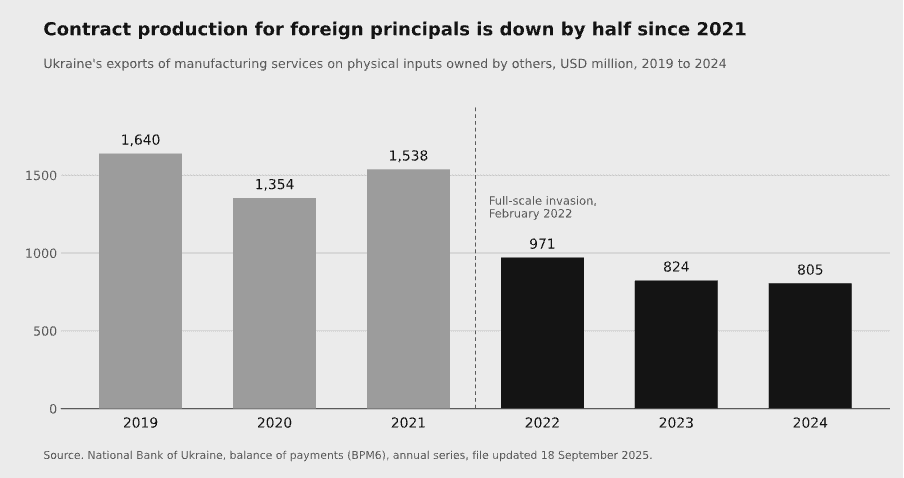
Exports of manufacturing services on physical inputs owned by others, from the National Bank of Ukraine balance of payments series compiled on the BPM6 standard.
The aggregate has not turned, and the detail explains why
The balance-of-payments line above is the cleanest available measure of contract production, because it counts the processing fee a Ukrainian plant earns from a non-resident who keeps ownership of the materials. It captures tolling, cut-make-trim and build-to-print work as value added rather than as gross goods value. It has flattened at roughly USD 200 million a quarter since mid-2022 and showed no recovery through the first quarter of 2025, which is the last period published in the series accessible at the time of writing. Full-year 2025 had not been released in the files reviewed.
Light industry shows the same shape at company level. Employment across Ukrainian textiles, clothing and footwear fell from 133,000 in 2019 to 91,000 in 2025, and Ukraine now supplies 1.3% of EU clothing imports.
The detail underneath those numbers matters more than the totals. The Uzhhorod garment factory UCF, which employs 230 people, made 60,000 units a year for French brands a decade ago and makes about 5,000 today, with French customers down from a quarter of turnover to a tenth. Maje, Gérard Darel, Tara Jarmon and Petit Bateau all left during the 2010s, well before the invasion. Part of this contraction is wartime and part of it is a competitiveness problem that predates the war, which is a distinction worth holding onto when a Ukrainian plant explains its empty capacity. Libération's reporting from the factory floor, republished by the sector association Ukrlegprom in February 2026, sets out both.
The wider industrial picture gives no offsetting lift. Ukrainian industrial production fell 2.4% in 2025 after growing 3.6% in 2024, and ran 0.2% below the prior year in the first half of 2026, with manufacturing down 2.1%. A flat national index conceals idle plants and fully committed ones in equal measure, so it settles nothing on its own. Read against the balance-of-payments series, though, it rules out the comfortable reading that foreign order books are quietly refilling.
Where production for foreign buyers still works
Three patterns are visible in the evidence, and they behave differently.
The first is a buyer who builds the supplier rather than finding one. The Danish merino brand Dilling publishes its own account of its Ukrainian production. It began sewing at Lesya in Novohrad-Volynskyi in 2022 as an independent third-party supplier, having dropped its Belarusian plant that March. In 2025 it became joint owner of a new facility in Zhytomyr called Novodan, split equally with Lesya and staffed by more than a hundred people against a target of around three hundred. That is the staged progression from contract production to shared ownership, documented by the buyer rather than the plant, and it took three years.
The second is domestic private label reaching outward. AFINA Group completed the privatisation of the Vinnytsiapobuthim household chemicals plant in January 2026 and launched a contract manufacturing service in July 2026 with the discount chain Kopiyochka as its first private-label customer. That first customer is also the caveat, because new consumer manufacturing capacity is being commissioned around Ukrainian retail demand. A foreign brand therefore arrives into an order book that is already forming rather than into idle capacity.
The third is fragmented and needs the most caution. Ukrainian machining and assembly firms market build-to-print work through the European Commission's Enterprise Europe Network, and electronics assemblers advertise ISO 9001 systems and IPC-A-610 class 3 acceptance criteria. These are individual company offers rather than evidence of a qualified national tier in industrial manufacturing. In the sources reviewed, no Ukrainian electronics manufacturer publicly holds IATF 16949, so a buyer needing automotive-grade assurance should treat that capability as unproven until audited.
One further pattern dominates by value and is easy to misread. The largest commissioner of Ukrainian contract production today is foreign governments, not foreign brands. Ukraine's Ministry of Defence reports USD 6.1 billion of foreign funding channelled into domestic defence production in 2025 against roughly USD 600 million in 2024, much of it through the Danish model of partner states paying Ukrainian manufacturers directly. These are Ukrainian government figures and no independent audit was found. The commercial consequence for a civil buyer is competition for engineers and machine operators rather than for machinery.
The legal frame changed in 2025 and most templates have not caught up
Ukraine has no standalone tolling statute, because the 1995 law on operations with customer-supplied raw materials was repealed by the Customs Code itself when that code took effect in 2012, and the subject was folded into two customs regimes. A Ukrainian counterparty whose draft still recites the old tolling law is telling you its paperwork has not been refreshed in more than a decade.
The operative regime is processing on the customs territory, in Chapter 23 of the Customs Code of Ukraine. It grants conditional full relief from import duty and VAT on materials brought in for processing, with the relief contingent on completing the regime correctly. Article 151 caps the aggregate processing period at 365 days, with 730 days for shipbuilding, and the clock runs from customs clearance rather than from contract signature. The yield of finished goods per unit of input has to be stated in the foreign trade contract itself and is then enforced by customs, which turns a bill-of-materials assumption into a commitment worth negotiating carefully.
The change that catches live arrangements is procedural. Law No. 3926-IX of August 2024 took effect on 19 April 2025and replaced the old processing permit with an EU-style authorisation, as part of aligning Ukrainian customs practice with the Union Customs Code. Existing permits had to migrate, which makes this the most likely source of administrative friction in a 2026 arrangement and the first thing to confirm before volume is committed.
The provision most often missed is not in the Customs Code at all. Customs status and civil ownership are separate questions in Ukrainian law, and the answers can diverge. Under Article 332 of the Civil Code, title to a new movable thing made from someone else's material vests in the owner of the material, unless the contract or a law provides otherwise. Where the value of the processing substantially exceeds the value of the material, the processor may claim ownership of the new thing instead. That is the ordinary economics of contract manufacturing, so a buyer supplying fabric, components or feedstock into a high-value-add process should treat title as something the contract has to secure expressly rather than something the customs regime delivers. Drafting and enforceability belong with Ukrainian counsel, and this article does not attempt either.
Capability is not the same as what your own customers will accept
A producer that makes an acceptable sample has demonstrated very little. What matters is repeatability under your acceptance criteria together with the evidence your customers and regulators require, and a large part of that evidence burden sits with you rather than with the plant.
Under EU product rules, an operator who markets a product under its own name or trademark takes on the manufacturer's obligations, including conformity assessment, the technical file and the declaration of conformity. An own-brand buyer therefore cannot rely on the Ukrainian producer's certificates and needs verifiable inputs to a file it signs itself. The same logic explains why the pending Agreement on Conformity Assessment and Acceptance of Industrial Products matters less to own-brand outsourcing than is usually assumed, since it is built for Ukrainian producers selling under their own names.
Two of these constraints already bite, and neither is theoretical. In consumer categories the real gate is a retailer scheme such as IFS or BRCGS with batch traceability and factory audits. Those are granted to a site rather than to a company, so they do not travel with you if you change plants, and requalification is measured in months.
The second constraint has a price attached. The EU Carbon Border Adjustment Mechanism entered its definitive phase on 1 January 2026, so an importing buyer in metal-intensive categories now carries a certificate cost that depends on verified emissions data from its producer. Default values are marked up by 10% in 2026 and 20% in 2027 where verification is missing, which turns a supplier's reporting discipline into a line in your own landed cost. The German Economic Team estimates cumulative losses of around USD 1.4 billion in Ukrainian exports of covered goods to the EU across 2026 and 2027, most of it in iron and steel.
Labour sets the ceiling, and the state is subsidising a different model
Available machinery is a weak proxy for available capacity. At the start of 2026, 78% of European Business Association member companies reported a shortage of skilled workers, with welders, CNC operators, maintenance fitters and sewists among the scarcest trades. Defence production competes for the same people. Reserved capacity, forecast commitments, scheduling priority and the agreed response to outage days therefore have to be negotiated and priced explicitly, because a buyer who assumes these will be conceded later has bought a quotation rather than capacity.
The cost advantage that justifies the effort is narrowing. Garment wages rose from about EUR 350 gross a month before the war to about EUR 600 by early 2026, an increase of roughly 70% in euro terms, while Eurostat puts Polish manufacturing labour costs at EUR 17.1 an hour in 2025. Those two figures measure different things, monthly gross pay against total hourly employer cost, so they do not net into a clean multiple. The direction is what matters, and the gap is still wide while closing steadily from the Ukrainian side.
Industrial policy pushes toward a different arrangement than pure toll manufacturing. Ukraine's grants for processing enterprises offer up to UAH 8 million for development and up to UAH 16 million to restore war-damaged assets, normally on 50/50 co-financing but on 70/30 terms when the recipient buys Ukrainian-made equipment, alongside job-creation and tax-payback conditions. A plant asked to install your specified imported machine loses the better rate. The wider Made in Ukraine programme rewards local content and domestic value added, neither of which a pure cut-make-trim arrangement generates. Expect a Ukrainian manufacturer to price that in or to push for a hybrid with local sourcing, and treat it as a negotiating fact rather than an obstacle.
Tooling, title and the insurance nobody has arranged
A low-capital model quietly creates high operational dependency, and low capital is easily mistaken for low risk. The question that separates them is whether production could be moved, if the relationship ended tomorrow, without rebuilding the process from the beginning.
What decides whether production can be moved
Tooling that is buyer-owned, removable and defined by drawings rather than embedded in a bespoke line.
Process documentation complete enough for a second producer to execute rather than reverse-engineer.
Engineering changes recorded in your system, not only in the supplier's.
Critical know-how held in documents rather than in named individuals on the supplier's payroll.
Inputs available from more than one source rather than controlled by the producer.
Conformity and customer approvals held at brand level, not granted to the producing site.
There is also a gap here that most buyers discover late. State and multilateral war-risk cover in Ukraine is built around Ukrainian-registered entities that own the asset, or around cross-border equity investment. The Export Credit Agency's war and political risk product is open to foreign investors but tests for a holding of at least 10% of the company, which consigned tooling is not. The EBRD and Aon facility launched in 2025 covers goods and vehicles in transit rather than static plant. Foreign-owned equipment sitting on someone else's premises falls between the two and goes to the commercial market. The Lloyd's-backed Ukraine war risk facility described by the American Chamber of Commercewrites static assets up to USD 50 million a policy from about 1% of the insured limit, with exclusions that include property within 100 km of the war zone. Check the factory's location against that exclusion before the tooling ships. The practical alternative is to require the Ukrainian producer to insure the assets locally and name you as loss payee, which also lets the producer claim the state premium subsidy.
This is the point at which the work stops being a sourcing exercise and becomes an operating one, covering supplier interface, qualification, control plans and escalation. It is the substance of operations and execution support and it is where most of the value or loss in a contract manufacturing arrangement is actually created.
When the arithmetic turns toward owned capacity
Outsourcing stops paying at identifiable points, and they are easier to recognise in advance than to unwind afterwards.
Signal | What it means |
Supplier margin exceeds the annualised cost of an owned line | Volume now funds your own capacity |
Scheduling priority is commercially decisive | You are buying a queue position you cannot enforce |
The process is the competitive advantage | Every iteration trains a supplier who serves others |
Quality variation survives inspection | Control has to move inside the plant |
No credible second source exists | You cannot leave, only renegotiate |
Until one of those is true, the staged route holds. Qualification and a first commercial run test the producer cheaply, a second stage commits volume and builds the control architecture, and a third tests whether the relationship scales. The Dilling sequence took three years to reach shared ownership, which is a realistic benchmark rather than a fast one.
What is adopted, and what is only intended
Three developments will move the balance, and they carry different weight. Ukraine's parliament adopted legislation in April 2026 harmonising accreditation and technical regulation with EU rules, which is settled law. The Ministry of Economy expects the conformity assessment agreement covering machinery, low-voltage equipment and electromagnetic compatibility to take effect in 2027, which is a government expectation and not an outcome. Extending carbon border rules to steel-intensive downstream goods from 2028 remains a European Commission proposal.
All three point the same way, toward convergence with European conformity and quality expectations. Convergence raises a Ukrainian producer's compliance costs at the same time as wages rise, which narrows the discount that makes the extra management effort worth taking. The window in which contract manufacturing is the cheapest way to test Ukrainian production is open now and is not widening.
What this decision actually turns on
Outsourced production in Ukraine buys an option. It substitutes a reversible commercial exposure for an irreversible industrial one, and it costs control over process, schedule and knowledge. What the data changes is the expected effort. In a base half its former size, with customers who left and labour that is scarcer than machinery, a buyer should expect to build the supplier relationship rather than select from a field, and to measure that work in years.
Two things decide whether that effort returns anything. The first is whether title, tooling and documentation are secured well enough that production could move, which in Ukraine is a contract question and not a customs one. The second is whether the buyer treats the arrangement as an operating commitment with real oversight rather than a purchase order with a lower unit cost. Buyers who commission production on the second assumption tend to discover the first set of questions at the moment they can no longer act on them.
If you are weighing a Ukrainian producer against building your own line, UA Consulting can test the production, control and transferability questions before volume is committed. Start a conversation.