Energy security in Ukraine is often read as a business-continuity problem, solved by buying a generator large enough to keep a site running through an outage. For a company operating or investing in the country, that reading is now too narrow. The damage to Ukraine's energy system has been severe enough that a simple return to the pre-war model is no longer the plan, and the system taking its place will be more distributed, more flexible and more technology-intensive than the one it replaces.
For an owner, board or investor, this shifts the nature of the decision. Power reliability no longer sits quietly in the background as a fixed input. It shapes where a business locates, how much capital a project needs, how the operating model is designed and how the whole case is financed and insured. The practical question is not whether to install backup power, but how to build energy exposure into the investment and operating case while the national system is being repaired and redesigned at the same time.
Ukraine's energy challenge is no longer only about repair
The damage is now well documented, and its pattern matters more to a business than its headline size. The World Bank's fifth Rapid Damage and Needs Assessment, released in February 2026, puts the cost of restoring Ukraine's power system and heating networks at close to 91 billion dollars over the coming decade, with damaged or destroyed energy assets up by roughly a fifth since the previous assessment. More than 80 per cent of the country's total documented damage sits in frontline and border regions. For a company choosing where to build or expand, that concentration is the operative fact, because it means energy risk in Ukraine is regional rather than uniform and has to be assessed site by site rather than assumed for the country as a whole.
The consequence was visible through the 2025 to 2026 winter. According to the International Energy Agency, electricity demand in mid-January 2026 reached around 18 gigawatts while available capacity stood at roughly 11 gigawatts, a deficit that forced rolling blackouts, with some areas including parts of Kyiv losing power for seventeen hours or more on the worst days. A shortfall of that size is not a maintenance backlog that repair alone will clear.
The harder issue is the nature of the damage. Generation, transmission, substations and district heating have been targeted repeatedly and deliberately, which changes what rebuilding should even aim for. Restoring the same large and centralised configuration would bring back capacity, but it would also bring back much of the exposure that made the system a target in the first place. For companies, the working conclusion is that power reliability has to be treated as a variable to be tested before a site or investment decision is made, not as an assumption to be confirmed afterwards.
The system that replaces it will be more distributed, flexible and technology-intensive
If the old configuration should not simply be rebuilt, the question becomes what replaces it, and the answer is not a single model. The direction of travel combines a restored central backbone and stronger integration with the European grid, more generation built closer to demand, and a technology layer of storage, cogeneration, digital control and flexible industrial load. The IEA's roadmap for a decentralised Ukrainian power system sets out the logic. Distributed resources such as solar, small gas engines and batteries are harder to target and quicker to restore when hit, and they generate power nearer to where it is used. The same analysis estimates that rebuilding on gas turbines and engines alone would require around 12.8 billion dollars upfront, while a more diverse mix that adds renewables and storage costs more to build but less to run over time, largely by reducing fuel and electricity imports.
This shift is already showing up in projects rather than plans, which is what makes it credible. DTEK, the country's largest private energy investor, has commissioned Ukraine's largest battery storage complex and set out a transition that phases out coal by 2035 while adding wind, gas and grid modernisation, a change accelerated by the very attacks that damaged its assets. The direction is reinforced by how new capacity is being financed. The EBRD and the EU are backing a 106 megawatt solar plant with co-located battery storage in one of the country's most energy-deficient regions under a Ukraine Investment Framework guarantee, while a separate EBRD facility is funding fast-starting gas-piston generation and batteries in western Ukraine to balance the grid and reduce outages. These are not demonstration schemes but commercial assets, structured to be financeable under wartime conditions and built to earn a return.
The transition is directionally clear but neither quick nor automatic, and it is worth being precise about why. Storage, cogeneration and grid technology depend on financing, bankable project structures, maintenance capacity and a regulatory framework that is still catching up with the pace of deployment. The realistic reading is that resilience is increasingly being designed into the system from the outset rather than added as an emergency layer afterwards, which is the principle the IEA has drawn from Ukraine's experience for use elsewhere. For an individual company, though, a national system that is improving in this direction does not remove the need to secure its own supply in the meantime.
Where energy exposure enters the investment case
Once resilience is being designed into the national system, it also has to be priced into the individual business case. Power reliability now runs through the whole feasibility question rather than sitting off to one side of it. It affects the choice of site and the capital budget through the cost of on-site generation or backup, it affects operating costs and downtime risk through the frequency and length of interruptions, and it affects financing and insurance because lenders and insurers increasingly want to see how continuity is secured before they price a facility. It also affects the credibility of commitments to customers, since a supplier that cannot guarantee output cannot guarantee delivery. A site with cheaper land or rent can therefore turn out to be the more expensive option once the full cost of keeping it running is counted, and that gap is easy to miss at the point when the location looks attractive on paper.
Exposure also differs by sector, and the difference is commercial rather than technical. In food processing and agribusiness, an interruption threatens refrigerated stock, controlled storage and seasonal processing windows that cannot simply be rescheduled, so the loss from an outage is measured in spoiled product and missed harvest throughput. In manufacturing, unplanned stops interrupt continuous process lines and can damage equipment, so the cost is both lost output and physical repair. In data-dependent and digital operations, where uptime and connectivity are the product, even short interruptions carry a disproportionate commercial penalty. The right level of resilience is not a fixed standard but a function of what a specific operation loses during an outage and what continuity is worth paying to protect.
The table below sets out the main resilience layers and the commercial question each one raises. It is intended to support a decision rather than prescribe a solution, since the right combination depends on the site, the sector and the investment horizon.
Resilience options and the questions they raise
Resilience layer | What it addresses | Typical business fit | Main constraint to test |
|---|---|---|---|
Backup generation (diesel or gas) | Short outages and critical loads | Almost any site with essential processes | Fuel logistics, maintenance and run-time economics |
On-site distributed generation (solar, small gas) | Recurring supply gaps and partial autonomy | Large, energy-intensive or remote sites | Capital cost, permitting and grid connection quality |
Battery energy storage (BESS) | Peak shifting and short-term stability | Sites with variable load or on-site renewables | Upfront cost, sizing and integration |
Cogeneration (CHP) | Combined heat and power needs | Processing, heating and industrial users | Capital intensity and predictable fuel supply |
Energy efficiency and load management | Reducing exposure before adding hardware | Most operations | Requires operational discipline, not only equipment |
Grid quality and European integration | Baseline reliability and import capacity | All grid-connected users | Regional differences and transmission limits |
Source: UA Consulting analysis, drawing on IEA and EBRD assessments of Ukraine's power system.
Resilience has two sides: national redesign and daily operating reality
The clearest way to hold this together is to treat resilience as operating on two connected levels. At the national level it is a strategic transformation, involving new infrastructure, generation built closer to demand, storage, digital control, international finance and closer integration with Europe. At the company level it is a practical operating discipline, shaped by current constraints such as equipment lead times, fuel logistics, maintenance capacity, permitting, regional disruption, cost and the quality of local execution. Progress at the first level does not automatically deliver the second, which is why a company cannot simply wait for the grid to improve.
Backup power sits inside this second level as one component rather than the whole answer. A generator is a useful asset, but on its own it is not a continuity strategy. Site-level resilience comes from the system around the equipment, which means mapping critical loads and defining which processes must stay live, securing fuel and spare parts, maintaining the plant, setting operating protocols, training staff to run them and writing energy continuity into the operating model itself. Companies that treat backup hardware as a complete solution tend to discover the gaps at the worst possible moment, when the equipment starts but the surrounding system is not ready to use it.
Timing is what makes this distinction consequential. A business cannot hold site, asset and production decisions until the national system reaches a settled end state, because that state is years away. It has to make defensible choices now, inside a system that is still being repaired, decentralised and modernised around it, and design its own continuity to a standard it controls rather than one it inherits.
Foreign technology and capital are necessary for energy security in Ukraine
Ukraine cannot rebuild this level of resilience from domestic resources alone, and the gap is where foreign participation becomes necessary rather than optional. The redesign calls for imported equipment and engineering capacity, storage and grid technology, digital monitoring, industrial efficiency, cogeneration and renewable generation, and it calls in parallel for the project finance, guarantees, insurance and credible local partners that let those assets be built. Much of the enabling architecture is already in place. The EBRD is Ukraine's largest institutional investor, having deployed more than 10.5 billion euros in the country since 2022, and the EU's Ukraine Facility, worth up to 50 billion euros in loans and grants between 2024 and 2027, provides much of the guarantee structure that makes private energy projects financeable. Instruments such as the EBRD's Energy Security Support Facility extend similar support to smaller businesses and municipalities.
For a foreign technology provider or investor, the distinction that matters is between an attractive market and an executable project. Demand for equipment and capital is real, but it does not by itself create a bankable deal. A project becomes investable only when the grid connection, the fuel or resource route, the offtake, the partner and the execution model all hold together under Ukrainian conditions, including war-related risk, permitting, procurement and regional exposure. Establishing whether they do is closer to due diligence than to sales, and it is the point at which this work connects with Political & Operational Risk in Ukraine and, where renewables and storage are central, with Green Hydrogen & Renewable Energy.
A decision sequence for energy resilience in Ukraine
For an owner, operator or investor, the decision is easier to manage as a sequence than as a single choice about equipment. The figure below sets out that sequence, from mapping energy exposure through to an integrated investment and operating decision, against the backdrop of a national system that is still changing.
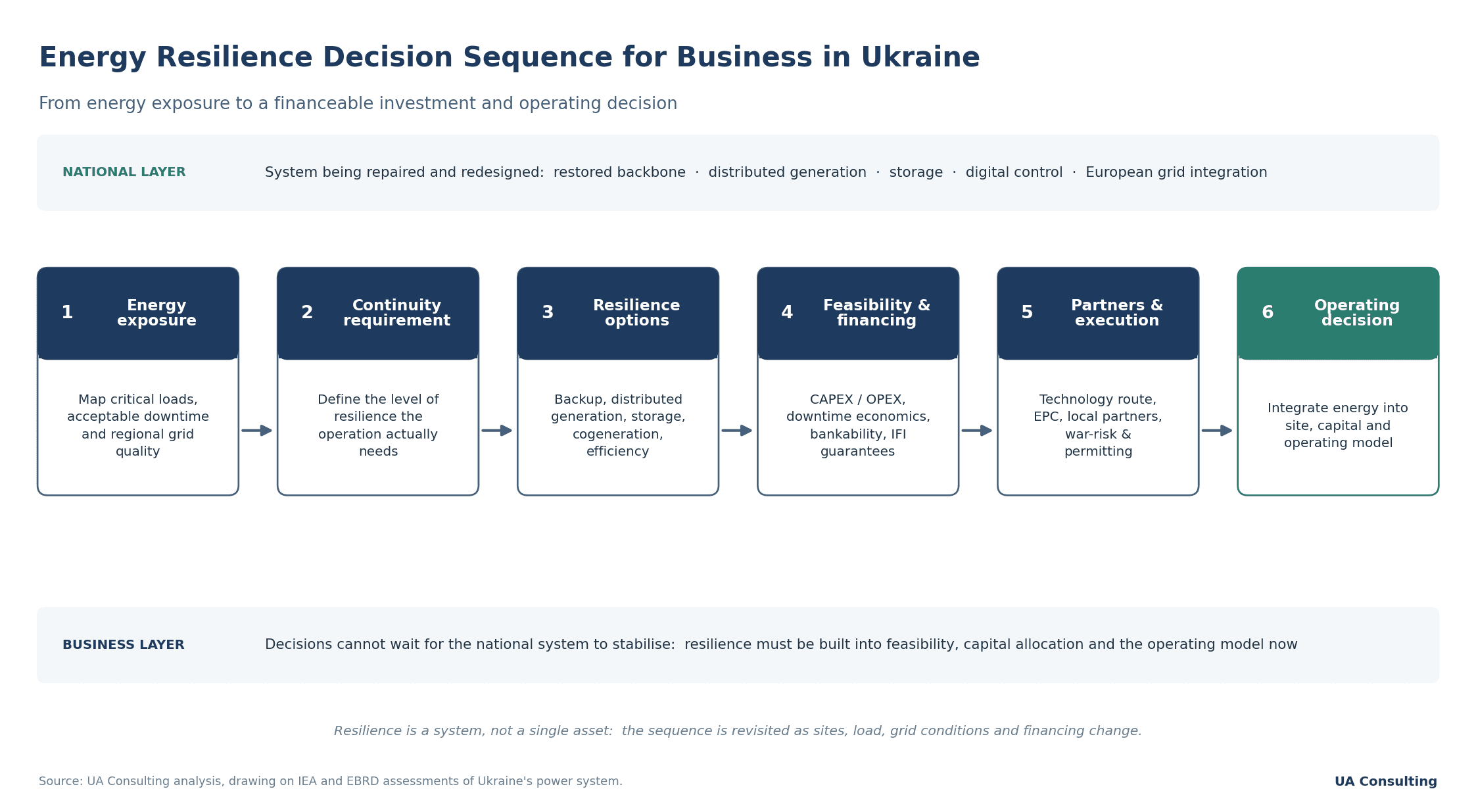
Handling the decision in this order is what prevents the two most common and expensive mistakes. When a company buys equipment before defining the continuity it actually needs, it tends to over-specify and overpay for resilience that the operation cannot justify. When it treats financing and partner selection as something to arrange after the technical choice is made, it often finds that the plan is not executable on the terms available. Working through exposure, requirement, options, financing and execution in sequence keeps each of those decisions anchored to the one before it.
How UA Consulting supports energy security and resilience decisions
UA Consulting works at the point where Ukraine's changing energy system meets a specific commercial decision. The firm is not an equipment vendor, an EPC contractor or an engineering designer. Its role is senior advisory, which means helping owners, investors, operators and technology providers translate a shifting national energy picture into practical choices about where to invest, how much resilience is commercially justified, which technologies and partners are relevant, and how energy exposure should be built into feasibility rather than added once the main decisions are already made.
In practice this covers energy exposure and continuity reviews at site and portfolio level, testing of investment feasibility where power reliability is material, mapping of technology and partner options, project structuring, and coordination between engineers, equipment providers, financiers and Ukrainian stakeholders. The system-level view connects with the firm's work in Energy & Critical Infrastructure, while the business-level implementation, from continuity planning to execution discipline, sits closer to Operations Consulting & Execution Support.
Conclusion
For a company in Ukraine, the decisive question is no longer how to get through the next outage. It is whether an operation or an investment will remain viable while the energy system around it is repaired, decentralised and modernised over a period measured in years rather than months. Approached that way, energy stops being a cost line to be covered by a generator and becomes one of the conditions that determine where a business can locate, how much capital a project needs, how continuity is financed and how credibly the company can stand behind its commitments to customers. Firms that judge this correctly will make sharper location and capital decisions than those that leave energy resilience to be sorted out once everything else has been settled, by which point the site and the budget are usually already fixed.
If energy reliability is material to your Ukrainian operation, expansion or investment case, UA Consulting can help assess the exposure, define the level of resilience that is commercially justified, and translate energy risk into a practical investment and operating plan before capital, time and management attention are committed. To discuss a specific case, contact UA Consulting.