The useful question for an investor or operator in Ukraine is rarely whether the country is risky in general. It is which exposures are structural, which belong to the current phase of war and recovery, which can be allocated or mitigated, and which change the investment case altogether.
Political risk in Ukraine is best understood not as a single country-risk label to be accepted or rejected, but as a set of distinct exposures that behave differently and call for different responses. The environment is genuinely high-risk, shaped by the war and its consequences for security, infrastructure, currency movement and the recovery timeline, and none of that should be understated. What the headline picture cannot do is tell an investor how any particular commitment will actually perform, because the risk is not uniform across sectors and assets, it does not stay constant over time, and it is not prohibitive in every case. The quality of an investment decision depends on separating that headline risk from the exposures that genuinely bear on a specific asset, contract, supply chain and capital structure. Approached in that way, assessing political risk in Ukraine becomes a structuring problem rather than a verdict, and the real work is deciding which exposures can be mitigated, which have to be priced, and which make a commitment uninvestable.
The question is not whether Ukraine is risky. The question is whether the risk profile of a specific asset can be structured into an investable position.
Much of the difficulty in reading Ukraine comes from treating the decision as binary. One group writes the country off on sight and steps away from opportunities that are, in practice, well contained, while another is drawn by the scale of reconstruction and commits before testing whether a given exposure can be managed at all. Neither response amounts to analysis, because both replace a specific question about an asset with a general verdict on the country, and an asset is what the capital is actually exposed to.
Why political risk in Ukraine is rarely about politics alone
Political risk, for a business, has little to do with party politics or the daily flow of political commentary. It is really a question of how predictable the rules are for the capital, contracts and operations that have to live under them. In practice that predictability comes down to how consistent regulation and its enforcement are, how much time and certainty go into obtaining permits and licences, and how public procurement and state-owned counterparties behave in reality. It also depends on whether contracts and judgments can be enforced, and on the way mobilisation and security are handled under martial law. Ukraine then adds two dimensions that conventional country analysis tends to overlook. The first is the conditionality attached to donor and international financial institution funding, which shapes how many reconstruction-linked projects are structured and governed. The second is the direction set by alignment with European Union rules, which is steadily reshaping the regulatory environment those projects will operate in. Seen in these terms, the relevant test is not whether the politics of the moment are favourable, but whether the rules, counterparties and enforcement mechanisms are predictable enough for the particular commitment being made.
Understood as a matter of institutions and predictability rather than opinion, political risk becomes far more tractable. An investor does not need the environment to be benign, but does need to establish, with reasonable confidence, how the rules will treat a specific asset and its cash flow over the life of the commitment. Where that confidence can be built, a large part of what is loosely called political risk resolves into a set of identifiable and often manageable exposures.
A high-risk environment moving in a defined direction
Ukraine sits in a genuinely elevated risk environment, and yet its institutional direction of travel is unusually well defined for a country at war. It has held European Union candidate status since June 2022, opened formal accession negotiations in June 2024, and completed the screening of its legislation against the EU body of law in September 2025. In June 2026 it opened the first negotiating cluster, the fundamentals cluster, which covers the rule of law, democratic institutions, public administration and procurement reform, and the core economic criteria.
This institutional trajectory matters to an investor in a practical rather than a political sense. Accession removes no risk on its own and offers no guarantee of pace, since progress is merit-based and tied to benchmarks Ukraine has formally accepted. What it does is anchor reform in exactly the areas that determine how businesses are regulated, how contracts are enforced and how the state deals with private capital. Risk is therefore better read not only against today's conditions but against the direction and credibility of institutional change, both of which shape the environment an asset will operate in over a five to ten year horizon. For a company new to the market, that trajectory forms part of the wider question of doing business in Ukraine, which frames a specific risk assessment without ever replacing it.
The scale of what is being rebuilt sets the commercial context for all of this. The joint assessment by the Government of Ukraine, the World Bank, the European Commission and the United Nations put reconstruction and recovery needs at almost USD 588 billion over the coming decade as at the end of 2025, with private capital expected to play a significant part alongside public, donor and international financial institution financing. A number of that size is a measure of opportunity, but it is equally a measure of how far the market still depends on deliberate de-risking and institutional support rather than on conditions returning to normal on their own.
Where political risk becomes operational reality
Most companies do not experience political and country risk as headlines. They experience it through operations, which is where abstract exposure turns into something concrete. Operational risk in Ukraine tends to show up in a few recurring places. Power supply is not always reliable, so energy resilience becomes a live commercial issue rather than a background utility. Logistics depend heavily on particular transport routes and border crossings, and the availability of labour is affected by mobilisation. Security and insurance are more expensive and, in some regions, harder to obtain, while heavier reliance on inventory ties up working capital. Underneath all of it, the physical resilience of assets varies sharply from one region to another, so that two businesses in the same sector can face very different exposure depending simply on where they sit.
These operational pressures are not separate from country risk. They are the mechanism through which it is transmitted into the business. Currency rules govern working capital and the ability to pay overseas suppliers. Energy reliability drives production schedules and delivery commitments, which is why energy security and resilience now reads as an operating dependency rather than a utility question. Mobilisation rules reshape workforce planning, and the state of infrastructure determines the cost and certainty of reaching customers. When this disruption arrives, it is rarely gradual. A delay at a single border crossing can turn a thin logistics margin into a loss, and a change in mobilisation rules can remove skilled staff from a plant with very little warning. A company that treats managing operational risk in Ukraine as a self-contained logistics problem, separate from the regulatory and macroeconomic picture, will usually misread both, because a change in one tends to surface quickly as a cost or a constraint in the other.
Why a country-risk score is where the analysis starts, not where it ends
Country-risk ratings and indices have their place, but they answer a different question from the one an investor actually faces. A rating will confirm that Ukraine is a high-risk environment, which any serious analysis already assumes. What it cannot do is say whether a particular logistics platform, food producer, energy-services business or industrial supplier is investable, because a national score is an average of the whole country. That average necessarily blurs the things that decide the outcome of a specific commitment, among them sector and regional exposure, the resilience of the individual company, the quality of a local partner, the structure of the capital, and whether a given risk can be insured, allocated or is already reflected in the price.
A rating, then, belongs at the beginning of the analysis rather than at its conclusion. The decisions that actually determine whether capital is protected are taken further down, at the level of the individual asset, the contract, the supply chain and the governance arrangement. The table below sets out the main categories of risk in those terms, showing what each one affects, whether it is structural or specific to the current phase of the war, and how it is typically addressed.
Risk category | What it actually affects | Structural or current-phase | How it is typically addressed |
|---|---|---|---|
Security and physical safety | Asset location, staffing, insurability, continuity of operations | Current-phase, regionally concentrated | Site selection, war-risk and political risk insurance, phased capital expenditure, continuity and evacuation protocols |
Regulatory and legal predictability | Permits, enforcement, ownership, disputes, compliance | Structural, improving with EU alignment | Legal structuring, dispute-resolution clauses, sanctions and compliance screening |
Currency and payments | Working capital, dividends, debt service, import payments | Current-phase, gradually liberalising | FX planning within NBU limits, financing structure, hedging where instruments are available |
Energy and infrastructure | Production schedules, delivery, cost to serve | Current-phase, partly mitigable | Backup generation, route and supplier redundancy, inventory policy |
Counterparty and partner | Revenue, execution, reputation | Asset-specific | Commercial due diligence, partner vetting, contractual protection, milestones |
Governance and decision rights | Speed of response, protection of value | Within the investor's control | Board oversight, local authority, reserved matters, crisis delegation |
Source: UA Consulting analysis, drawing on World Bank Group RDNA5 (2026), European Commission accession reporting (2026) and National Bank of Ukraine foreign exchange guidance (2026).
What investors and operators should actually assess
Once the analysis moves to this level, it tends to resolve into five practical questions, each of which turns a general unease about the country into something specific enough to act on. Good risk management consulting in Ukraine is less about forecasting the next event than about structuring exposure so that a particular business can absorb the events that do arrive.
The first is whether the investment can be protected in law and by contract. In the Ukrainian context that covers the ownership structure and the shareholder and governance rights attached to it, the way disputes would be resolved, exposure to permits and regulatory decisions, and the sanctions and compliance obligations that come with counterparties and financing. The second is whether the asset can keep operating when conditions deteriorate, which comes back to energy resilience, alternative routes and suppliers, a sensible inventory policy, and the staffing and safety arrangements that allow a site to function under pressure. The third, and often the most underestimated, is whether cash can move when it needs to. Ukraine has run a temporary foreign exchange regime since martial law was introduced in 2022, and the National Bank of Ukraine has been easing it in measured, incentive-based stages, most recently through a further easing of restrictions in January 2026 that widened the conditions for cross-border payments while leaving the core controls in place. Dividend repatriation, debt service, payments to importers and any hedging all have to be planned within that evolving regime rather than taken for granted.
The fourth question is whether management can act quickly enough when something changes, which depends on the balance between local authority and board oversight, on which matters are reserved to shareholders, and on how fast a decision can be escalated and taken in a crisis. The fifth, and the area where the market has moved furthest, is whether risk can be allocated or shared rather than simply carried in full. In June 2026 the U.S. International Development Finance Corporation and the World Bank's Multilateral Investment Guarantee Agency signed a framework to advance political risk insurance for investment connected to the U.S.-Ukraine Reconstruction Investment Fund. Cover of this kind can address exposures such as political violence, expropriation and restrictions on transferring currency, although availability depends on the eligibility, structure and terms of each instrument rather than being automatic. Used alongside phased capital deployment, milestone-based investment and the participation of development finance institutions, it allows specific exposures to be transferred or shared rather than carried alone. This is where disciplined investment and project advisory does much of its work, and where most effective risk mitigation for investors in Ukraine actually happens.
Taken together, these questions turn the unanswerable question of whether Ukraine is risky into a set of decisions an investor can actually take, and the map below brings them into a single view.
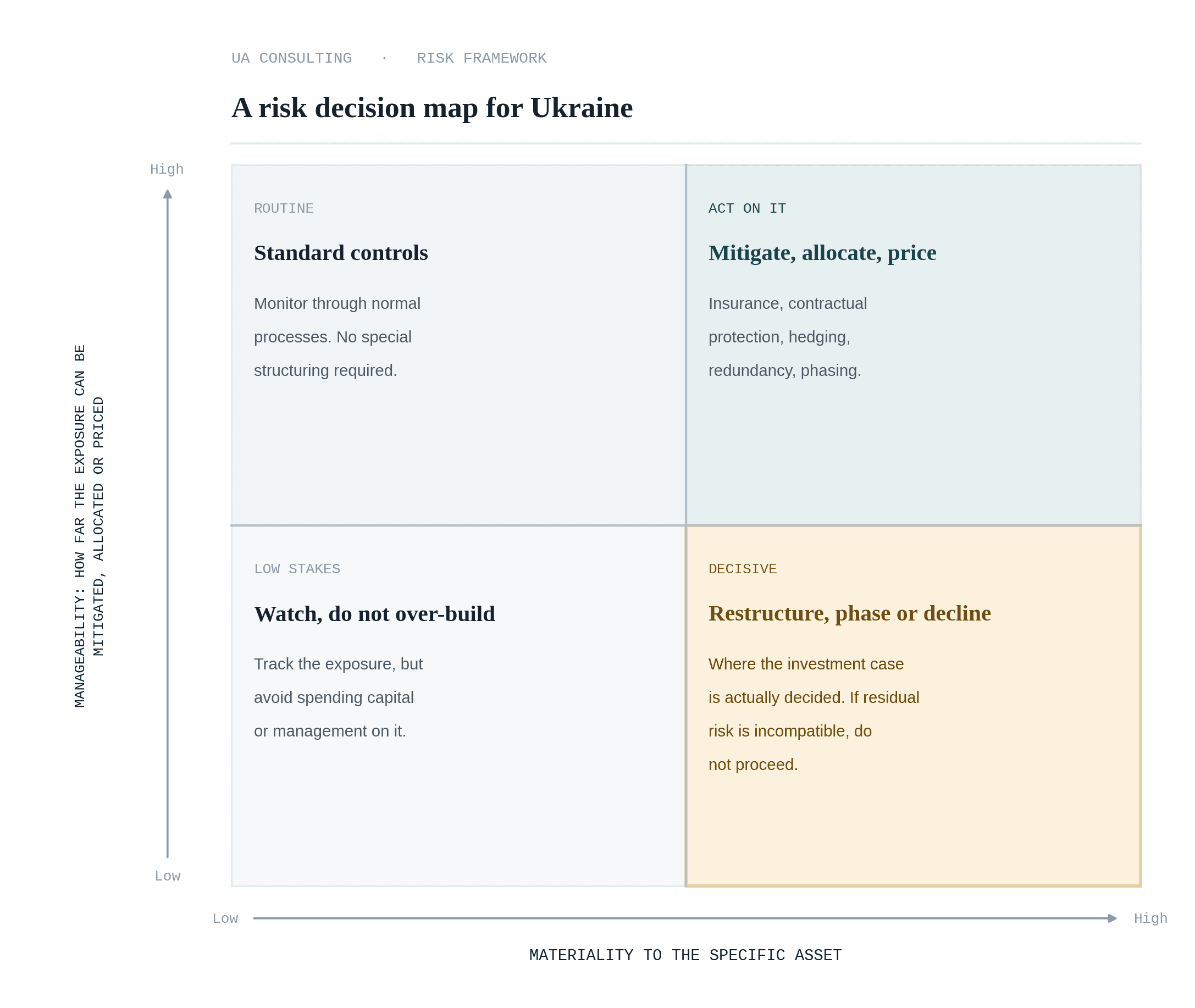
Figure 1. A risk decision map for Ukraine. The decisive quadrant is not the largest risk in the abstract, but the risk that is both material to the asset and difficult to manage. That lower-right zone is where the investment case stands or falls, and where most disciplined commitments are reshaped or declined.
Risk mitigation is not risk elimination
None of this turns Ukraine into a low-risk market under present conditions, and any analysis that suggests otherwise deserves to be treated with suspicion. The purpose of disciplined risk work is both narrower and more useful than that. It is to identify the exposures that genuinely matter to a particular commitment, to establish which of them can be mitigated or transferred and which have to be priced, and to be willing to decline the commitments where the residual risk simply cannot be reconciled with the investment case. The aim is not a risk-free position, which does not exist in Ukraine today, but an investable mandate in which the risks being taken are understood, deliberate and capable of being survived.
When risk becomes a board-level decision
Political and operational risk stops being an operating matter and becomes a governance one once a few thresholds are crossed. That point is usually reached when a commitment is large in capital terms, when there is significant foreign shareholder exposure or reliance on debt and donor financing, when the business depends on public permits or state counterparties, or when the exposure is large enough to move the value of the enterprise. It is reached, too, wherever local management lacks the authority to respond at the speed events require. At that stage the decision belongs in front of owners and boards, because it touches not only the operation itself but the protection of value and the credibility of the response an investor can offer its own stakeholders. This is the point at which risk assessment, owner, board and investor advisory and crisis management come together, and where the analysis has to feed directly into decisions on whether to proceed, how to price the commitment, whom to partner with and when to restructure.
Risk cannot be taken out of a Ukrainian investment decision, and it is a mistake to promise otherwise. What it can be is made visible, structured and governed, which is a more modest but far more achievable goal. The difference between an exposed commitment and an investable one is usually created well before any capital is deployed, in the quality of the work that separates headline country risk from the exposures that genuinely bear on a specific asset, and that decides, one exposure at a time, what to mitigate, what to price and what to walk away from.
If you are assessing political or operational risk in Ukraine, UA Consulting can help separate headline exposure from asset-specific risk, test the available mitigation options, and structure the decision before capital, time or management attention are committed. Start a confidential conversation.