For a foreign company, doing business in Ukraine is not a choice between opportunity and risk. It is a test of whether the business can operate across two realities at once. One is a digital, adaptive and reconstruction-driven economy with real strategic relevance. The other is a wartime operating environment shaped by bureaucracy, energy disruption, labour shortages, logistics pressure and uneven institutional capacity. The decision that matters is not whether Ukraine is attractive or dangerous in the abstract. It is whether a specific company can build an operating model that holds under local conditions. The investors who struggle here are rarely short of information and more often, they misread what the information means for their own decision. This guide sets out how to read that duality before capital, time and management attention are committed, and where broad interest in the market should become a structured assessment of entry route, feasibility and risk.
Why doing business in Ukraine starts with operating reality, not market potential
Most guidance begins with company registration, tax residency and legal structure. Those steps matter, but they answer a narrow question which is how to establish a presence. They reveal nothing about whether that presence will function. The consequential question sits earlier, and it is the one a foreign board should ask first. Can the business reach demand, protect its margins and keep operating when conditions tighten?
The mistake that follows is almost always one of two. Some investors treat Ukraine only as a risk case and never look past the war. Others treat it only as an opportunity, drawn by reconstruction figures, and underestimate how demanding execution is. Both decisions are made on a single dimension, and both tend to be wrong for the same reason. They settle whether the market is attractive without settling whether it is reachable.
This is why the framing matters more than any single statistic. The OECD's 2026 assessment describes an economy that is resilient but whose outlook is exceptionally uncertain, with labour shortages and attacks on energy, logistics and businesses all weighing on activity. The World Bank describes the same economy as holding a wartime equilibrium, stable in aggregate yet under continuous strain. For an investor, the practical implication is not that Ukraine should be avoided or embraced, but that opportunity and execution have to be judged together. A decision built on one without the other is the most common way capital is misallocated here.
A market of asymmetries, not a single national story
The single most useful thing a foreign investor can understand about Ukraine is that it does not behave as one market. It is a set of sharply different segments, and the gap between the strongest and the weakest is unusually wide. The most visible illustration is defence technology, which the war has turned into one of Europe's most dynamic sectors. But defence is an example, not the argument. The argument is that a sector can be world-leading while the one beside it is held back by damaged infrastructure, trade friction or thin local capacity.
For the investor, this changes the first question. The question is not whether the Ukrainian market is attractive, because there is no single answer to that. It is whether a specific segment, in a specific region, with the counterparties actually available, is structurally real and reachable. National averages, and national headlines, mislead in both directions. They make strong segments look dangerous and weak segments look promising.
The error this discipline prevents is the most expensive one available in Ukraine. It is the decision to enter, or to stay out, on the strength of a country-level narrative rather than a segment-level assessment. Where that assessment moves into channels, pricing and customer access, it becomes the work of go-to-market strategy in Ukraine, but the segmentation has to come first.
A world-class digital surface over an uneven institutional base
Ukraine is one of the most digitally capable states a foreign investor will deal with. Through the Diia platform a company can be registered in around ten minutes, and Ukraine ranks fifth in the world for online public services on the United Nations E-Government index. For routine administration, the friction many expect of an emerging market is real but lower than assumed.
The judgement an investor has to make is what that surface does and does not tell them. It tells them that transactions with the state are fast. It does not tell them that the institutions behind those transactions are predictable. Contract enforcement, the courts, procurement integrity and regulatory consistency remain uneven, and governance reform is still in progress. Anti-corruption is a live issue rather than a settled one, as recurring high-level cases continue to show.
The mistake here is subtle and common as investors read the ease of starting as evidence of the safety of scaling, and price the operating environment accordingly. The two are not the same. A business can be opened in minutes and still depend, a year later, on a dispute being resolved fairly, an approval being granted predictably or a regulator behaving consistently. The digital front end lowers the cost of entry. The institutional base determines the cost of operating, and it has to be assessed on its own terms.
Operating assumptions the war makes non-negotiable
In a stable market, power supply and staffing are background conditions. In Ukraine they belong inside the operating model, because they change the economics of the business rather than merely its comfort. This is the shift in thinking that most foreign operators have to make.
Energy is the clearest case, since any operation that cannot tolerate interruption has to treat backup power, redundancy and the cost of resilience as part of the core business model rather than as a facilities assumption. Labour is the second constraint, with mobilisation, emigration and large-scale displacement tightening the workforce to the point where skilled people become a binding operating condition rather than a safe input. Logistics is the third, as routing, insurance, lead times and exposure are shaped directly by the security environment, while the fourth constraint is less visible but often equally damaging: management attention, because longer decision cycles and senior time diverted to problems that would not exist in a stable market create an operating cost of their own.
None of this makes market entry unattractive in itself, but it does mean that these exposures have to be priced, structured and allocated before the commitment is made, not treated as issues to be solved later. Although war-risk cover has developed inside Ukraine, it remains focused largely on domestic businesses and local exposures, which is why foreign investors typically need to rely on political risk insurance, guarantees and related instruments from multilateral and development finance institutions.The detailed treatment of these exposures belongs with a structured review of political and operational risk in Ukraine. For the entry decision, the point is simpler: they are model inputs, not background noise.
Entry options and what each route actually controls
Foreign investors can enter Ukraine through a representative presence, a distributor or partner arrangement, a wholly owned company, an acquisition, a joint venture, a project-based structure, or participation tied to international financial institutions and donor-funded programmes. Each has a place, and none is correct in the abstract.
The more important judgement is that the legal form is rarely the central decision. The central decision is where control will sit once the business is operating. That means asking who owns the customer relationship, who has authority over day-to-day decisions, who controls cash, and who has access to the information on which management depends. A distributor may provide speed and reach, but the customer relationship often remains with the distributor and can leave with them when the relationship ends. A joint venture may bring local capability, assets or eligibility, but it also shares control over governance, compliance and operating decisions, which are exactly the areas where risk tends to concentrate in Ukraine. Choosing a route to market is therefore not mainly a question of how the business is registered. It is a decision about which parts of control the company must retain, which it can safely share, and which it should not give away at all.
This is where partner selection stops being administrative and becomes the principal mechanism of risk control. Weak partner and governance choices are difficult to reverse once capital and reputation are committed, and they are the most common source of avoidable loss. Structured market entry and expansion advisory exists for this decision: not to pick a legal form, but to align the route with how the business intends to hold demand, margin and risk.
What foreign investors need to test before committing capital
Before capital is committed, the assessment reduces to a small set of questions that deliberately cut across both opportunity and execution. The table below sets out the dimensions that most often decide whether an entry succeeds, what each one tests, and why it carries particular weight in Ukraine.
Area to assess | What to test | Why it matters in Ukraine |
|---|---|---|
Market opportunity | Whether demand is structurally real and reachable, not simply large in theory | Asymmetry is extreme: some segments operate at a global frontier while others remain constrained |
Entry route | How the business will access the market, and what each option controls | The legal form matters less than who holds customers, decisions, cash and information |
Operating model | Whether the business can function under local conditions, not only register | A presence is easy to establish; operating it through disruption is the real test |
Partner and governance risk | Who controls relationships, money and compliance, and how reversible the choice is | Local relationships carry weight, and weak partner or governance choices are hard to undo |
Infrastructure and energy resilience | Whether the model withstands power and supply interruption, and at what cost | Attacks on energy and logistics make backup capacity a core cost, not a footnote |
Labour and management capacity | Whether the business can attract, retain and supervise the people it needs | Mobilisation, emigration and displacement have made skilled labour a binding constraint |
Regulatory and political exposure | What must be assessed and insured before capital is exposed | The digital surface is strong, but institutional predictability and risk cover are uneven |
Source: UA Consulting assessment framework, drawing on OECD analysis, World Bank reporting and the 2026 Rapid Damage and Needs Assessment, RDNA5.
The discipline the table enforces is to refuse a single verdict on Ukraine and to require a verdict on a particular business, in a particular segment, under particular conditions. Where the answer turns on capital commitment and project feasibility, it moves into the territory of foreign direct investment in Ukraine and the work of investment and project advisory, where a commitment is tested against feasibility rather than appetite.
From assessment to investment readiness
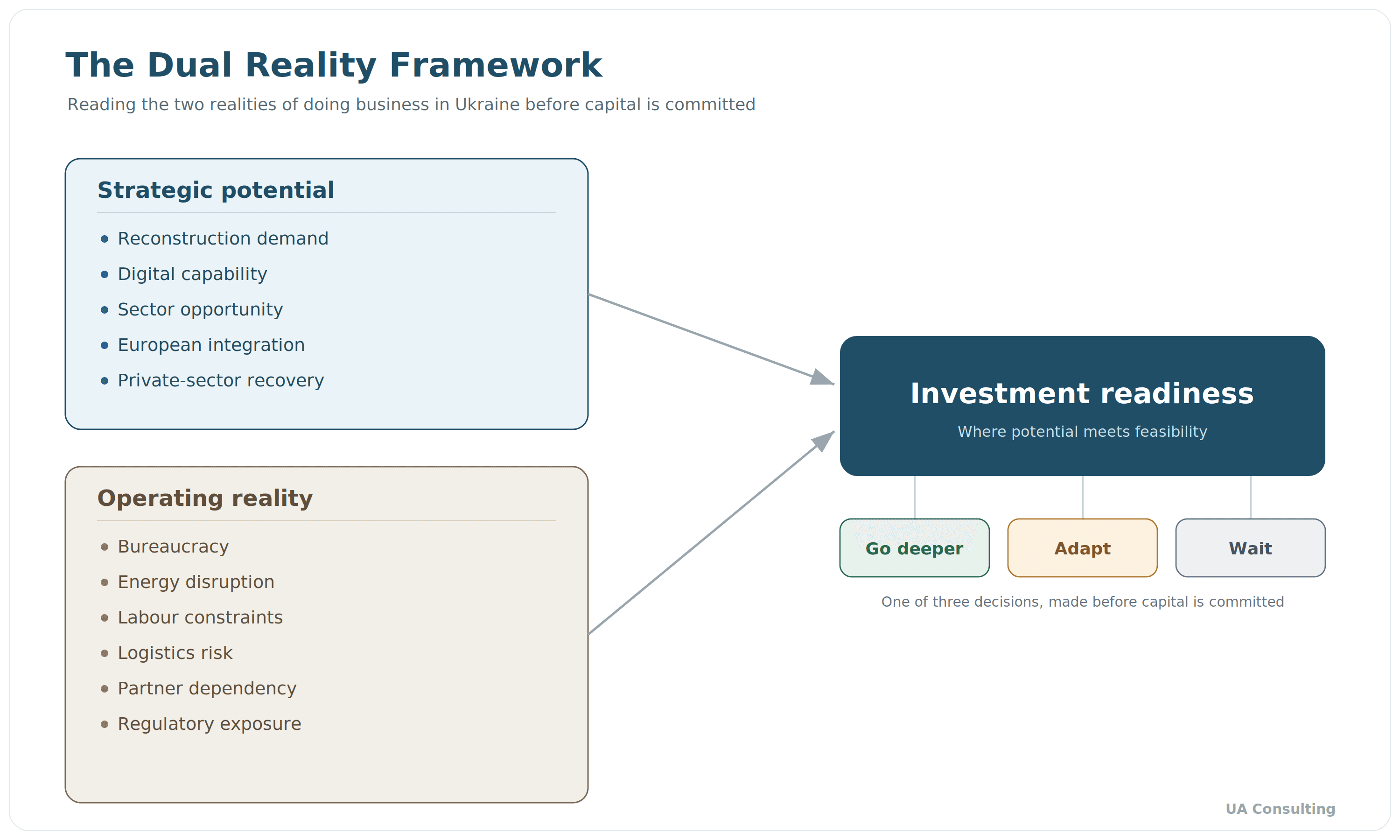
The framework for answering these questions is straightforward to describe but difficult to apply. Two layers have to be assessed at the same time. The first is strategic potential: reconstruction demand, digital capability, sector-specific opportunity, the pull of European integration and a recovery process that will depend heavily on private capital because public funding cannot carry it alone. The scale of that recovery is not the issue; the real question is where that scale translates into investable opportunity for a specific company, asset or project. The 2026 Rapid Damage and Needs Assessment, produced jointly by the World Bank, the European Commission and the United Nations, puts reconstruction and recovery needs at around 588 billion US dollars over a decade. The second layer is operating reality: bureaucracy, institutional unevenness, energy disruption, labour constraints, logistics risk, partner dependency and regulatory exposure.
Investment readiness is the point at which strategic potential and practical feasibility have to be judged together. A disciplined assessment should not force a simple yes-or-no answer, but lead to one of three defensible decisions: proceed where the opportunity and the operating case align, adapt the model where the opportunity is real but the structure, partner arrangement, capital profile or execution path needs to change, or wait where the conditions are not yet sufficiently investable. Each outcome can be the right answer. The value is in reaching it deliberately, so that the investor is left with a decision that can be defended, revisited and acted on rather than a broad in-or-out view of the market.
The decision that separates investors who succeed
Doing business in Ukraine requires more than an appetite for risk and more than a thesis on reconstruction. It requires the discipline to separate strategic potential from executable opportunity, and both from the risks that must be structured before capital is committed. Ukraine’s potential is real, but it is not evenly distributed, not automatically investable and not accessible on the same terms across sectors, regions or operating models.
The market rewards neither blanket caution nor blanket optimism. The investors best placed to succeed are not those waiting for a certainty that a wartime economy cannot offer, and not those treating reconstruction figures as a substitute for asset-level analysis. They are the ones able to judge where opportunity is structurally real, where it is operationally reachable, where the model has to be adapted, and where restraint is the better decision. That judgement, formed before capital, management attention and reputation are committed, is what doing business in Ukraine now demands.
If you are assessing a market entry, investment or operating decision in Ukraine, UA Consulting can help structure the question before capital, time and management attention are committed.