A go-to-market strategy in Ukraine is best approached less as a launch plan than as a test of whether a visible opportunity can actually be reached, priced, controlled and served under current conditions. It should not begin with a channel list, a distributor search or a sales target, but with the harder question of which part of the market is not only attractive but commercially accessible to a specific company with a specific model. For most foreign entrants the binding constraint is not the absence of opportunity. Ukraine's reconstruction and recovery needs are now estimated at about $587.7 billion over a ten-year horizon, and the scale of that demand is real. The more common error is to read the opportunity broadly while designing the route to market narrowly, committing to partners, pricing and hiring before establishing whether the relevant demand can be reached, served and retained. This article sets out how to structure that decision, treating go-to-market as the operating architecture that determines whether a working commercial model exists behind the headline figures, before capital and management attention are committed.
Why a go-to-market strategy in Ukraine starts with executable demand
In a stable economy, a go-to-market plan can reasonably begin with segmentation, channel selection, pricing and hiring. Ukraine rewards a different starting point, because that sequence assumes an access to customers that has to be proven rather than presumed. The decision that matters is not whether to enter early or late, but whether a visible market opportunity can be turned into executable market access.
Visible opportunity is straightforward to establish. The scale of need is well documented, and reconstruction is expected to draw private capital for years, with the World Bank estimating that private finance could cover around 40% of total recovery costs. Executable access is a separate and harder test. It turns on whether a specific company can reach the right customers through channels it controls, at prices that survive local cost structures, through partners that actually perform, with an operation able to supply and service what it sells. The opportunity describes the market as a whole, while access describes whether a particular company can convert any part of that market into revenue, and the two rarely coincide as neatly as a national figure suggests.
Understood this way, a go-to-market strategy in Ukraine is closer to an operating architecture than to a launch document. Its function is to confirm that a working commercial model exists before resources are committed to building it, rather than to schedule the activities of a launch that has not yet been validated.
Why Ukraine is not a standard launch environment
Ukraine is not a standard launch environment, and the difference runs deeper than the level of risk. The war has changed the texture of commercial decisions, not only their probability of disruption. Decision cycles have become shorter and more conditional, and customer priorities have moved towards continuity, resilience and supplier reliability rather than novelty. Payment discipline has tightened as buyers and suppliers manage cash more carefully, and the combination of energy disruption, logistics constraints and security exposure has raised the value of partners who can actually deliver while lowering the value of those who can only promise reach.
The market is also far from uniform, and that unevenness is commercial rather than incidental. Damage, demand and operating conditions remain concentrated by region and by sector, with needs heaviest in frontline oblasts and major metropolitan areas while purchasing power and practical access vary sharply across the country. Growth has returned but remains modest, with the World Bank expecting expansion of around 2% in 2025, down from 2.9% the year before, as the war continued to weigh on investment. A company that treats Ukraine as a single national market, or assumes that the broader conditions for doing business in Ukraine apply evenly, ends up designing for an average customer who does not exist in any particular region or segment.
The practical consequence is that demand has to be read at the level of sector, region, customer and channel rather than at the level of the country, because that is the level at which a route to market either works or fails.
From visible demand to reachable demand
Beneath any opportunity sit three layers of demand that narrow quickly from one to the next. Visible demand is the need that appears to exist, whether that is a population to be served, a reconstruction line item or a sector that is plainly under-supplied. Reachable demand is the smaller share of that need a company can actually access through real channels, given where customers are located, how they buy and who already serves them. Executable demand is narrower still, covering only the part that can be supplied, serviced and retained under local operating conditions.
The gap between these layers is where go-to-market plans in Ukraine most often fail. A reconstruction requirement measured in hundreds of billions describes visible demand, but it says little about whether a foreign supplier can reach the municipalities, contractors and distributors who control purchasing, or whether procurement rules, payment terms and logistics make that demand serviceable at an acceptable cost. A market can be large and visible while remaining, for a particular company with a particular model, largely out of reach.
Reading demand in these layers changes the first decision a company has to make. The operative question stops being how large the market is and becomes which reachable and serviceable segment justifies the cost of building a route to it. Once that segment is defined, the choices that follow on channel, partner and price have something concrete to serve rather than a national aggregate to chase.
Choosing the right route to market: direct, distributor, hybrid or partner-led
Once reachable demand is defined, the route to market in Ukraine becomes a question of control as much as coverage, because the model that reaches the most customers is not always the model that keeps the company in charge of its own commercial future. Four broad approaches are available, and each strikes a different balance between reach and control.
A direct model gives the most control over customers, pricing and service, but it demands the local presence, working capital and execution capacity that entrants most often underestimate. A distributor model offers fast access to existing retail and distribution networks and immediate coverage, at the cost of placing the customer relationship, pricing discipline and market intelligence in someone else's hands. A hybrid model that uses direct sales for strategic accounts and distribution for breadth is frequently the realistic answer, provided the company can manage the channel conflict it creates. A partner-led model relies on a local operator's relationships and is the quickest to establish, though it carries the greatest exposure to partner dependency.
The distributor decision deserves particular care, because the real question is not only who can sell, but who can sell without distorting the strategy. A distributor model works well where speed and coverage matter most and the category is largely transactional, and it erodes control where brand, pricing and customer intelligence are strategic. A strong distributor with the wrong incentives can fix a brand at the wrong price tier, in the wrong segments or at the wrong service standard, often before the entrant notices that its position has narrowed. For that reason, selecting the right distribution partner and designing the route-to-market structure around control rather than convenience is one of the highest-leverage decisions in the entire plan.
Once the route to market has defined how demand will be reached, pricing tests whether that access can remain economically viable.
Pricing as a resilience test
Pricing for the Ukrainian market is best treated not as a positioning decision taken late in the process, but as a resilience test for the whole operating model, since a price that looks competitive on a spreadsheet can still fail once it absorbs the real cost of operating in the country. Several pressures sit inside that price at the same time. Logistics carry war-related cost and risk, and the movement of movable assets and inland cargo now depends in part on dedicated cover such as the EBRD-backed war-risk facility developed to widen insurance for goods and vehicles in transit. Currency exposure and payment terms can erode margin between order and settlement, while channel margins, service and warranty obligations, competitive intensity and discount discipline all draw on the same envelope. A price set without testing it against these pressures tends to look profitable only until the first disruption.
This is why pricing belongs inside go-to-market design rather than in a later commercial review. It is the stage at which reachable demand is tested for profitability, and the conclusion can be uncomfortable. If a price cannot carry logistics, currency risk, channel cost and service obligations and still leave an acceptable margin, the demand may be reachable without being profitable, and a route to market built on it will not hold under stress.
Table: From Market Opportunity to Executable Demand
Question | What it tests | Why it matters in Ukraine |
|---|---|---|
1 · Visible demand: Does a real need exist? | Whether the underlying need is genuine and sizeable. | Documented need is not the same as addressable demand. The scale of reconstruction is real, but scale alone does not create a market a single company can serve. |
2 · Reachable demand: Can we access the customer? | Whether real channels connect the company to the customers who control purchasing. | Demand is fragmented by region, sector and channel. Large visible segments can be effectively closed to a given model. |
3 · Profitable demand: Does the price survive the cost of operating? | Whether pricing holds after logistics, currency exposure, payment terms, channel margins and service obligations. | War-related logistics, currency risk and payment delay compress margins. A competitive headline price can still lose money. |
4 · Controllable demand: Do we keep control of the relationship? | Whether the company keeps control over customers, pricing, brand, service and market intelligence. | Heavy distributor dependence can hand strategic control to a partner whose incentives differ from the entrant's. |
5 · Executable demand: Can the model be supplied, serviced and scaled? | Whether the operation can deliver, support and grow under local constraints. | Energy, security and supply constraints make execution capacity, not market attractiveness, the binding limit. |
Sources: World Bank, Government of Ukraine, European Commission and the United Nations (RDNA5, February 2026), and the European Commission Ukraine Facility. Framework: UA Consulting.
What first-time entrants and returning companies need to decide
First-time entrants and returning companies work from the same framework but arrive with different questions. A first-time entrant is building access from nothing, deciding which segment to serve first, which route to use, which partners to trust and whether the operating model can be established at all. The hardest discipline at this stage is resisting the move from a general sense that Ukraine looks attractive straight into a distributor search, before the reachable segment has been defined.
A returning company faces a subtler trap, because the market it left is not the market it is re-entering. Channels have reorganised, customer priorities have shifted, partner reliability has been re-sorted by years of war and cost structures have moved. Reactivating former distributors and reusing former pricing assumes a continuity that no longer exists, which is why a relaunch in Ukraine is better handled as a re-reading of the market than as a restart of an old plan.
It helps to keep three related decisions distinct rather than collapsing them into one. Market entry strategy in Ukraine is the broader judgement of whether, where and how to commit. Route to market is the structure that connects the company to demand once that judgement is made. Channel strategy in Ukraine is the narrower choice of specific channels within that structure. Treating a channel decision as if it were a market-entry decision is a common and costly error, and it is usually the point at which informal planning has to become structured market-entry and expansion advisory.
The Reachable Market Framework
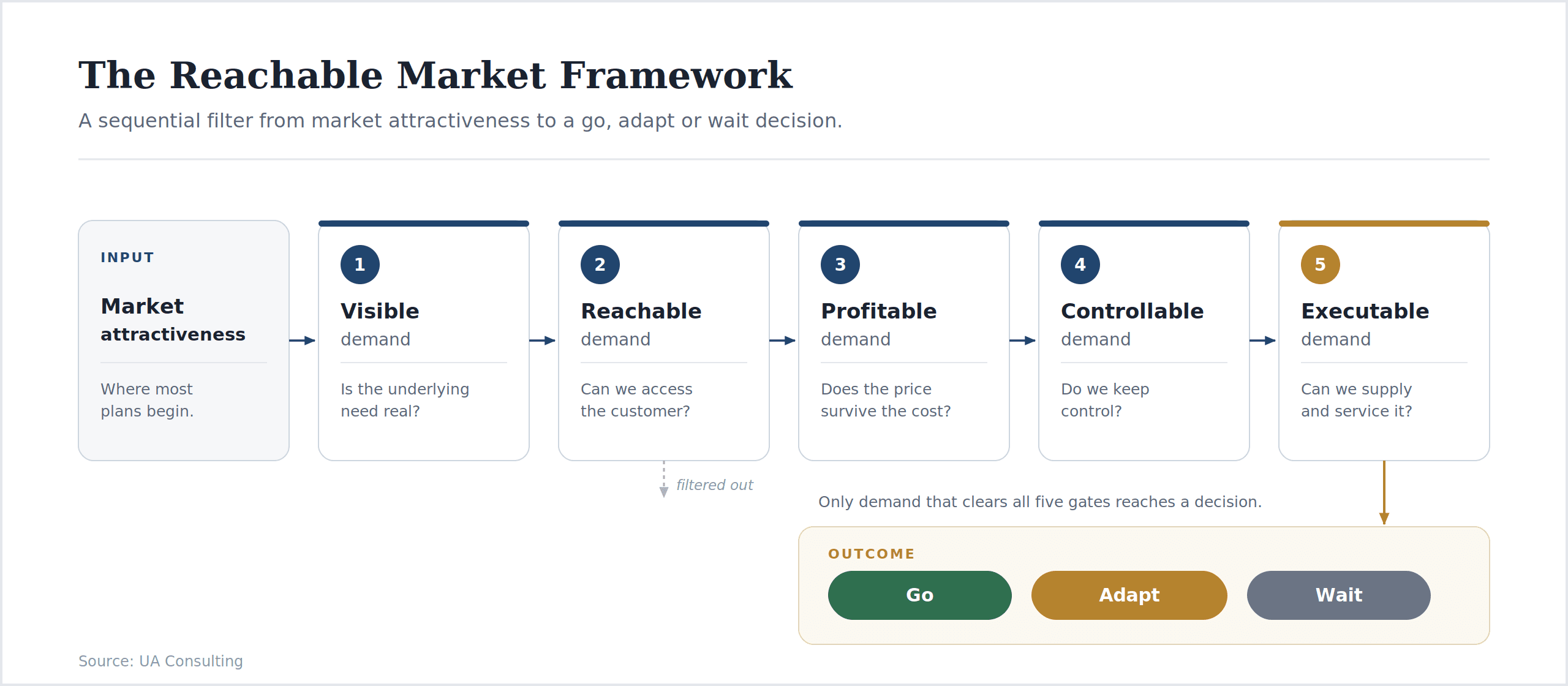
The logic set out above can be drawn as a single sequence. The Reachable Market Framework treats go-to-market not as a funnel that widens towards ever more customers, but as a filter that narrows towards a decision, with each stage acting as a gate through which demand either passes to the next test or is set aside rather than carried forward on optimism.
Instead of moving from a general sense of market attractiveness directly to launch, a company passes the opportunity through five successive tests of visible, reachable, profitable, controllable and executable demand, and arrives at one of three conclusions. A verdict to go means the model holds across all five. A verdict to adapt, which is often the most useful outcome, means the opportunity is real but the route, pricing or partner structure has to change before capital is committed. A verdict to wait means the demand is visible yet not reachable or executable on terms the company can accept. Used with discipline, the framework earns its value as much from the segments it screens out as from the one it confirms.
Diagram — The Reachable Market Framework
From strategy to controlled execution
In Ukraine, a go-to-market strategy functions as an operating architecture rather than as a launch plan or a sales document, since what ultimately decides the outcome is whether a foreign company can convert a visible opportunity into market access that is controlled, profitable and executable. The reconstruction need is real and private capital is beginning to move, yet neither on its own guarantees that any single company can reach, serve and retain the demand that sits behind the headline figures.
The strongest entrants tend not to be those that move first or fastest, but those that establish which part of the market they can actually reach, price, control and execute against before they commit capital, hire locally or sign distributors. That clarity is what separates a plan that survives contact with the market from one that unravels on contact with it.
If you are building or revising a go-to-market strategy in Ukraine, UA Consulting can help test which demand is genuinely reachable, how the route to market should be structured and what has to be resolved before capital, partners and local execution are committed.