In Ukraine, a joint venture is rarely the default route to market, and a joint venture in Ukraine is better treated as a deliberate structural choice than as a precondition for entry. Across most sectors a foreign company can establish, invest and operate directly, so the decision to share ownership has to be earned by the economics of a project rather than assumed from the difficulty of the market. A partnership is the right answer only when a project needs something a supplier, a distributor, a contractor or a hired local team cannot provide, whether delivery capacity on the ground, operating assets, customer access, regulatory and procurement eligibility, or a real sharing of investment risk. The first question is therefore not which partner to choose, but what actually has to be shared. Where nothing has to be shared that cannot be bought as a service, shared ownership adds governance risk without adding control, and only where the answer is concrete does a partnership, and occasionally a full equity joint venture, become the instrument that fits.
Why a joint venture is not the default route into Ukraine
Western practice often treats a joint venture as the natural way into a difficult market, with the local party supplying access and the foreign company supplying capital, technology or brand. In Ukraine that reasoning holds only in particular cases, because a foreign company rarely needs a local shareholder to register a business, hold an asset or build a team. Treating a JV in Ukraine as a mandatory entry ticket is therefore artificial, and can be costly, since international investors read the country through the combined lens of wartime risk, currency controls, sanctions exposure, procurement rules and governance. Handing operational control to a local partner is usually the larger risk rather than the safer one, unless reporting lines, reserved matters and control of cash are built into the structure from the outset. Where the genuine concern is political or wartime risk, instruments such as the political risk insurance framework agreed in June 2026 by the United States DFC and the World Bank's MIGA can address it more directly than shared ownership.
A second consideration is specific to Ukraine, where some companies operate with a speed and commercial discipline that foreign partners tend to underestimate, so that a foreign shareholder can slow decisions once approvals and reporting are layered on. The clearest warning sign is a partner who offers access, connections or a promise to resolve approvals in place of a tangible contribution, because that describes dependence rather than value.
When a Ukrainian partner genuinely adds value
A local partner is worth equity when the contribution is concrete and hard to replicate, and the claim that should always prompt scepticism is that a partner simply knows the market, since market knowledge alone is rarely a reason to share ownership. What changes the calculation is control of an operating platform, regional infrastructure, qualified field teams, live customer contracts, technical permits, procurement eligibility or a local balance sheet, because each of these alters what the project can actually deliver.
The decisive test in practice is replaceability, and where the same contribution can be obtained through a supplier, a distributor agreement, a consultant or a hired country manager, a partnership is not required and shared ownership only dilutes control. Where it cannot be obtained any other way, the case for a structured relationship begins, and the question becomes how much of it must be locked in rather than contracted for. Entering Ukraine through a local partner makes commercial sense when the partner materially improves the economics or the deliverability of the project, and not when the attraction is a local name on the structure.
The partnership logic test
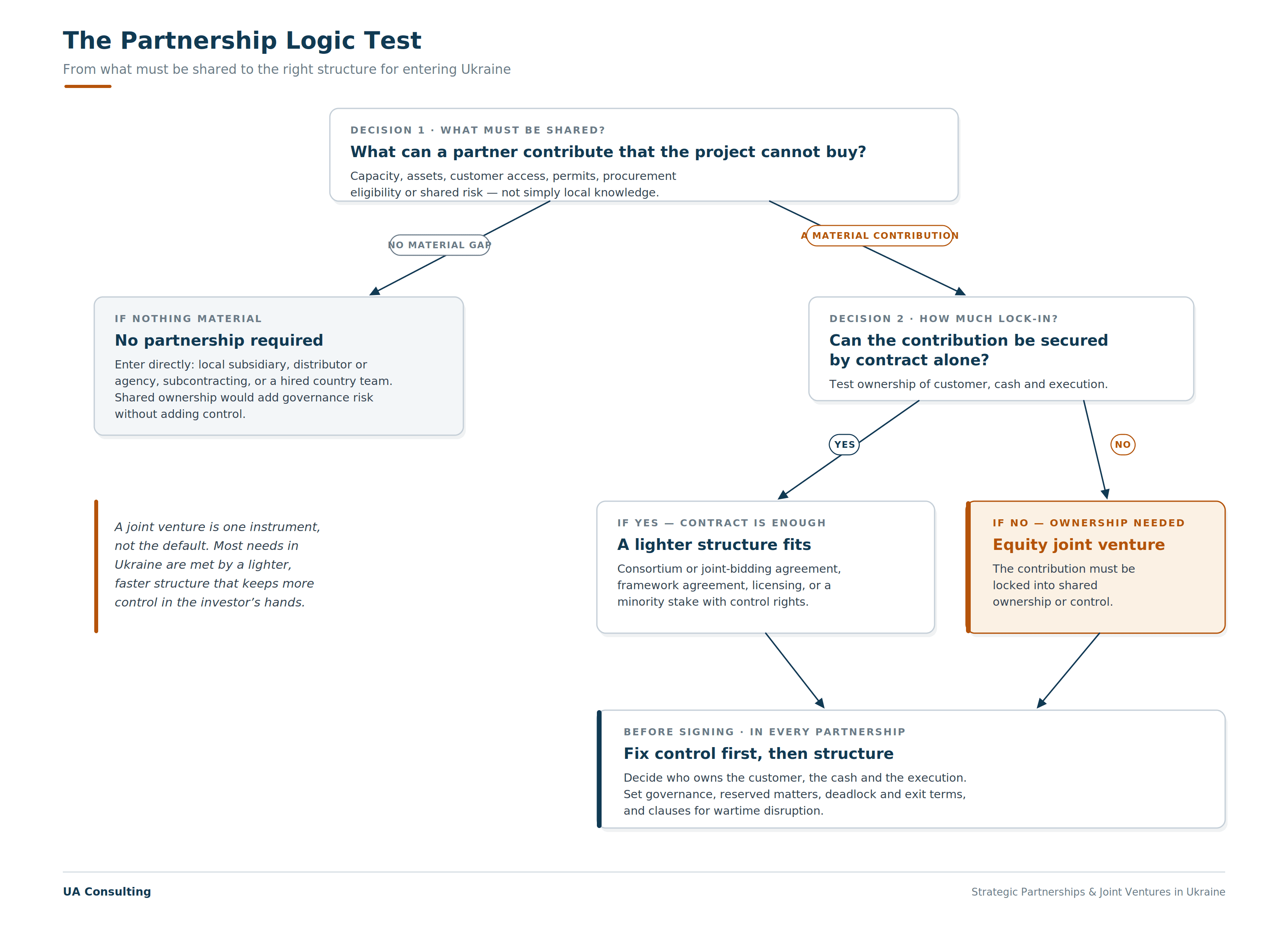
Before any partner is assessed, it is worth testing the logic of the partnership itself, since most failures are decided here rather than in due diligence. Five questions, in order, establish whether a relationship is needed and in what form.
The first is what the partner can contribute that cannot be bought as a service, because if a contractor, a distributor or a direct hire could supply it, an equity joint venture is not warranted and a lighter arrangement achieves the same result with less exposure.
The second is whether the partner's strength is compatible with foreign governance, since strong Ukrainian operators tend to work quickly and informally while foreign investors require controls and reporting, and partnerships often fail not from bad faith but from an incompatible operating tempo, which is better examined before signing than after.
The third is whether the partnership needs equity or only alignment, because shared ownership is frequently more than the situation requires when exclusivity, revenue sharing, a project company or a minority stake with control rights would deliver the same outcome with the downside contained.
The fourth, which matters more in Ukraine than in many markets, is who controls the customer, the cash and the execution, because a structure can look balanced while one party signs with the customer, another delivers and a third receives the money, so it must be clear who absorbs cost overruns and who owns the data, the licences and the customer relationship.
The fifth is what happens once the business begins to operate, since most weak partnerships look sound until they are tested, and strain then appears as divergent margins, different compliance standards, undocumented promises, competition with the partner's own business, and the difficulty of exiting without surrendering the market.
Read in sequence, these questions move from what must be shared to the structure that fits, the logic captured in the decision map below. Approached this way, structuring a joint venture in Ukraine becomes the conclusion of a deliberate test rather than its starting assumption.
Choosing the right structure
An equity joint venture is one instrument within a wider architecture of partnership, not the architecture itself, and the task is to choose the lightest structure that still secures whatever genuinely has to be shared, whether capital, execution, risk, technology or ownership. The comparison below sets the main options against the dimensions that matter to an investor, and the pattern is consistent, since most requirements are met below the level of full shared ownership.
Structure | What is shared | Control profile for the foreign party | Capital commitment | Best suited to | Principal risk |
|---|---|---|---|---|---|
Equity joint venture | Ownership, profit, governance and risk | Shared by agreement, with real influence only where reserved matters are tightly drawn | High | Assets, technology transfer or regulated access that must be jointly owned | Being tied to a partner without day-to-day control |
Project consortium or SPV | A defined project and its delivery | High within the project's scope, lower beyond it | Project-bound | Funded infrastructure tenders and one-off builds | Partner performance on a single mandate |
Distributor or commercial agency | Market access only | High, since ownership is not shared | Low | Selling an established product without local assets | Channel reach and partner incentives |
EPC with a local construction partner | Execution on the ground | High on commercial terms, lower over field execution and permits | Project-bound | Reconstruction and engineering delivery | Build quality, permits and timelines |
Minority stake with control rights | Capital and upside, with negotiated rights | Partial, exercised through reserved matters | Medium | Backing a strong operator without full ownership | Influence without operational control |
Licensing or technical partnership | Technology or know-how | High, with exposure concentrated in the intellectual property | Low | Transferring capability rather than capital | Protecting intellectual property and quality |
Acquisition with the founder retained | Full ownership and a shared transition | Full, subject to retaining the operator | High | Buying capability and keeping the operator who built it | Retention and integration after closing |
UA Consulting analysis
The comparison makes two things plain, that the lighter the structure the more control the foreign party keeps, and that the heavier it is the more deliberately the relationship has to be engineered to survive execution. The equity joint venture at the top of the table is warranted only where ownership genuinely has to be shared, as in defence, where Ukraine's UkrOboronProm and Thales registered a joint venture in 2025 covering air defence, radar, electronic warfare and tactical communications. Where the question shifts from selecting a structure to negotiating and executing the relationship, it moves into the territory between market entry and expansion advisory and M&A transaction support.
Searching for and assessing a partner
Once the logic holds, partner search in Ukraine is best treated as a filtering exercise rather than a database search, because the supply of willing counterparties is far larger than the supply of suitable ones. Finding a JV partner in Ukraine should begin not with a longlist of available companies but with a contribution map, meaning a clear statement of what the project requires, which capabilities cannot be built internally in an acceptable timeframe, and which Ukrainian operators can credibly provide them under the governance standards a foreign investor will impose. Candidates can then be screened by sector relevance, operating capacity, reputation and compliance readiness, and only then validated against the evidence that predicts behaviour.
That validation reaches well beyond legal due diligence, and the areas that tend to move a decision include beneficial ownership and political exposure, litigation and sanctions history, conduct on tax and customs, related-party transactions, the quality of management accounts, debt and contingent liabilities, customer concentration, behaviour in past disputes, any dependence on informal access, and the ability to work to donor, IFI and procurement standards. This is the commercial counterpart to legal review, and the subject of commercial due diligence in Ukraine. Where a transaction is involved and the parties are sizeable, or the structure changes market concentration, competition clearance may also need to be assessed, since it affects both the shape of the deal and its timing, a point examined in antitrust and merger control in Ukraine.
Structuring the deal around control and execution
What the relationship looks like after signing is decided by governance rather than paperwork, and a strategic partnership in Ukraine survives or fails on how precisely that governance is drawn. Board composition, reserved matters, budget and capital-expenditure approval, deadlock resolution, audit and reporting rights, ownership of customers and intellectual property, exit provisions including put and call options, change-of-control terms and clauses for wartime disruption together form the operating system of the venture. Settled before signing, they determine whether the business is governable, whereas left vague for the sake of momentum they become the first thing the parties argue about once the commercial stakes are real.
The underlying discipline is to design the deal for execution and not only for completion. A partnership negotiated around control of the customer, the cash and the delivery chain can absorb the disagreements that inevitably follow, whereas one built on goodwill and informal understanding tends to fracture at the moment it begins to matter.
Reconstruction, donor-funded projects and the new partnership reality
Reconstruction is the context in which partnerships now matter most, though usually not as an equity joint venture. Rebuilding energy, critical infrastructure, logistics and industry produces projects in which a foreign company cannot simply arrive and sell, because delivery depends on local contractors, engineering coordination, permits and the capacity to keep working through disruption. In sectors such as energy and critical infrastructure, the partnership question is practical rather than proprietary, turning on who can deliver, maintain and govern the asset under Ukrainian conditions, and on what terms.
The scale of available finance has sharpened that question, since the European Union's €50 billion Ukraine Facility for the period 2024 to 2027 includes the Ukraine Investment Framework, which the European Commission describes as having a capacity of up to €9.6 billion in guarantees and blended finance, intended to mobilise up to €40 billion in public and private investment. The EBRD reported a record €2.9 billion of financing for Ukraine in 2025 and around €9.1 billion deployed since the start of the full-scale invasion, with the private sector accounting for more than 90 per cent of its projects and 57 per cent of its investment.
None of this turns the equity joint venture into a default, because it raises the demand for collaboration rather than for any single legal form. In practice that can mean a consortium assembled for a funded tender, an EPC contractor paired with a local builder, a technology provider working alongside a Ukrainian operator, or financing from an international financial institution backing a local implementer. Formal joint ventures do appear where strategic control, technology transfer and security genuinely align, as in parts of the defence sector, but that remains a case in which ownership is justified rather than a template for the wider market.
When not to partner
The discipline is clearest at the point of refusal, and an advisor earns trust partly by being willing to recommend against a partnership. A partnership should not proceed where the partner brings no contribution that cannot be bought, where access rests on informal promises rather than substance, where governance cannot realistically be controlled, where the parties' incentives plainly diverge, or where the foreign company can reach the market more effectively on its own. A frequent error, worth naming directly, is the belief that sharing ownership reduces risk, when in reality it does not on its own and can increase risk by creating dependence on a partner without delivering the control that would justify it.
The decision a board should reach
A partnership in Ukraine should be the product of a deliberate decision rather than a reflex, and the decision turns on a single distinction. A local partner in Ukraine is valuable when it brings execution capacity, assets, market position or institutional credibility that materially changes the economics or the deliverability of a project, and a joint venture in Ukraine is justified only when that contribution must be locked into shared ownership or shared control. Where it need not be, a lighter structure is almost always safer, faster and more commercially rational, and keeps more control in the investor's hands.
If you are assessing a Ukrainian partner, a joint venture structure or a partnership-based model for entering the market, UA Consulting can help test whether the commercial logic, the governance and the execution model hold before the relationship is formalised.