
Advisory demand in Ukraine is measurable, and so is the gap in the evidence that buyers rely on. Transaction data for 2025 record 63 deals above USD 5 million, 26% more than in 2024, with USD 1.2 billion of disclosed value and an average deal size of USD 34 million. The audit regulator reports that registered firms sold UAH 4.85 billion of services in the year to 30 June 2025, 43% more than in 2021. Against those figures stands a thinner public record, since only 57% of the 2025 deals disclosed a value and statistical reporting was suspended for most of the war before being restored in July 2025. More than 20 state registers were also closed or restricted after February 2022.
That combination defines the task, because choosing a consultant for Ukraine is less a question of brand than of matching the decision to the discipline that owns it. The next step is to check that the evidence the decision needs can still be obtained and that the people who will obtain it are named in the contract. The sections below set out what companies actually buy here, what the public record supports, how provider models differ in price and hours, and which Ukrainian rules change the cost and mechanics of the engagement.
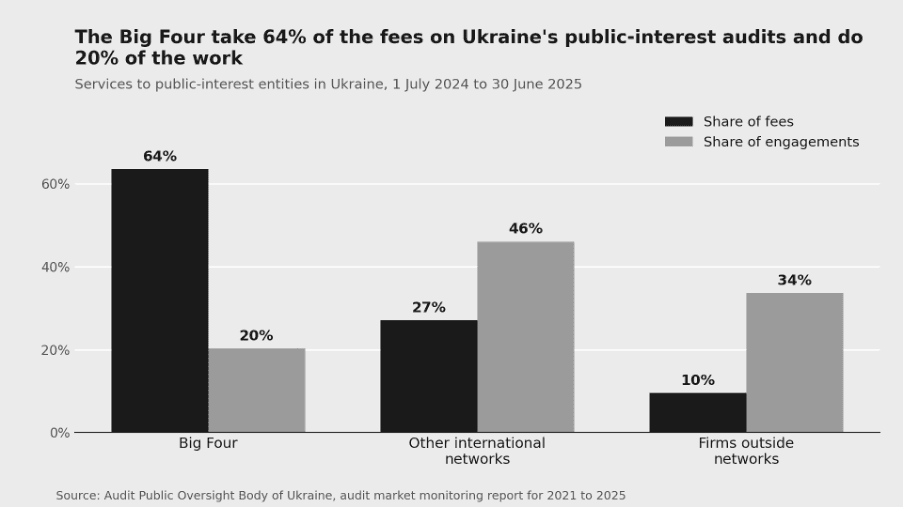
Shares of fees and of engagements for services to public-interest entities, 1 July 2024 to 30 June 2025. Source: Audit Public Oversight Body of Ukraine.
What companies actually buy advisory work for in Ukraine
Three buying channels dominate, and each has its own procurement logic. The first is transaction work, where deal flow is mid-market and increasingly domestic, since 40 of the 63 deals recorded in 2025 were domestic and Ukrainian investors were involved in eight of the ten largest. The first half of 2026 brought 40 deals against 35 a year earlier, with USD 978 million of disclosed value. A foreign buyer entering this market is usually the outsider in a room of local sellers and local advisors, which puts a premium on commercial and legal work that can be verified on the ground.
The second channel is regulated and compliance-driven, and registered audit firms performed 31,036 engagements in the year to June 2025, with non-audit services accounting for 62% of that number and UAH 1.55 billion of the value. Much of what a foreign group needs in Ukraine, from statutory audit to tax and accounting support, is bought through this channel and is governed by professional rules rather than by negotiation alone.
The third channel is donor-funded, and a programme launched by the EBRD and the EU in June 2026 shows its scale. It is expected to mobilise at least EUR 135 million for Ukrainian companies, support at least 15 investment projects and advise up to 34 startups. Where an engagement touches a financing institution, the procurement rules of that institution, rather than the client's own preferences, will often determine how consultants are selected and how their teams are fixed.
Start with the decision, then the discipline
Work filed under "Ukraine consulting" can belong to different professions. A licensing question is a legal matter, a holding structure is largely a tax and legal one, and statutory accounts belong to accountants. Whether Ukraine deserves a place in the group's strategy, or whether a market entry can earn its cost, is a strategic and commercial judgement. Testing an investment project or an acquisition combines financial, commercial, legal and often technical work, while redesigning an operating model or inspecting a plant calls for other skills again. The table maps typical decision requirements to the discipline that should lead and shows where another may need to join.
Decision requirement | Professional centre of gravity | What the provider must establish | Where another discipline is needed |
Regulatory or legal interpretation | Lawyers, tax advisors, compliance specialists | How the rule applies to the company's facts | Business advice when the answer moves the commercial case |
Market or commercial decision | Strategy and commercial advisors | Whether demand, channels and economics support the options | Legal and tax input on entity and contract choices |
Investment or transaction assessment | Investment and transaction advisors | Whether the asset justifies price, structure and risk | Legal, tax, technical and valuation specialists |
Operating model or transformation | Operations and transformation advisors | Where performance is lost and what change is absorbable | Employment, systems and legal specialists |
Technical or engineering question | Engineers and certified technical experts | Condition, capacity and compliance of assets or designs | Business advice to convert findings into economics |
Implementation-heavy mandate | Advisors with delivery capacity in Ukraine | Owners, milestones and sequencing that survive operating conditions | Specialists wherever delivery touches regulated work |
What the public record supports, and what it does not
Ukraine is unusual in that some evidence is cheaper to obtain than in most European markets while other evidence has become harder. Company data remains accessible through the state register and commercial platforms built on it, court decisions and public procurement records are searchable, and financial statements of larger companies are published. Four constraints, however, change what a brief can promise.
Deal comparables are thin, since value was disclosed for 57% of 2025 transactions, down from 64% in 2024, and for only 45% in the first half of 2026. Valuation work that leans on local multiples is therefore working from a partial sample, and the gap has to be closed with primary evidence from the target and its counterparties.
Audited figures carry more qualifications than a foreign board usually expects. Of 1,316 audit reports on public-interest entities in the year to June 2025, 581, or 44%, carried a qualified opinion and only 55% were unmodified. Reading the opinion itself, rather than the fact that an audit exists, is part of scoping a transaction.
Official statistics also have gaps, because reporting to the statistics service was voluntary for much of the war and the obligation to file statistical and financial reports was restored only from 5 July 2025. Series covering 2022 to 2025 should be treated as incomplete rather than comparable with pre-war data.
Open data has narrowed again as well, with more than 20 key registers restricted after February 2022 and most reopened during 2022 and 2023. In 2025 the state closed more datasets than in any previous year, among them property data, defence-sector companies and prosecution statistics. A government resolution adopted in October 2025 also lets companies ask for their own data to be removed from open data platforms. A scope written today should name the source for each material question and budget for interviews and site work where no source exists.
What each provider model is built to do
The regulator's own numbers show how differently provider models operate. In services to public-interest entities, the Big Four earned 63.5% of the fees while performing 20% of the engagements, other international networks earned 27.1% while performing 46%, and firms outside networks earned 9.5% while performing 34%. The average fee per engagement follows the same pattern, at UAH 2.21 million for the Big Four, UAH 417,000 for other networks and UAH 200,000 for non-network firms.
Part of that gap is explained by hours, since a statutory audit of a large public-interest entity took the Big Four an average of 2,152 hours at a calculated cost of UAH 3.2 million. Other networks spent 628 hours at UAH 554,000 and firms outside networks 455 hours at UAH 301,000. The regulator also notes that outside the Big Four the correlation between fee and hours is weak, which it attributes to limited pricing transparency. For a buyer, the practical conclusion is to ask for the hours, the seniority mix and the number of site days behind a fee, because those, rather than the headline number, explain what is being bought.
Capacity is the other variable, and as of 1 July 2025 the register held 765 audit entities, of which 145 could perform statutory audits and 65 could audit public-interest entities. Almost a third of those entities had no auditor employed as their main place of work, and similar concentration applies in advisory work, where a familiar brand may rest on a small local team.
Two tests then apply to every model, and the first concerns who will actually do the work. UK guidance tells evaluators to confirm that the team proposed is the team that will deliver. The World Bank's standard request for proposals goes further and allots 30 to 60 of 100 technical points to named key experts, against no more than 10 for the firm's own experience. That rule governs donor-funded work in Ukraine directly and is worth borrowing for private mandates.
The second test is independence, and Ukraine's audit law restricts eleven categories of other services, including tax advice, valuation, legal assistance and financing or investment strategy work, for public-interest entities that a firm audits. A firm that audits the company or the target may therefore be unavailable for part of the mandate, and one that advises a counterparty may be conflicted.
From brief to scope under Ukrainian access conditions
A brief framed as "research the Ukrainian market" can yield a competent report without telling a board whether to commit. Before hiring a consultant for Ukraine, a company needs a document built around the decision. It should name that decision, its owner and the approvers, whose criteria define what the evidence must prove, and set out the context, assumptions, constraints and scope so that advisors test the company's thinking instead of rebuilding it. It should also state the information and access available, the deadline and what management must be able to do when the work ends. A decision-oriented version might say that the board will choose between a distributor and its own subsidiary before year-end, with channel economics and named partner candidates tested against the company's own sales data.
Scoping a consulting engagement in Ukraine then turns that brief into workstreams, evidence requirements and responsibilities, and it fixes who supplies what. ISO 20700, the international standard for management consultancy services, holds the advisor responsible for its own work but places ultimate accountability for decisions and outcomes with the client. In practice that means internal data, management judgement, sponsor time and timely feedback have to come from the company.
Physical access constraints in Ukraine directly affect how evidence can be gathered and verified. In advice current in September 2026, the UK Foreign Office advises against all travel to most of Ukraine and against all but essential travel to parts of the west, and warns that ignoring this advice can invalidate insurance. The same advice records that Ukrainian airspace is closed, that martial law is in force and that Ukrainian men aged 23 to 60 are prohibited from leaving the country. Management meetings therefore happen inside Ukraine or online rather than at headquarters. Travel is overland and slower, which is why site visits should be planned around what they must establish and why duration follows the evidence plan rather than a standard number of weeks.
Contracting mechanics that change the cost
Two Ukrainian rules affect the commercial structure before any fee is discussed. The first is value added tax, because for consulting, legal, advertising and IT services the place of supply is the customer's location. A Ukrainian company receiving those services from a non-resident advisor charges 20% VAT on the imported service and reports it, while the same work contracted by a foreign parent falls outside that mechanism. The choice of contracting entity therefore changes both the cash cost and the paperwork.
The second is currency control, and cross-border payments from Ukraine still run under the wartime regime introduced by National Bank Resolution No. 18 of 24 February 2022. That regime has been eased in stages, most recently by Resolution No. 90 of 10 August 2026, in force from 11 August 2026. Payment routes and timing for a Ukrainian subsidiary paying a foreign advisor should be confirmed with its bank before signature rather than after the first invoice.
Within those constraints, fixed-scope, phased, time-based and ongoing arrangements suit different levels of certainty, and a phased structure lets a short diagnostic shape the main phase before a larger commitment. UK guidance links time-based pricing to unclear scope and fixed prices to mature requirements, and effort rises with scope, seniority, fieldwork, specialist input, access constraints and implementation support.
Where business advisory stops
Some questions belong to other professions altogether, and in Ukraine statutory audits may be carried out only by auditors and audit firms entered in the official register. Architects, design engineers and technical supervision engineers doing certain construction-related work must hold a qualification certificate obtained through professional certification, for which they answer personally. Legal advice, tax structuring, accounting, regulatory certification and formal technical due diligence sit with those specialists. A business advisor can identify the need, coordinate them and build their conclusions into the decision, but it should not stand in for them.
The decision a foreign company faces is therefore narrower than it looks. Ukrainian data can tell a buyer what work is being bought, what it costs per hour of senior time and which professions must own which question, and public registers still answer a great deal about counterparties. What no dataset can supply is the evidence specific to one asset, one partner or one plant, and that is what a properly scoped mandate exists to produce.
UA Consulting works with foreign companies on Ukraine-related strategic, investment and operating mandates, from defining the decision to execution where execution is part of the brief.
To discuss a specific Ukraine mandate, contact UA Consulting.