
For a company weighing donor-funded projects in Ukraine, the first correction is usually about difficulty rather than access. These projects can look like the most orderly part of the recovery market. The money is visible, the sponsors are credible, the procurement rules are published, and most programmes are tied to clearly stated priorities. That structure is real, but it does not make participation easier. It changes what a company has to prove and how it has to deliver. A donor-funded or IFI-backed project reduces some of the funding and counterparty risk that makes ordinary Ukrainian commercial work uncertain. In its place, it introduces eligibility rules, procurement discipline, environmental and social safeguards, reporting obligations and a documented delivery standard that many otherwise strong companies are not prepared to meet. The opportunity is genuine. Whether a specific company can reach it is a separate question, and it is the one worth answering first.
How donor-funded projects work in Ukraine
The scale behind these programmes explains why the question is now a live one for boards rather than a theoretical one. The latest joint assessment by the Government of Ukraine, the World Bank, the European Commission and the United Nations puts reconstruction and recovery needs at close to USD 588 billion over the coming decade, with housing, transport and energy the most heavily affected. A need of that size is not met through aid alone. It is being met through a development finance architecture that combines grants, concessional loans, guarantees and private capital, and that architecture is what a company actually enters when it pursues a funded project.
That is also why the phrase "donor-funded projects in Ukraine" describes routes rather than a single market. It covers grants and technical assistance, sovereign and concessional loans, municipal and state-owned enterprise finance, guarantees and blended finance, investment facilities, emergency repair programmes, infrastructure procurement and private-sector windows. Each of these is governed differently. A grant-funded advisory assignment, an EBRD-financed infrastructure contract and an EU-guaranteed blended investment share a label but very little in the way they are awarded, controlled and paid. The first question for a company is therefore not who funds the project, but which instrument, which implementing entity and which procurement route govern it.
Donor money, IFI finance and programme governance
Underneath the labels, most funded work in Ukraine follows a recognisable division of roles. Donors and the EU define mandates, envelopes and policy priorities. The EU's Ukraine Facility is the clearest example, offering up to €50 billion in support for 2024 to 2027, with a dedicated Ukraine Investment Framework equipped with €9.6 billion in guarantees and blended grants and designed to mobilise up to €40 billion in public and private investment. International financial institutions then structure the financing and attach the safeguards, procurement standards and reporting requirements that travel with their money. The EBRD, Ukraine's largest institutional investor with close to €10 billion deployed since 2022, works through exactly this model, concentrating on energy security, vital infrastructure, food security, trade and the private sector.
Ukraine is not a passive recipient in this system. Ministries, municipalities, utilities and state-owned enterprises act as implementing entities, and much public procurement runs through the national Prozorro platform, sometimes under IFI rules, sometimes under Ukrainian public procurement law, and often under a combination agreed for the specific project. For a company, this means the counterparty it must satisfy is frequently Ukrainian even when the money is international. Reading a programme accurately depends on understanding who implements it, who pays, and whose rules apply, and misjudging any of the three is where confident assumptions tend to go wrong.
Reading the funding route
The differences between routes are easiest to see side by side. The table below sets out the main routes a company is likely to meet in institutional project work in Ukraine, what tends to govern each, and what a bid has to prove.
Funding route | What usually governs it | Typical implementing or counterparty entity | What the company must prove |
|---|---|---|---|
Grant-funded technical assistance and advisory | Donor rules and terms of reference | Ministry, agency or donor programme unit | Expertise, references, integrity, reporting capacity |
IFI-financed infrastructure procurement | IFI procurement rules, often via Prozorro | State agency, municipality, utility or SOE | Prequalification, bid responsiveness, technical and financial strength |
Blended finance and EU-guaranteed investment | Facility rules and safeguards, such as the Ukraine Investment Framework | Partner financial institution and beneficiary | Bankability, E&S capability, co-financing, eligibility |
Private-sector windows and DFI debt or equity | The institution's investment and safeguard standards | Private company or project vehicle | Commercial viability, governance, safeguards, risk cover |
Ukrainian public procurement with donor or budget support | Ukrainian procurement law, sometimes IFI rules | Public authority or SOE via Prozorro | Registration, compliant bid, delivery capacity |
Sources: European Commission; EBRD; World Bank. Categories are indicative; the governing rules for any specific project are set by its financing agreement.
Where funded opportunities appear
Funded demand in Ukraine is concentrated where damage and urgency are greatest, which is why the logic behind the sectors matters more than the list. Energy sits at the centre, covering grid resilience, substations and transformers, decentralised generation and storage, after repeated strikes on the power system. Around it are municipal infrastructure, water and wastewater, district heating, transport and logistics, housing and public buildings, healthcare and social infrastructure, agribusiness and food security, and finance for small and medium enterprises. Demining and the restoration of critical services run through many of these. So does a steady demand for engineering, supervision, technical assistance and project implementation support, which is where advisory and technical firms most often enter.
What connects these areas is not that they look attractive in the abstract, but that they carry funded, prioritised demand under difficult conditions. The same features that create the opportunity, damaged assets, regional variation, security exposure and stretched municipal capacity, also shape how realistically it can be delivered. An opportunity that reads well on a programme summary can look very different once the region, the counterparty and the delivery conditions are examined.
Eligibility before opportunity
Before any of this becomes a bid, a company has to clear eligibility, and eligibility in funded work is wider than the qualification most firms have in mind. It is not only relevant experience and a clean set of documents. It reaches into legal standing, sanctions and beneficial ownership screening, integrity and anti-corruption checks, demonstrated financial capacity, verifiable technical references, the required licences and certifications, consortium structure, conflict-of-interest rules, environmental and social capability, and the practical ability to deliver in Ukraine under wartime conditions. These are, in effect, the IFI project requirements in Ukraine that decide who is allowed to compete before anyone competes.
The consequence is uncomfortable but useful to face early. A company can be commercially strong, well capitalised and technically capable, and still not be bid-ready for an IFI-funded project in Ukraine. Eligibility is a gate, and it is tested against the funder's standards rather than the company's own sense of its strength. Establishing where the company sits against that gate is one of the cheapest and most valuable checks it can run, because it determines whether the rest of the effort is worth making at all.
Procurement discipline in funded projects
Procurement in funded work is a business capability, not an administrative task, and treating it as paperwork is a common and expensive mistake. Monitoring tenders is necessary but far from sufficient. The field is often shaped earlier, during pipeline formation and prequalification, before a formal notice appears. Once a tender is live, the technical proposal, the financial proposal and the supporting documentation have to tell a single coherent story, and a bid that is not responsive to the stated requirements can be set aside before its price or technical merit is ever weighed. Clarifications and complaints are part of the process rather than signs that something has gone wrong.
Ukraine's institutions treat this seriously, which raises the standard for everyone bidding. The World Bank has run business outreach on public procurement opportunities in Ukraine covering the procurement rules of Ukraine and the IFIs, bidder participation, and upgrades to the Prozorro system. For a company, the message is that procurement for funded projects in Ukraine is a discipline to be built and resourced in advance, not improvised once a promising tender appears.
E&S safeguards as a condition of access
Environmental and social safeguards are where the gap between marketing and reality is widest. In donor-funded and IFI-backed projects, these are not a communications layer or a statement of values. They are conditions of eligibility, bankability, procurement compliance and execution control. The requirements can include environmental and social screening, labour and working conditions, occupational health and safety, stakeholder engagement, community impact, land acquisition or resettlement where relevant, grievance mechanisms, and a monitoring and reporting trail that continues throughout delivery.
Companies that approach these obligations as documentation to be produced after award tend to discover the cost late, when it is hardest to absorb. Handled properly, safeguards capability is part of what makes a bid credible and a project deliverable, and it is best assessed alongside the wider compliance picture rather than added at the end. This is the practical sense in which ESG operates in funded work, closer to project finance than to reputation, and it connects directly with UA Consulting's ESG Advisory.
Local partners, delivery capacity and integrity risk
Few funded projects in Ukraine are delivered without a local partner, and partner selection carries more weight here than in ordinary commercial work. A Ukrainian partner can supply delivery capacity, licences, regional coverage, a local workforce, subcontractor networks and familiarity with public-sector counterparties. The same partner can also introduce integrity, sanctions, beneficial ownership, quality or conflict-of-interest exposure that then attaches to the whole consortium. In funded work, choosing a partner is not only a commercial decision. It is a procurement, compliance and execution decision, and a weak choice can disqualify an otherwise strong bid or surface as undocumented risk during delivery.
Engagement with public institutions sits on a similar line between advantage and exposure. Understanding implementing agencies, reading programme priorities, clarifying procedures and taking part in consultations are legitimate and often necessary. Treating that engagement as a way around procurement, or as informal influence, is a serious risk in an environment built on transparency and audit. The boundary matters enough to be set deliberately, an issue examined in more detail in UA Consulting's work on Government Relations & Institutional Engagement for Investors in Ukraine.
Why funded projects still fail in execution
The most instructive failures happen after the funding is secured and the tender is won. A company misreads who the real client or decision-maker is. The bid team and the delivery team operate as if they were separate organisations. Local subcontractors are engaged too late, safeguards are treated as filing rather than fieldwork, and assumptions about tax, customs, logistics and payment timing prove thin once work begins. Security conditions move the schedule. The reporting and documentation burden, real and continuous in funded contracts, is left out of the budget. Variation orders turn out to be harder than expected, compliance review slows decisions, consortium governance is unclear, and the Ukrainian partner cannot always deliver the capacity promised at bid stage.
The underlying point is easy to underestimate. Funding improves payment visibility and the credibility of the counterparty, but it does not remove Ukrainian delivery risk. It makes much of that risk more documented, more auditable and more consequential when it materialises, which is a different thing from making it disappear.
That risk profile is also why the newer de-risking instruments matter without changing the fundamentals. Guarantees, blended finance and political risk cover are expanding, illustrated by the recent DFC and MIGA agreement to establish a political risk insurance framework for the United States-Ukraine Reconstruction Investment Fund. Instruments of this kind can improve the financeability of a project, but they do not substitute for a company's own eligibility, procurement discipline and delivery capacity.
How companies should prepare
The same logic can be read as a sequence of gates. A donor-funded opportunity becomes a real one for a specific company only once it has passed each of them, and most opportunities that fall away do so at an early gate rather than on price.
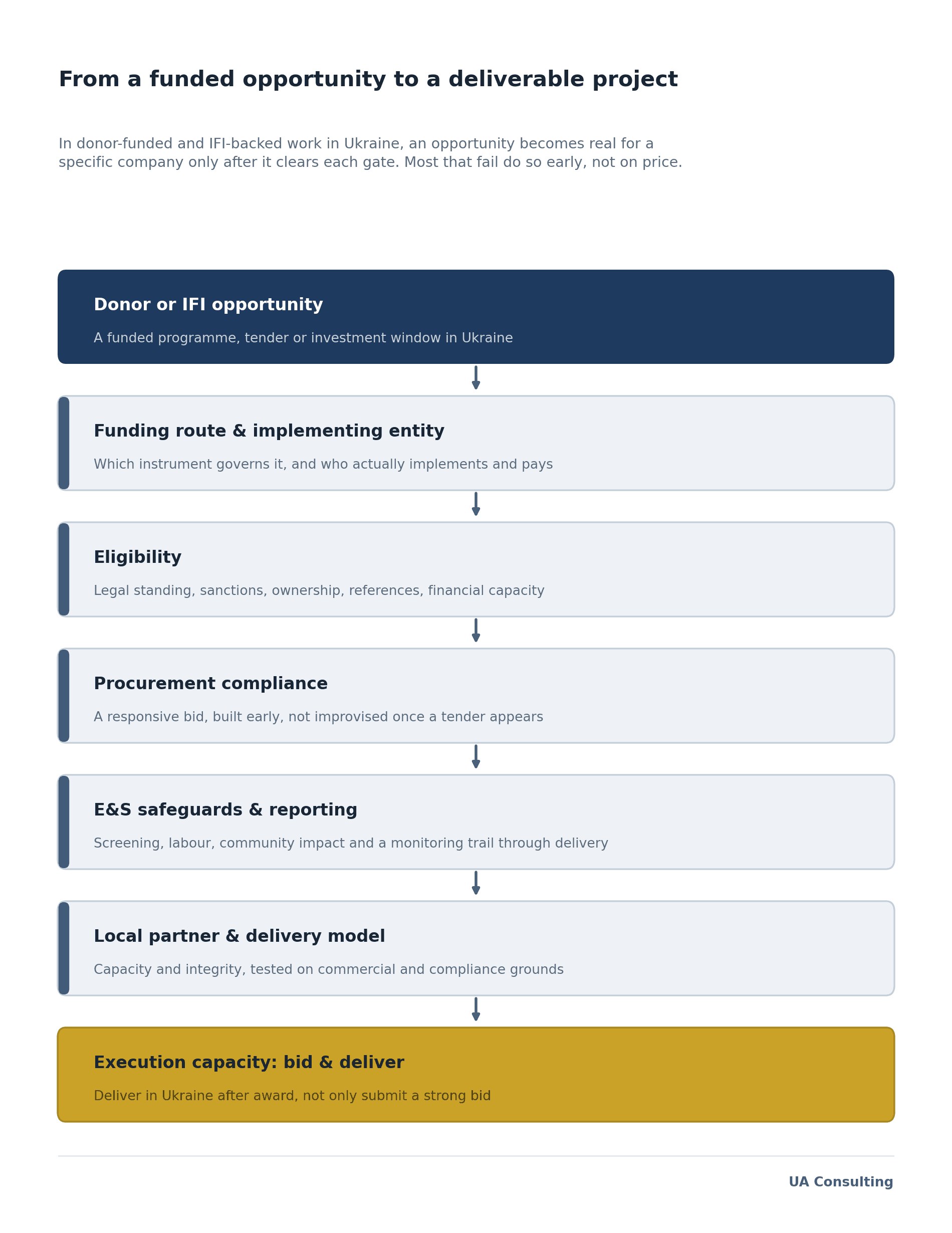
A serious readiness review tests the opportunity against these gates before bid resources, capital or management time are committed. It asks which funding window and implementing entity are actually in play, and which procurement rules apply. It establishes whether the company fits the eligibility profile and which references it can stand behind. It determines whether a Ukrainian partner is needed and whether that partner is suitable on both commercial and compliance grounds. It checks whether the bid can be made responsive, whether genuine E&S capability exists, and whether pricing carries the full cost of reporting, supervision, insurance, security, logistics, customs, working capital and local delivery.
Two questions tend to decide the outcome, and they are the ones companies skip most often. Can internal decision-making move at the speed of the tender timetable, and can the company deliver in Ukraine after award rather than only submit a strong bid. A review of this kind is not a checklist to be ticked. It is a pre-bid judgement about whether the opportunity is real for this company, made while the cost of walking away is still low.
The decision before the bid
Donor-funded and IFI-backed work is one of the more financeable parts of Ukraine's recovery, and for the right company it offers something ordinary commercial work in Ukraine often cannot: a credible counterparty, visible funding and a defined set of rules. None of that lowers the bar. It raises it, and it moves the decisive questions upstream, into eligibility, procurement, safeguards and delivery capacity, well before a contract is in sight. The companies that succeed in this environment are rarely those with the most attractive offer in isolation. They are the ones that can operate inside the rules, standards and delivery realities of funded programmes, and that have tested honestly whether they can before they commit.
For a broader view of where these projects sit in the recovery market, see Ukraine Reconstruction Projects: How to Participate, and for the execution side of funded recovery work, UA Consulting's Recovery & Reconstruction Advisory. If you are assessing donor-funded or IFI-linked opportunities in Ukraine, UA Consulting can help test the case before resources are committed, from programme mapping and eligibility review to partner qualification, procurement readiness, safeguards assessment and execution-model design. To discuss a specific opportunity, get in touch.