
Government relations in Ukraine should not be read as lobbying or public affairs. For an investor it is a practical part of project execution. The work is to identify which public institutions a project actually depends on and to understand how decisions move between central government, municipalities, regulators, state-owned entities, donors and international financial institutions (IFIs). It is then to prepare what each of them needs before the project can secure permits, financing or institutional support. What makes this framing necessary is that Ukraine is open to investment without being institutionally simple. Public channels for private capital are widening, digital tools are improving the transparency of recovery projects, and donor-backed programmes are becoming more structured. None of this removes the harder problem, because central support does not automatically resolve local implementation, and a commercially sound project can still stall when land, permits, utilities, procurement or local capacity are not sequenced correctly. The real advantage in Ukraine is not access to institutions but the ability to give those institutions a project they can approve, finance and stand behind.
Why government relations in Ukraine is now an execution question
The instinct many investors bring to a new market is to find the right contact in the right ministry. In Ukraine that instinct is largely misdirected, because access at the central level is, in many areas, already available. Over the past two years the European Union, donors and Ukraine's own institutions have built increasingly deliberate channels for private capital. The Ukraine Investment Framework is the investment arm of the EU's €50 billion Ukraine Facility. With a capacity of €9.6 billion, comprising €7.8 billion in guarantees and €1.8 billion in blended finance, it is built to mobilise up to €40 billion of investment for recovery, reconstruction and modernisation. Taken together, these mechanisms show that Ukraine and its partners want private capital to be part of the recovery architecture rather than a separate afterthought.
What follows from that openness is the harder part of the problem, because a project still has to move through a system where national priorities, local capacity, permitting and public-investment rules rarely advance together, and where donor requirements and wartime conditions shape the timing further. Openness of this kind creates a starting point rather than an executable pathway, and that pathway usually has to be built rather than found.
Ukraine is open to investment, but administratively uneven
The openness described so far is real, but it is not evenly distributed across the institutions an investor actually has to work with. At the central level, government tends to understand international investors, donor logic and IFI requirements well, while the weight of delivery increasingly sits with local authorities. Decentralisation has made municipalities and hromadas the owners of land, communal infrastructure, local permits and much of a project's legitimacy, and yet the capacity to exercise that ownership is often stretched by war, displacement and staff shortages.
The OECD's 2026 assessment of Ukraine's recovery architecture states the position plainly, noting that a comprehensive recovery architecture is now in place, while fragmentation, coordination gaps and acute human-capacity constraints continue to limit implementation. The same paper records more than thirty ministers and dozens of deputy ministers leaving office since February 2022, alongside high turnover, understaffed bodies and frequent reorganisations that erode institutional memory and complicate coordination with international partners. The constraint an investor runs into is therefore not bureaucracy in the ordinary sense, but institutional capacity that is distributed unevenly between the centre and the regions.
For an investor, this unevenness has a direct and practical consequence, because central political support does not automatically translate into local implementation, and a willing municipality may still lack the capacity to prepare a project to the standard a donor or lender expects. Engagement therefore has to work at both levels on their own terms, rather than assuming that interest at the top will carry a project through the bottom.
Reconstruction is making engagement readiness-based, not relationship-based
If unevenness is one side of the picture, the other is that Ukraine is actively formalising how public investment is selected, prepared and financed, and that shift is changing what engagement requires. The clearest example is the reform of public investment management built around DREAM, the digital ecosystem now at its centre. Amendments to the Budget Code in January 2025 replaced eighteen fragmented procedures with a single process, and in 2026 the Cabinet of Ministers approved a concept positioning DREAM as the backbone of public investment across the whole cycle. For an investor, the practical consequence is that public-investment funding is increasingly reserved for projects that can be registered, assessed, prioritised and monitored through the system rather than advanced through contacts.
The relevance for an individual investor is not that every project will use the same programme, but that the environment as a whole is moving toward structured pipelines, documented readiness and evidence-based prioritisation. Projects are increasingly appraised through a five-case model that weighs their strategic, economic, commercial, financial and managerial merit, which means an investment case now has to demonstrate readiness on several fronts at once rather than rest on commercial logic alone. The financing architecture is developing along the same lines, with the US International Development Finance Corporation and the World Bank's MIGA agreeing in June 2026 a political risk insurance framework for the US-Ukraine Reconstruction Investment Fund to draw private capital into projects that carry war-related and political risk. Instruments of this kind can improve the risk profile of an investment, but they reward projects that are already prepared rather than compensating for those that are not.
The conclusion that follows is that access in Ukraine increasingly follows readiness rather than relationships. Where the question becomes programme eligibility, procurement rules, safeguards or IFI compliance, it moves into the more specific logic of donor-funded and IFI-backed projects, which is a distinct discipline in its own right. Institutional engagement, in the sense used here, begins earlier, with whether the project can be shaped to fit a recognisable public, financial and implementation logic at all.
Why mid-sized projects are often the hardest
The demands of readiness fall unevenly across projects, and the ones usually discussed, the largest and most visible, are not where most investors meet the greatest institutional difficulty. A large strategic project tends to have a relatively clear pathway, because it is visible, politically material and tied to national priorities, and a small local project usually has a single, manageable interface. The projects that are hardest to move are the mid-sized ones in between.
Mid-sized commercial projects, the ones that are viable without being national flagships, can fall between the systems designed for the others. They need land, a grid or utility connection, municipal cooperation, sometimes a line ministry and often a donor or a bank, and yet they rarely arrive with a single public owner or any automatic prioritisation. A project of this kind can be entirely sound on its economics and still be institutionally underprepared, which leaves the investor to construct the pathway rather than expecting to find one. This is the practical core of government relations for most private capital in Ukraine, and it is precisely the part that broad accounts of reconstruction opportunity tend to pass over. How these difficulties present themselves, and where investors are most likely to misread the system, depends on the profile of the project.
Project profile | Institutional pattern | Where investors misread the system | Main execution risk | What engagement should establish |
|---|---|---|---|---|
Large strategic project | High visibility, often tied to national priorities or IFI programmes | Assuming visibility removes the preparation burden | Slow diligence across many public bodies, with safeguards and procurement complexity | Programme fit, an evidence base, an institutional owner and IFI-grade preparation |
Mid-sized commercial project | Economically viable but not automatically prioritised | Assuming a sound business case creates a public pathway | No single public owner, fragmented approvals and limited local capacity | A deliberately built pathway across municipality, sector body, utilities, permits and financing |
Small or local project | Concentrated around a municipality or local authority | Assuming local simplicity means local capacity is sufficient | Underprepared documentation, local bottlenecks and standard permitting delays | A clear local owner, a realistic permit sequence and a basic readiness package |
Structure informed by the OECD Infrastructure Policy Review of Ukraine (2026) and Consolidating Ukraine's Recovery Architecture (OECD, 2026).
Stakeholder mapping is not enough on its own
Stakeholder engagement in Ukraine is too often reduced to a list of the relevant ministries, agencies, regional bodies and municipalities. Such a list is necessary but not sufficient, because the same institution matters at different moments and in different roles. The questions of who decides, who influences, who implements, who finances and who can ultimately delay a project are seldom answered by the same actor. Engaging the right institution at the wrong stage can cost as much as engaging the wrong one.
The OECD's June 2026 infrastructure review makes the same point in policy terms, observing that Ukraine has strengthened the upstream of its system while the binding constraints have moved downstream, toward project preparation, procurement strategy, permitting coordination and lifecycle management. For a specific project this means that permits cannot be treated as isolated tasks, since site selection determines which permits are needed, the source of funding shapes the procurement route, the infrastructure connection shapes the economics, and local capacity sets the timeline. What matters is not how many approvals a project carries, but whether they are sequenced around a credible plan.
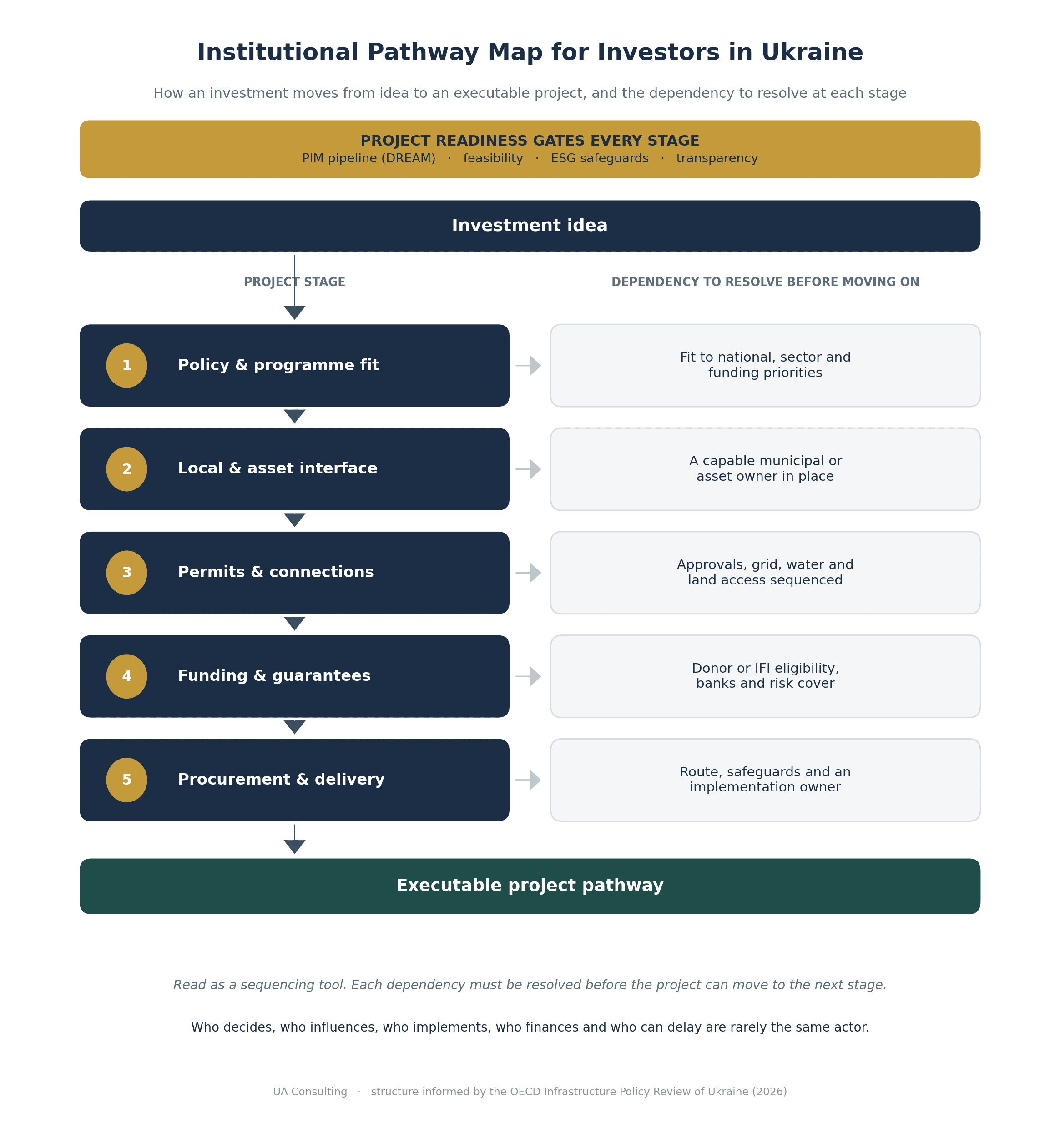
The map below is a sequencing tool rather than an organisation chart. It follows a project from its initial idea through policy and programme fit, the local and asset interface, permits, funding and procurement. At each step it shows which institutional dependency has to be resolved before the next stage can move, and how project readiness gates the sequence as a whole.
What investors should test before engaging institutions
Treated as an execution discipline, institutional engagement in Ukraine begins with a set of questions an investor should be able to answer before the first meeting. The starting point is what the project actually needs from the public side, whether that is land, permits, an infrastructure connection, procurement access, financing, guarantees, policy support or local participation. From there, the investor has to establish which institution owns each decision and, just as importantly, which actor can delay a decision without formally owning it. The next test is whether the project genuinely fits current policy, sector and funding priorities, or whether that fit has only been assumed, and whether the local authority involved can realistically prepare, approve and implement its part. Beyond that lies the question of evidence, from feasibility and economic impact through employment, tax and resilience to the environmental and social safeguards that donor and IFI financing require. Timing has to be understood as well, because central, local, donor and financing schedules interact and a project tends to move at the speed of its slowest dependency. The final question is who will own the asset after approval, through implementation and once it is operating.
This is also where public-sector engagement connects to the rest of the investment process. Questions about how a project fits the recovery system and its programmes sit close to Recovery & Reconstruction Advisory, while the business case, feasibility and financing structure belong with Investment & Project Advisory. Where a project touches energy, utilities, transport or other public-infrastructure interfaces, the institutional pathway has to be read against the wider delivery logic set out in Energy & Critical Infrastructure. Where the binding constraints are political and operational, including wartime and counterpart risk, they sit alongside the analysis of political and operational risk. In each case the common thread is that engagement is preparation undertaken before a project stalls, not a rescue attempted afterwards.
The advantage is readiness, not access
Government relations in Ukraine ultimately rewards a different instinct from the one the term usually implies. The state is, in many areas, genuinely open, and digital and donor mechanisms are making the environment more transparent and more rules-based than investors tend to expect. Openness, however, is not the same as institutional simplicity, and institutional support is not the same as project readiness. The investors who do well treat public institutions as part of the project architecture rather than as an external hurdle. They prepare for the system as it actually works, keep central support and local implementation clearly apart, and build a pathway from interest to execution instead of relying on a contact. The advantage that decides outcomes is not access to institutions, but the disciplined preparation and sequencing of the institutional dependencies that allow an investment project to move from interest to approval, financing and execution.
If you are assessing an investment or reconstruction project in Ukraine that depends on public institutions, UA Consulting can help structure the institutional pathway, test project readiness and identify the dependencies that should be resolved before capital, time and management attention are committed.