
For a foreign company, the decision to take part in Ukraine reconstruction projects is best made before any tender is opened, because the first question is not where the contracts are but whether the company's capability matches Ukraine's rebuilding priorities, which funding route fits its profile, what local structure it will need and which of the war's risks it can realistically absorb. Reconstruction on this scale is not a pipeline of contracts waiting to be picked up. It is a national rebuilding effort that will determine how Ukraine's energy system, transport, housing, industry, logistics and public services work for the next generation, and access to it depends far more on qualification, delivery credibility and long-term usefulness than on interest in the market.
That attention is warranted by the numbers. In February 2026 the World Bank and its partners estimated Ukraine's recovery and reconstruction needs at US$587.7 billion over ten years, close to three times the country's 2025 GDP. A figure of that size confirms that the market exists, but it says nothing about which projects will reach financial close, which companies will qualify to deliver them, or what execution requires in practice, and those are the questions that decide whether participation is worthwhile.
Why the scale of Ukraine's reconstruction is easy to misread
The temptation on seeing a figure approaching six hundred billion dollars is to read it as a budget waiting to be spent, when in reality it is an estimate of need compiled from four years of destruction. The same assessment recorded around US$195.1 billion of direct physical damage by the end of 2025, concentrated in housing, transport and energy and heavily weighted toward the frontline regions that have absorbed the bulk of documented losses. Money to close that gap will arrive over many years, through different channels, in tranches and against reform conditions, so the practical pipeline in any given year is a fraction of the headline and is shaped by who is paying and what they require.
This is the point at which many companies misjudge the opportunity. The binding constraint on rebuilding Ukraine is no longer the level of international attention, which is already considerable, but the capacity to select, prepare, finance and deliver projects that hold together under wartime conditions. Ukraine's task is therefore not only to attract capital, contractors and suppliers, but to filter participation so that spending produces lasting value rather than margin extracted from urgency. Scale explains why so many companies are looking at the country, and selection explains why comparatively few will win and hold work.
Rebuilding systems, not replacing what was lost
Part of the difficulty here is conceptual. Reconstruction is easily imagined as restoration, putting back what the war destroyed, but a good deal of Ukraine's pre-war infrastructure was already ageing and over-centralised, and rebuilding it on a like-for-like basis would reproduce the same vulnerabilities at considerable expense. The World Bank assessment is explicit that recovery should follow a build back better approach, restoring assets and essential services while raising them to a higher standard. The more useful question for a company is therefore not how to replace what was lost, but which projects move Ukraine toward the system it will need once the fighting ends.
In practice that points toward decentralised and more resilient energy, modernised networks for power, heat, water and transport, an industrial base rebuilt closer to EU standards as accession advances, and physical and digital protection against repeated attack. Ukraine's energy sector shows the shift most plainly, because repeated strikes on centralised generation have turned distributed and small-scale capacity into a question of resilience rather than preference, a direction already visible in the decentralised generation and storage that international lenders have financed through the war. For companies, this changes what a strong proposition looks like, since solutions that improve resilience, efficiency and productivity attract firmer institutional backing than efficient replacements of obsolete systems, and it is increasingly technology, rather than construction capacity alone, that sets the credible bidders apart.
What counts as a Ukraine reconstruction project
One reason the market resists a single description is that it is not one market. Reconstruction projects in Ukraine run from emergency repairs to long-horizon investment, and they differ less by sector than by the logic of participation, meaning who pays, who decides and in what capacity a company can take part. A firm that is well matched to one of these segments may be entirely unsuited to another, which is why reading the market through them, rather than as a single construction opportunity, is the first discipline of any serious approach.
Reconstruction segment | Typical funding logic | Primary participation roles | What qualification hinges on |
|---|---|---|---|
Emergency and early recovery | State budget, donor grants, municipal funds | Contractor, supplier, engineering firm | Speed, local mobilisation, safety compliance |
Core infrastructure such as energy, transport, water and grids | IFI loans, EU instruments, sovereign guarantees | EPC or EPCM provider, equipment supplier, operator, investor | Technical references, financial capacity, procurement eligibility |
Municipal and community reconstruction | Municipal budgets, EU and IFI programmes, donor funds | Contractor, developer, local partner, design consultant | Local delivery model, community engagement, cost discipline |
Industrial and productive capacity | Private capital, blended finance, IFI equity and loans | Investor, developer, joint-venture partner, manufacturer | Business case, offtake, localisation, ESG safeguards |
Technology and systems | Donor programmes, private capital, public procurement | Technology provider, systems integrator, supplier | Proven solution, interoperability, data and cyber standards |
Private investment-linked recovery | Equity, concessions, PPPs, guarantees, insurance | Investor, concessionaire, operator, strategic partner | Bankability, risk allocation, long-term commitment |
Analysis by UA Consulting, drawing on the World Bank's RDNA5 (2026), the EU's Ukraine Facility, the EBRD and the DFC and MIGA political risk insurance framework of 2026.
The segmentation matters commercially because each row carries a different funder, a different qualification bar and a different local model, and it determines where a company competes on price, where it competes on technology and where it competes on the ability to structure and finance a project at all. For the construction-intensive segments in particular, the availability of contractors, materials and skilled labour is a constraint worth assessing in its own right, a question examined in UA Consulting's analysis of the construction market in Ukraine and the underlying construction and building materials sector.
Who funds reconstruction, and why the funder shapes the requirements
Because no single institution will finance the rebuilding of Ukraine, the funding map is layered, and each layer sets its own conditions of entry. Public money moves through the Ukrainian state budget and the government's State Project Portfolio, alongside the budgets of the individual municipalities and communities that commission much of the local rebuilding. Above this sits the European Union, whose €50 billion Ukraine Facility for 2024 to 2027 combines direct budget support with a dedicated Ukraine Investment Framework of €9.6 billion in guarantees and grants intended to mobilise up to €40 billion of public and private investment. The international financial institutions, among them the World Bank, EBRD, IFC, EIB and MIGA, finance the larger infrastructure and private-sector projects, while bilateral donors, development agencies and a widening pool of private investors complete the picture, increasingly supported by blended finance, guarantees and political risk insurance.
That private-sector layer is now substantial rather than aspirational. In 2025 the EBRD deployed a record €2.9 billion in Ukraine, with more than nine in ten of its projects and well over half of its investment directed to the private sector, a large part of it into energy resilience and into businesses continuing to operate through the war. Risk cover has moved in step with the capital. In June 2026 the US International Development Finance Corporation and MIGA agreed a political risk insurance framework for the United States-Ukraine Reconstruction Investment Fund, structured specifically to absorb war and political risk so that private capital can enter projects it would otherwise avoid. The reason this detail matters to a prospective participant is that the funder shapes the requirements, since eligibility rules, procurement procedures, environmental and social safeguards and reporting obligations differ sharply between a municipal contract, an institution-financed infrastructure project and a privately structured concession. Establishing who is paying is therefore not administrative housekeeping but the step that defines what qualification will mean, and for companies pursuing donor or institution-funded work in particular, the procurement and compliance mechanics are involved enough to warrant separate treatment in UA Consulting's analysis of donor-funded and IFI projects in Ukraine.
How companies take part, and what qualification tests
Participation takes several forms, and the right one is a strategic choice rather than a default. Depending on its capability, balance sheet, appetite for risk and existing presence in the country, a company may enter as an investor or developer, as a contractor or EPC provider, as a supplier of equipment or materials, as a technology provider, as an operator or concessionaire, or as the local partner in a joint venture, and manufacturers increasingly participate by localising production inside Ukraine rather than exporting into it. Finding these projects is easier here than in most post-conflict settings, since the government's DREAM platform now publishes a single open pipeline in which communities post reconstruction projects for partners and funders to assess. Visibility, though, is not the same as strategy, and browsing that pipeline is not where a serious company should begin.
Qualification is where the chosen role is tested, and it is easy to mistake for paperwork when it functions as Ukraine's principal filter. A programme of this size will draw serious long-term contributors and opportunistic entrants in roughly equal measure, and the practical task facing funders and Ukrainian counterparts is to tell them apart. In that assessment they look for a combination of demonstrated technical capability and relevant references, financial resilience and transparent ownership, the ability to deliver under wartime conditions and to comply with EU, donor and environmental and social standards, and a credible local footprint expressed through Ukrainian partnerships, realistic pricing and the capacity to maintain assets after handover. A company that cannot evidence these will struggle however attractive the pipeline appears, and qualifying for reconstruction projects in Ukraine routinely takes longer than newcomers expect.
What execution in Ukraine actually requires
Funding is decided centrally, but projects are delivered locally, on a specific site, in a specific community, with particular contractors, permits, risks and constraints, and this is where well-financed projects still fail and where foreign capability, on its own, is rarely enough. Several realities tend to be underestimated by companies approaching Ukraine for the first time. It is not a blank market waiting for foreign contractors, because local firms already hold the knowledge, relationships, speed and improvisational capacity that four years of war have forced them to build, and the most effective delivery models pair international standards with that local operating intelligence rather than displacing it.
The constraints that most often derail delivery are practical rather than financial, and they tend to compound one another. Donor or institutional funding removes financial risk but does nothing to remove execution risk. Security exposure reshapes logistics, insurance and staffing, permitting and approvals often run longer than a foreign sponsor assumes, and working capital and payment timing can be difficult to manage across public counterparties whose capacity varies enormously, from well-run municipalities to overstretched state-owned enterprises. Labour has become the most binding of these constraints, to the point that the EBRD's senior leadership observed in early 2026 that workforce and the quality of personnel had become a more pressing problem for many companies than access to electricity. Above all, the choice of local partner tends to determine the outcome, which is why partner selection deserves at least as much diligence as the commercial case itself. Taken together, these conditions argue for a particular order of decisions, in which a company settles its approach before it begins chasing individual tenders.
Figure 1. The participation thesis for approaching Ukraine reconstruction projects before searching for tenders.
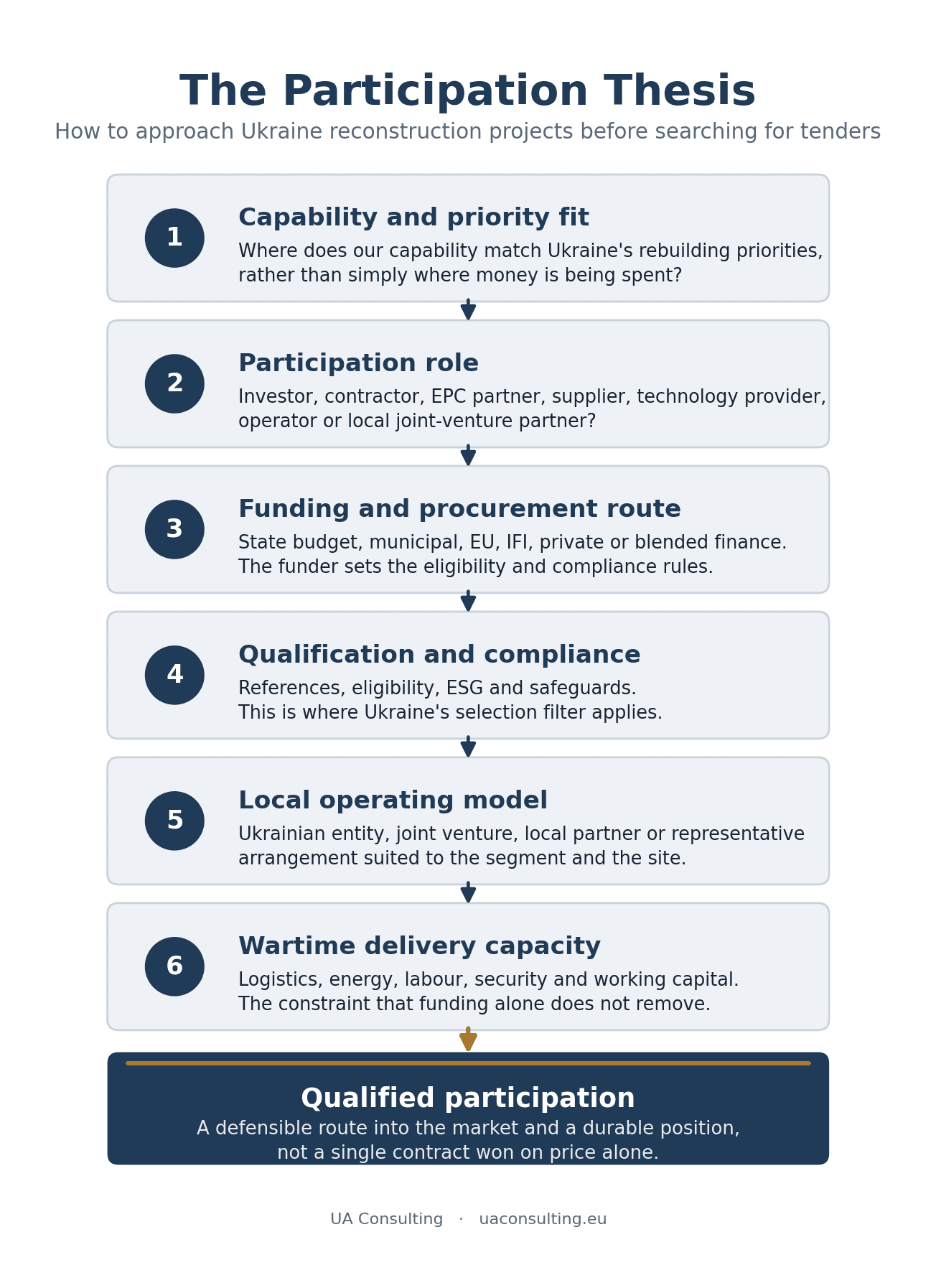
Approached in this order, qualification and local delivery stop being obstacles discovered late in a bid and become parameters set at the outset. That shift, from pursuing contracts to designing participation, is usually what separates the companies that build a durable position in Ukraine from those that win a single project and then withdraw.
From a single project to a market position
For a company with a longer horizon, a reconstruction project can be considerably more than a contract. It can serve as an entry point into the market, a reason to establish a local presence, build Ukrainian partnerships, localise supply, adapt technology and accumulate the references that open the next opportunity, so that project work gradually becomes a sector position and, as Ukraine converges with the EU, a platform for regional relevance. Read as a one-off, reconstruction is a margin opportunity pursued under time pressure. Read as market entry, it becomes a considered decision about where and how a company intends to operate in a rebuilding European economy over the coming decade.
That is the judgement this article is meant to sharpen. The scale of Ukraine's reconstruction is genuine, but scale is not a strategy, and the share of it that any single company can realistically reach is narrower and more demanding than the headline figure suggests. The firms that benefit will be those that decide their role, funding route, local model and risk position deliberately, and early, before capital and senior attention are committed to a particular bid.
Where a company is weighing participation in Ukraine's recovery and reconstruction, UA Consulting's work in Recovery & Reconstruction Advisory and Investment & Project Advisory is built to structure that decision, from mapping where a company's capability fits the pipeline and selecting a participation route to qualifying partners, testing feasibility and building the execution model. If that is the decision in front of you, we are glad to discuss it before commitments are made, in keeping with a wider approach that puts the structuring of a question ahead of the deployment of resources.