In Ukraine, ESG is easily misread as a reputational theme, a question of sustainability language and corporate reporting. For a company seeking capital, funded reconstruction work or a durable place in EU-aligned markets, it behaves instead as a condition of access. Most reconstruction and development finance does not arrive as neutral money. It comes with expectations around procurement, transparency, environmental and social safeguards, governance and monitoring, and those expectations tend to decide whether a project qualifies before they decide how it looks. This is why ESG consulting in Ukraine has less to do with adding sustainability language to a finished plan than with making sure environmental, social and governance requirements are built into project design, procurement, risk allocation, reporting and delivery.
The practical consequence is a problem of sequencing more than of intent. A project can be commercially sound and operationally deliverable and still stall at financing, procurement or investor due diligence, simply because ESG was treated as documentation to be assembled once the commercial case was already built. Requirements that surface at that late stage tend to appear as delay, financing risk or grounds for refusal, whereas the same requirements built in while the project is still being shaped become part of what makes it fundable.
Why ESG carries different weight in Ukraine now
The scale of what Ukraine needs to rebuild is what has moved ESG from the margins of an investment decision towards its centre. The most recent joint assessment by the World Bank, the Government of Ukraine, the European Commission and the United Nations puts reconstruction and recovery needs at almost $588 billion over the next decade, close to three times the country's 2025 GDP. A figure of that magnitude cannot be met from public budgets, so the recovery model depends on drawing in private and institutional capital at scale, and capital of that kind rarely arrives without conditions.
The financing architecture already reflects this. The EU's Ukraine Facility provides up to €50 billion of support for the 2024 to 2027 period, and its investment arm, the Ukraine Investment Framework, is designed to mobilise up to €40 billion of public and private investment through guarantees and blended finance, with a minimum share reserved for green investment. Money structured in this way is governed by rules rather than offered as ordinary commercial capital, and the environmental, social and procurement standards attached to it can themselves influence approval timelines and disbursement. For a company on the receiving end, ESG is therefore not a narrative laid over the commercial case but part of whether the project qualifies for the capital in the first place.
ESG as a readiness test, not a reporting exercise
It is more useful to treat ESG in Ukraine as a readiness test than as a reporting requirement. What it measures is whether a company or a project can meet the standards expected by investors, IFIs, donors, public procurement frameworks and EU-aligned regulation while still being executable under Ukrainian conditions. Many companies continue to approach it as a document, a section in a tender file or a slide in an investment memorandum, when in a financed project the substance sits in the project itself. Safeguards have to be reflected in how land and sites are used, how labour and safety are managed, how surrounding communities are affected, how procurement and contractors are controlled, and how the work is monitored and reported. That thinking has to be in place before the project is priced rather than assembled afterwards.
For an investor deciding whether a project can move from interest to commitment, ESG readiness sits alongside the commercial, financial and execution analysis rather than following it, which is why it belongs within investment and project advisory from the outset. Procurement is usually where this becomes tangible. A tender may call not only for price and technical capacity but for evidence of environmental management, labour standards, contractor controls, conflict-of-interest procedures and reporting discipline, and a bidder that cannot produce that evidence can be entirely capable commercially and still ineligible. The reverse error is just as costly. Green or social claims that are not supported by documentation, controls and monitoring tend to raise rather than lower due-diligence risk, because in a funded project unsupported ESG language reads as exposure rather than reassurance.
Requirements also vary with the source of capital. An IFI loan, an EU-guaranteed facility, a bilateral donor grant, a private equity investment and a supply contract into an EU-linked value chain do not impose the same obligations, even though each carries its own version of environmental and social safeguards in Ukraine. The table below sets out, in broad terms, what different funders tend to look for, and the practical task for a sponsor is to identify which of these apply before the project is designed rather than after.
Source of capital | Typical ESG expectation | What it tests |
|---|---|---|
IFIs (for example EBRD, IFC) | Environmental and social due diligence, risk categorisation, Environmental and Social Requirements, contractor and supply-chain controls, grievance mechanism | Whether the project is designed and monitored to recognised international standards |
EU Ukraine Facility and Ukraine Investment Framework | Procurement discipline, transparency, green-recovery alignment, anti-corruption controls, monitoring | Whether the project fits EU-aligned reconstruction priorities and controls |
Bilateral donors | Programme eligibility, social and environmental safeguards, reporting and audit trail | Whether the project meets the donor's mandate and accountability rules |
Private and strategic investors | Governance and ownership transparency, environmental liabilities, ESG data for their own reporting and due diligence | Whether the asset carries hidden risk or reporting exposure |
EU-linked customers and lenders | Supply-chain data, sustainability information, due-diligence responses | Whether the company can remain in a European value chain |
Indicative only. Based on the EBRD Environmental and Social Policy (2024) and European Commission Ukraine Facility and Ukraine Investment Framework documentation; specific requirements vary by institution and project.
Environmental and social safeguards in a wartime economy
Environmental requirements in Ukraine cannot be reduced to carbon accounting. The country's environmental exposure has been shaped by the war, so a credible assessment has to deal with damaged and contaminated sites, the legacy of destroyed industrial facilities, the volume of demolition and construction waste, and pressure on water and energy systems, alongside the more familiar questions of emissions, energy efficiency and climate resilience. In practice this translates into environmental impact assessment, contamination and remediation work, and mitigation and monitoring plans that a lender or a donor can actually follow. In sectors such as energy and critical infrastructure the point is unavoidable, because rebuilding generation and networks brings environmental, safety and resilience questions together within a single project.
The social dimension is at least as demanding, and it is the part companies most often underestimate. It extends from worker safety and labour standards to the position of displaced people, the effect of a project on the communities around it, accessibility, the conduct of contractors and the presence of a working grievance mechanism. The EBRD's Environmental and Social Policy, updated in 2024 and effective from the start of 2025, sets minimum requirements for managing these risks across the full life of a financed project, and it places responsibility on the borrower for labour, human-rights and environmental risks within its suppliers and contractors where those risks are material. In reconstruction, where delivery usually runs through several layers of contractors and subcontractors, this is where projects are most exposed, since a sponsor can be ready while the chain that will actually build the project is not.
Governance: where ESG meets capital protection
Governance is the part of ESG most directly connected to whether capital is committed and then protected. When investors, banks and donors look at a project, they read its ownership structure, its procurement and conflict-of-interest controls, its exposure to sanctions and compliance risk, and the strength of its board oversight, delegated authority and audit trail as evidence of how it will actually be run. The OECD's 2025 economic survey of Ukraine continues to identify corruption, rule-of-law concerns and weak institutional predictability as material constraints on investment, alongside the security environment. That context does not make the country uninvestable, but it does mean that a specific project has to demonstrate, at its own level, that funds will be used as intended and that decisions can be traced. Governance is ultimately where an ESG position is either substantiated or found wanting, and for most investors it is the dimension that decides confidence.
What EU simplification changes, and what it does not
European sustainability rules are sometimes read as a signal that ESG is about to apply in full to every Ukrainian company, and sometimes as a signal that it is quietly going away. Neither reading holds. In February 2026 the EU adopted the Omnibus I directive, which narrows the scope of the Corporate Sustainability Reporting Directive and the Corporate Sustainability Due Diligence Directive and reduces the reporting burden, with the explicit aim of limiting the way obligations pass down to smaller companies. In general terms, direct reporting duties now fall mainly on larger companies, broadly those above 1,000 employees and €450 million in turnover, with higher thresholds again for due diligence, though the detail depends on scope and national implementation.
The direction is simplification rather than withdrawal. Even where formal reporting no longer applies, sustainability data, supply-chain transparency and governance controls remain part of the environment a company operates in if it wants to work with European capital and markets, and Ukraine's accession path makes that more operational rather than less. For most Ukrainian companies the practical position is therefore largely unchanged. A supplier inside a European value chain, or a project seeking EU-aligned finance, will still be expected to show environmental and social discipline whether or not a directive names it directly, because the requirement now travels through investors, lenders, customers, grants and procurement rather than through legislation alone.
What credible ESG consulting in Ukraine looks like
The most expensive mistake in this area is also the most common one, which is to treat ESG as a late-stage compliance step added once the commercial case is complete. By the time land, procurement, contractor selection, community impact, environmental risk and reporting have all been decided, retrofitting safeguards onto those decisions tends to create delay or hand a reviewer a reason to decline. The discipline has to be present while the project is being designed, not bolted on afterwards, which brings the argument back to sequencing.
It also has to be matched to delivery, and the two are best looked at together. A project's position depends on how far its environmental, social and governance documentation and safeguards are actually in place, and on how realistically it can be executed under Ukrainian conditions. A strong narrative attached to weak execution tends to stall later, at the monitoring stage, while a genuinely capable operator with no safeguards documentation struggles at due diligence or procurement. A large number of able Ukrainian companies sit in that second position, able to build but not yet able to qualify, and for them the distance to close is usually a matter of safeguards, documentation and governance rather than delivery.
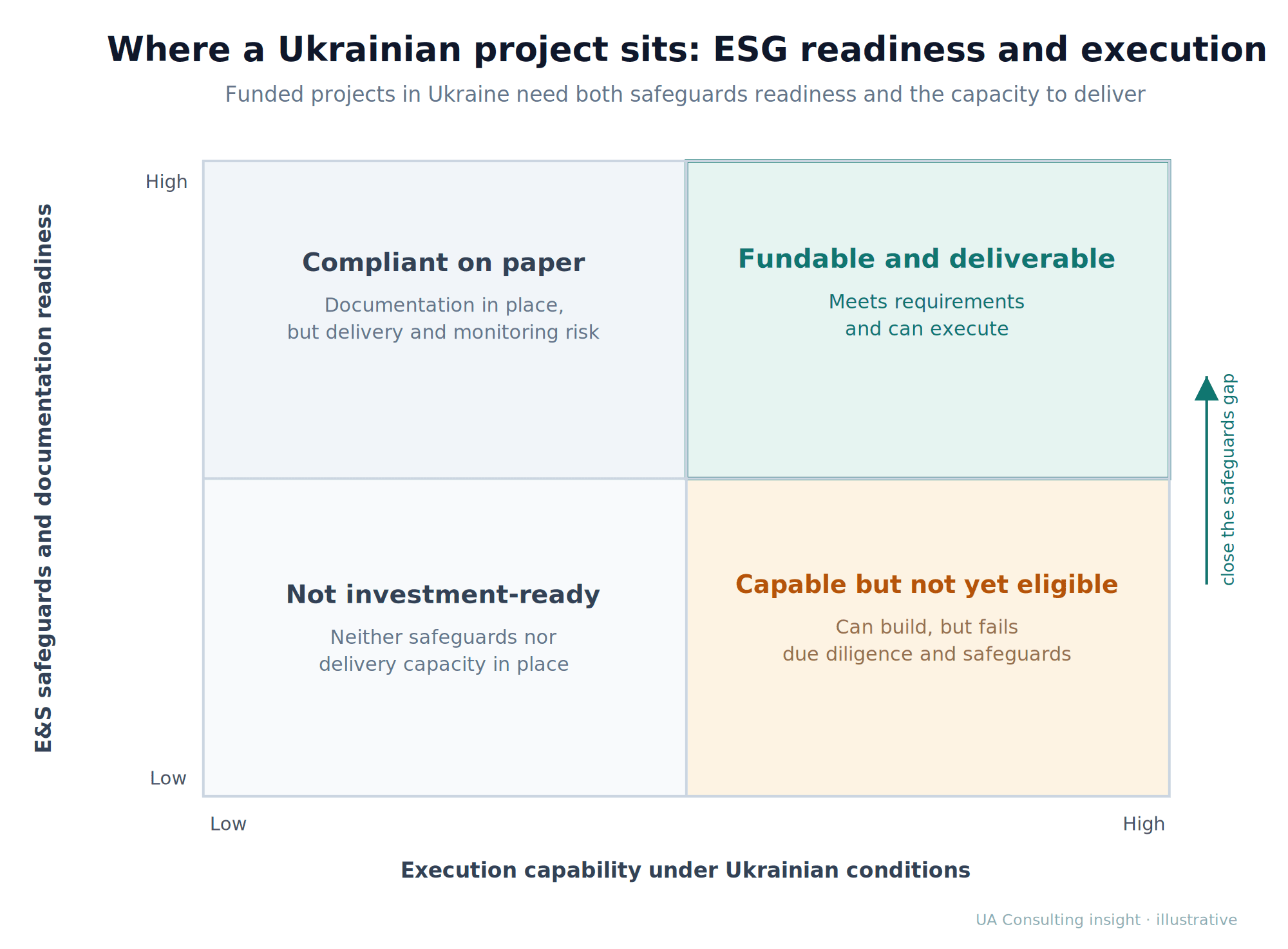
A project becomes fundable only where safeguards readiness and execution capability are both present. For otherwise capable Ukrainian operators, the more common gap lies on the safeguards side rather than in the ability to deliver.
Credible ESG consulting in Ukraine is largely the work of closing that distance. It begins by establishing which requirements actually apply given the source of capital, the procurement route and the type of project, and then turns IFI and donor safeguards into defined workstreams rather than statements of intent. From there it means finding the gaps in documentation, governance and reporting before a lender or a tender panel does, aligning procurement and contractor controls with the conditions attached to financing, and setting a reporting rhythm that a project can realistically sustain. Running underneath all of it is the same connection back to risk allocation, financing, approvals and execution. This is the point at which the work overlaps with recovery and reconstruction advisory and with the requirements of donor-funded and IFI projects, and where the distinction between climate-aligned capital and genuinely bankable projects becomes the subject of sustainable and green investment in Ukraine.
The decision behind the requirement
ESG in Ukraine has become part of the operating infrastructure of reconstruction and investment rather than a commentary running alongside it. For an investor, a board or a contractor, the useful question is no longer whether the language of sustainability is present, but whether environmental, social and governance requirements have been built into the way a project is assessed, financed, procured and delivered. That resolves into a fairly concrete set of questions for the sponsor. It matters which source of capital or procurement route is in play and what it actually requires, whether safeguards have been designed into the project ahead of financing and procurement rather than after, and whether the contractor and supply-chain controls will hold up in delivery. It matters, too, whether governance genuinely protects the capital and allows decisions to be traced, and whether the reporting and monitoring built into the project are realistic under Ukrainian conditions. The underlying test is whether a project that looks attractive in principle is also one that can be funded, procured, executed and monitored in practice.
If ESG requirements are material to an investment, a tender or a funded project in Ukraine, UA Consulting can help map the standards that apply, close the readiness gaps and connect safeguards, governance and reporting to a realistic route through financing, procurement and delivery. Discuss a specific project or transaction.