A senior perspective on managing a business crisis in Ukraine: how to separate ordinary operational volatility from a genuine crisis, stabilise operations under disruption, and protect liquidity, delivery and value.
For companies operating in Ukraine, crisis management consulting in Ukraine should not begin when the crisis is already visible. It should begin at the earlier, quieter point at which management starts to lose control over cash, supply, delivery, decision authority or asset protection. The first warning sign is rarely a dramatic event; it is the moment a management team can no longer tell whether the next disruption is absorbable or value-threatening. Companies that treat every shock as an isolated emergency tend to miss that signal, spending scarce attention on firefighting while the real problem, a steady erosion of control, goes unmanaged. The discipline that matters in Ukrainian conditions is therefore narrower and harder than it first appears. It is not reacting to disruption, which is constant, but recognising the precise point at which routine volatility becomes a threat to liquidity, execution and the value of the business, and acting on it before the options close.
Why crisis management in Ukraine is different
Two different kinds of pressure act on a business in Ukraine at the same time. One is the set of conventional corporate crises that can arise anywhere, from the loss of a key supplier or a liquidity squeeze to a halted production line or a contract that can no longer be met. The other is a continuous layer of wartime operating pressure that rarely lifts entirely. It would be a mistake to reduce the whole subject to the war, because what makes the environment genuinely demanding is that several of these strains move together and feed one another. Energy supply, logistics and currency conditions interact with working-capital strain, mobilisation and labour shortages, shifting demand and the physical security of sites, and the balance between them differs markedly from one region to another. A company in the west of the country and one operating close to the front line are managing the same categories of risk on very different terms.
The more useful approach is to distinguish three states rather than two. Persistent disruption is simply the operating environment, the repeated pressure on power, logistics, currency, working capital, staffing and security that a well-run company can absorb without losing control. Acute crisis is the narrower moment at which one of those pressures breaks a specific line of control, whether cash, supply, delivery, decision authority or the protection of assets. Structural misfit, the state most often missed, is different again, and describes a company that is not passing through a crisis so much as living permanently in emergency mode because its model no longer suits the conditions. Keeping these three apart is what allows a management team to stay composed through constant disruption and still recognise, without delay, the point at which a situation has changed in kind rather than in degree.
That picture is consistent with how the wider economy has behaved. The OECD's 2025 Economic Survey of Ukraine describes an economy that has proved resilient, held up by firms and workers adapting to new conditions and by substantial external support, while cautioning that the outlook remains exceptionally uncertain and that continued attacks on energy supply, logistics and businesses are slowing activity. What follows for management is fairly precise. The capability that matters in Ukraine is not surviving a single shock but keeping a company steady across an environment in which several pressures are always live, and that work begins with an honest assessment of exposure. It belongs, in the first instance, to political and operational risk analysis rather than to crisis response alone.
Not every disruption is a crisis
Defining a crisis narrowly is what separates mature crisis management from a state of constant alarm, and in Ukraine that discipline usually decides how well a company performs under pressure. Because disruption is so frequent, the more experienced operators resist the urge to label every setback a crisis and instead watch a small number of control lines. A genuine crisis begins when management loses its grip on one of them, namely liquidity, the continuity of supply or production, the ability to meet customer commitments, the alignment and authority of the management team, or the company's legal, regulatory and asset-protection position.
Each of these lines absorbs a great deal of volatility before it becomes critical. Receivables slip, routes change, lead times stretch and priorities are argued over, and none of that, on its own, is a crisis. The line is crossed only when the buffer behind it runs out. Cash cover no longer reaches the next set of obligations, a critical input stops with no available substitute, contracted volumes can no longer be met, decisions stall because authority has become unclear, or exposure starts to threaten the company's assets or its licence to operate. Each of these is a change of state rather than a worse version of a familiar problem, and it is the point at which crisis management, not routine management, has to take over.
One of these lines deserves particular emphasis, because it is the one most often underestimated. A striking number of business crises in Ukraine are not, at root, about power, logistics or even cash, but about decision rights. Where ownership and management pull in different directions, where authority is ambiguous and where no single decision rhythm exists, a problem that was entirely manageable can turn acute through delay alone. In that sense crisis readiness in Ukraine is as much a governance question as an operational one, and it often belongs with owner, board and investor advisory as much as with day-to-day management. The table below sets out, for each of these lines, where ordinary volatility ends, what signals that a crisis has begun, and where the first priority lies.
Dimension | Manageable operating volatility | Signal it has become a crisis | First management priority |
|---|---|---|---|
Liquidity control | Normal swings in receivables, payables and currency timing, absorbed by buffers | Cash cover no longer reaches upcoming obligations, with no reliable forward view | Build a rolling short-term cash view and protect critical payments |
Supply and production | Occasional delays absorbed by inventory or alternative routes | A critical input, supplier or site stops with no ready substitute | Map single points of failure and secure or replace critical supply |
Customer delivery | Lead times stretch, but commitments still hold | Contracted volumes or deadlines can no longer be met | Re-sequence commitments and renegotiate before default |
Decision authority | Normal debate over priorities within a working decision process | Decisions stall, authority is unclear, and owners or managers diverge | Restore a single decision rhythm and clear escalation rules |
Legal, regulatory and asset protection | Routine compliance and contract management | Regulatory, contractual or security exposure threatens assets or the licence to operate | Protect assets and licence, and take advice before positions harden |
Framework: UA Consulting.
The first task is stabilisation, not strategy
When a genuine crisis does arrive, the instinct to reach at once for a new strategy is usually a mistake, because a strategy built on an uncontrolled situation rarely survives contact with it. The first task is narrower and more practical, which is to regain control of the facts. In most cases that begins with cash. A rolling short-term cash forecast, tight control over which payments are actually made, and a clear-eyed view of near-term obligations restore the ability to decide on the basis of what the business genuinely has rather than on last month's accounts. Alongside it comes a faster decision rhythm, weekly or, where the situation demands, daily, supported by explicit rules on who can commit the company to what. The operating side needs the same treatment, starting with a short map of the suppliers and customers the business cannot afford to lose, a triage of activities into those that must keep running and those that can safely pause, and a small set of credible scenarios rather than a single plan. Running through all of it is candid communication with lenders, investors, owners and staff, because in a crisis silence is quickly read as loss of control and becomes a risk in its own right.
In practice, the better-run companies in Ukraine have already absorbed much of this under sustained pressure. A 2026 study by Deloitte and the American Chamber of Commerce in Ukraine found that most companies now run business continuity plans systematically, while a meaningful minority still manage disruption reactively, and that during prolonged power outages only about one in ten fully avoided any negative effect on profitability. Stabilising operations under disruption does not, on its own, resolve the underlying problem. What it does is buy the time and the reliable information on which any credible strategy depends, which is the ground covered by operational stabilisation and execution support.
Energy, logistics and currency as operating variables
Crises in Ukraine are often handled badly because energy, logistics and currency are treated as separate line items rather than as variables that run through the whole business. A power outage is rarely just a facilities problem. It moves straight into production scheduling, customer commitments, cost structure, inventory and working capital, which is one reason energy security and resilience has become an operating discipline in its own right rather than a matter for the facilities team. Logistics behaves in the same way. A blocked route or a lost carrier does not stay contained in transport but lengthens lead times, changes pricing, deepens dependence on particular corridors and undermines the reliability of contracts. Each of these looks like a single-function issue and turns out to be a system-wide one.
Currency is the most easily misread of the three, because the question is rarely the exchange rate alone. What actually matters is the interaction of foreign-exchange controls, import payments, debt service, dividend repatriation and access to external financing, and that interaction keeps shifting. From 14 January 2026 the National Bank of Ukraine extended its gradual, calibrated easing of the temporary wartime currency regime introduced in 2022, adding a new mechanism for certain cross-border transactions while leaving the broader controls in place. It is a regulated environment being loosened in deliberate steps rather than a free one, and treating it as either fully open or wholly closed leads to predictable mistakes in payment and financing planning. Managed as isolated risks, energy, logistics and currency keep surprising the business. Treated as linked operating variables, they become planning inputs that can be built directly into budgeting, procurement and working-capital decisions.
When crisis management becomes part of ordinary management
The practical consequence of all this is that a serious company in Ukraine cannot keep a crisis playbook in a drawer, separate from how it runs day to day. The mechanisms that carry a business through disruption are largely the same ones that govern it in normal times. Budgets are built on disruption assumptions rather than best-case ones. Energy back-up, alternative routes, inventory policy and a degree of supplier redundancy are treated as standing features of the operating model, not emergency measures. Working-capital discipline, contingency capital expenditure, insurance cover and legal review sit inside ordinary governance, while clear rules of delegation and a settled communication protocol make it possible to act quickly when something breaks. Understood in this way, crisis management is less a separate function than a more demanding form of ordinary management, suited to an environment in which disruption is frequent, information is incomplete and the cost of a late decision is high.
Handled well, this capability is not only defensive. Under Ukrainian conditions the same discipline can create room to act. A company that understands its own cash position, routes, suppliers, energy dependency and decision rights more precisely than its competitors is able to keep serving customers while others pause, to negotiate from a position of relative strength, and to use a period of disruption to reset an operating model that was already under strain. The American Chamber of Commerce in Ukraine and Citi, in their 2026 survey Doing Business in Ukraine During the War, reported that more than nine in ten member companies were operating at full capacity and that a clear majority planned to hold or increase their investment for the year, a pattern that points to adaptation rather than mere survival.
There is, finally, a harder signal that deserves attention. When a company finds itself permanently in emergency mode, the problem is usually no longer a run of separate crises but a structural one. The business model, cost base, footprint or financing structure has stopped fitting the conditions in which the company now has to operate, and the relevant question changes with it. It is no longer how to respond to the next shock but whether the operating model itself needs rebuilding, which moves the work out of crisis response and into business transformation and restructuring. Where a company cannot stabilise on its own and the real issue becomes the protection of assets, a change of ownership or a transaction, it can move further again, towards distressed M&A and asset integration.
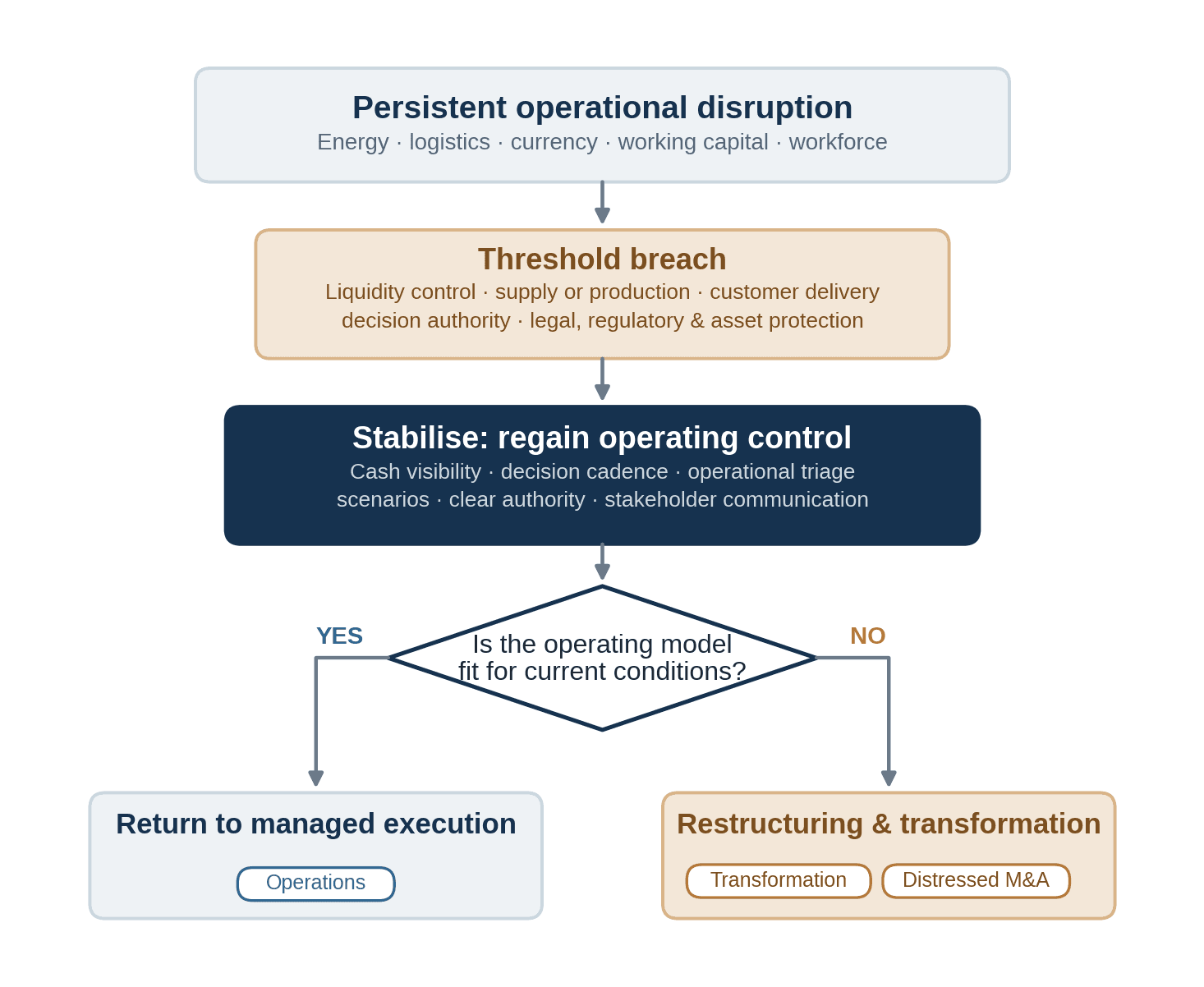
From disruption to a managed outcome. The same crisis can resolve into a return to controlled execution or into a deeper rebuild of the operating model, and it is at that fork, rather than at the moment of the shock, that value is usually protected or lost.
What crisis management consulting in Ukraine actually changes
The contribution outside support makes in a crisis is easy to overstate and just as easy to misdescribe. In the main it is not that an adviser arrives with knowledge the company lacks. Under pressure, the binding constraints are rarely knowledge at all. A management team in the middle of a crisis is short of independent information, short of time, and pulled between too many priorities to hold a clear order among them. Useful crisis support works on exactly those constraints. It establishes an independent view of the facts, separates symptoms from underlying causes, and imposes a decision cadence that a stretched team finds hard to keep on its own. It insists on a short list of genuinely non-negotiable priorities, tests them against a small number of scenarios rather than a single forecast, and protects value in the negotiations with lenders, suppliers and counterparties where outcomes are often quietly settled. It also prepares the move from stabilisation to whatever follows, whether a return to controlled execution or a deeper restructuring. The value lies not in expertise in the abstract but in judgement and discipline applied at speed, next to a management team that still has to run the business while the crisis is being worked through.
The judgement that decides the outcome
The companies that endure in Ukraine are not the ones that avoid disruption, because none of them can. They are the ones able to tell, early and without drama, when ordinary volatility is turning into a threat to liquidity, execution and value, and disciplined enough to act on that reading before their options narrow. Seen in this light, crisis response for companies in Ukraine is not a separate function reserved for emergencies but part of how a serious business is run where the cost of a late decision is high and the next disruption is only a matter of time. The firms that have understood this have largely stopped asking whether they can withstand the next shock. They ask instead whether their operating model still fits the conditions in which they now have to perform, which is a considerably more useful question to be able to answer.
If your operations in Ukraine are under acute pressure, or the same disruptions keep returning, UA Consulting can help stabilise the situation and frame the decision before more liquidity, time and management attention are committed. Start a confidential conversation.