Retail growth in Ukraine is often read either as a recovery of consumer spending or as a migration from physical stores to online, and neither reading captures what is actually happening on the ground. The Ukrainian B2C market is already more developed than many outside observers assume. Consumers are digitally active, delivery infrastructure is dense and fast, marketplace habits are well established, and local retailers have learned to keep trading through sustained disruption. The more useful question for an owner or investor is no longer whether consumer demand exists, but whether that demand can be served profitably as a business expands across formats, regions and channels. For most retailers and consumer brands the binding constraint lies less in consumer readiness than in the economics of serving that consumer, and in the capital a business must commit before the model begins to pay back. On that reading, a B2C strategy in Ukraine is better built from unit economics and format discipline than from store count or the addition of another sales channel.
Retail growth in Ukraine is no longer a recovery story
At first glance the headline data appear to support the recovery reading. Retail trade turnover grew by about 6% in nominal terms over the first nine months of 2025, reaching roughly UAH 1.9 trillion, following an 11.5% rise across 2024 to around UAH 2.17 trillion, according to the State Statistics Service. Domestic trade, and retail in particular, was also one of the sectors supporting real GDP growth of about 2.2% in 2025, on preliminary estimates from the Ministry of Economy. Those figures have to be read with two qualifications, however. They exclude temporarily occupied territories and areas of active hostilities, and because the numbers are nominal and inflation has stayed high, they overstate the real growth in volumes actually sold.
Read with those caveats, the data describe an active market rather than an automatically profitable one. Turnover can rise even as margins come under pressure from inflation, rent, the rising cost of energy resilience, shrinkage and labour scarcity, which means headline growth tells an owner very little about whether a business is capturing that growth without eroding margin or cash. That distinction sits at the centre of retail strategy in Ukraine, which is a commercial question well before it is a macroeconomic one.
A B2C market more advanced than it looks
Ukraine did not build its consumer market in the familiar sequence of physical stores first, then modern retail, then e-commerce and finally omnichannel. Those layers arrived together, and under pressure, which is why the clearest evidence of the market's maturity now sits in its logistics. Nova Post handled about 480 million shipments in 2024, up roughly 16% year-on-year, and now moves more than 1.5 million parcels a day on a network that keeps running through blackouts and strikes on backup power, as reported by Reuters.
This density does more than move parcels. It has reshaped consumer behaviour, so that next-day delivery, parcel lockers and click-and-collect now function as defaults rather than premium features. For retailers, that infrastructure does not so much remove friction as raise the standard they are expected to meet, because fast and low-cost delivery lifts expectations around availability, returns and service, and pushes fulfilment cost and last-mile performance to the centre of the operating model. Advanced logistics therefore create growth potential and a higher operating bar at the same time, a pattern visible across the wider consumer retail and distribution sector.
Consumer demand is real, but uneven
There is no single Ukrainian consumer, because demand is fragmented by geography, income, security and mobility. Purchasing power has recovered for many middle-income households whose incomes now match pre-war levels, while internally displaced families remain under greater pressure and have shifted structurally towards cheaper products, as the USDA Foreign Agricultural Service notes. Price sensitivity has risen across the board, which helps explain why discount and convenience formats have expanded fastest. According to the Ukrainian Retailers Association, ATB reached 1,319 stores by the end of 2025, while Fozzy Group's Thrash! discount chain opened 48 outlets during the year to reach 192, with much of that new store growth concentrated in the relatively safer western and central regions.
For the purposes of a growth plan, that unevenness matters more than the national headline. Consumer demand in Ukraine has to be read by segment and region rather than as a single average, because a shopper in a large western city, a household in a frontline-adjacent town, a returning or displaced family and a younger, digitally native buyer each behave in materially different ways. The recurring mistake is to size a single national opportunity and then discover that the genuinely profitable pockets are narrower, and more scattered, than the aggregate figure implied.
Stores and e-commerce are one operating model, not two channels
In Ukraine the store-versus-online debate is too narrow to be useful. The physical store remains a valuable asset, but its role has widened well beyond selling. It now generates local traffic, anchors trust and service, handles pickups and returns, and signals brand presence in a neighbourhood, often all at once. The more important question is one of role clarity and store productivity, judged by the contribution a store makes once the sales that naturally migrate online are stripped out, rather than by whether to keep opening shops. The choice of format should follow from that judgement, whether the right answer turns out to be a flagship, a compact store, a showroom, a pickup-led point or a franchise.
E-commerce belongs inside that same operating model rather than alongside it as a separate channel. Independent market estimates put online retail turnover near UAH 256 billion, or roughly USD 7 billion, in 2025, close to a tenth of total retail, though the figure is better treated as an indication of scale than as a precise measurement, because methodologies differ across sources. Whatever the exact number, e-commerce in Ukraine is best judged by margin after fulfilment rather than by revenue, since reach is comparatively easy to buy while profitability is not. What actually determines whether online growth creates value or simply adds orders is the interaction of marketplace dependency, the cost of acquiring customers set against how often they return, and the economics of returns, last-mile delivery and customer-data ownership. Managing e-commerce and retail in Ukraine as one integrated system, rather than as two competing lines, is where those economics begin to work.
Retail economics decide whether growth creates value
It is at the level of unit economics that a growth plan is ultimately made or unmade. An additional store, channel, SKU or city earns its place only when it strengthens the underlying economic model rather than adding cost and complexity, and whether it does so becomes visible in a familiar set of measures. Contribution margin and store EBITDA show whether a location covers its own cost, while sales per square metre, rent-to-sales and inventory turns reveal how hard the physical footprint and the working capital tied up in it are being made to work. Fulfilment cost per order, set against the lifetime value of a customer, then shows whether online demand is being served at a profit rather than merely being served. Growth funded on thin contribution and slow cash conversion can erode value even as reported turnover climbs.
The available routes to B2C growth are not interchangeable, because each carries its own economic signature and its own pattern of risk. Deciding which route fits a particular brand, category and region is a matter of strategy and management consulting well before it becomes a question of channel preference.
B2C growth route | What it is best for | Capital intensity | Main margin risk | Customer-data ownership | Best-fit condition |
|---|---|---|---|---|---|
Own stores | Trust, local traffic and immediate availability | High | Rent-to-sales and low sales per square metre | Full, where loyalty is in place | Proven demand density; categories that need a physical presence |
Franchise or partner stores | Fast regional coverage with less own capital | Low to medium | Weaker standards and shared margin | Partial or lost | Reach in regions you cannot fund directly |
Own e-commerce | Margin control and a direct customer relationship | Medium, rising with fulfilment scale | Acquisition cost, returns and last-mile | Full | Repeat-purchase categories, strong brand, data maturity |
Marketplaces | Reach, discovery and low entry cost | Low | Commission, promotion dependency and price transparency | Limited or none | Awareness, volume and testing demand |
Hybrid or omnichannel | Coverage and economics together, when integrated | High | Complexity and duplicated cost if uncoordinated | Full, if unified | Mature operators able to unify stock, data and fulfilment |
Source: UA Consulting analysis.
None of these routes is superior in the abstract. Each trades control, capital intensity and margin against reach in a different way, so the right answer depends on where a brand already holds demand density, customer data and the operational capacity to serve that demand profitably. Once those economics are understood, the next constraint is capital. A model can be perfectly sound at the level of an individual store or order and still fail to scale if funding inventory, fit-out, fulfilment and energy resilience draws down cash faster than the business can generate it.
Commercial infrastructure has outpaced financing
Ukraine's B2C growth has not simply followed its infrastructure. It has helped to build it, in a loop where consumer demand generated parcel volume, that volume made the logistics and marketplace layer denser, and the resulting fall in friction drew in still more sellers, brands and buyers. The commercial side of that system has run well ahead of the financial infrastructure around it, and that gap is where the main constraint on growth now sits. Retail has to commit cash long before it earns cash back, funding store openings, fit-out, inventory, technology, fulfilment and energy backup, as well as the working capital that ties them together. The real limit on B2C growth in Ukraine is therefore less the level of demand than the difficulty of financing expansion under uncertainty, in an environment of elevated capital costs, cautious lending and currency risk.
Those financing conditions are beginning to change, though so far only at the margins. In 2026 the European Commission announced a 1.2 billion euro investment package under the Ukraine Investment Framework, aimed at priority infrastructure, energy resilience, dual-use sectors and small businesses and delivered through partners including the European Investment Bank and the EBRD. Very little of that money funds retail outlets directly, but the guarantees, small-business finance and energy-resilience support it provides help shape the environment in which commercially viable operators can raise growth capital. How far sustainable consumer-market growth follows will depend in part on whether such instruments actually reach those operators, rather than only the largest infrastructure projects.
The B2C growth decision, in one view
Before capital is committed, it helps to locate each format, category or region against two dimensions at once, namely the strength of the underlying consumer demand and the readiness of the unit economics to support profitable scaling. Because so much of Ukrainian B2C already sits high on the demand axis, the decision that matters most usually runs horizontally, and it turns less on whether people will buy than on whether they can be served at a profit today, or only once the model has been corrected.
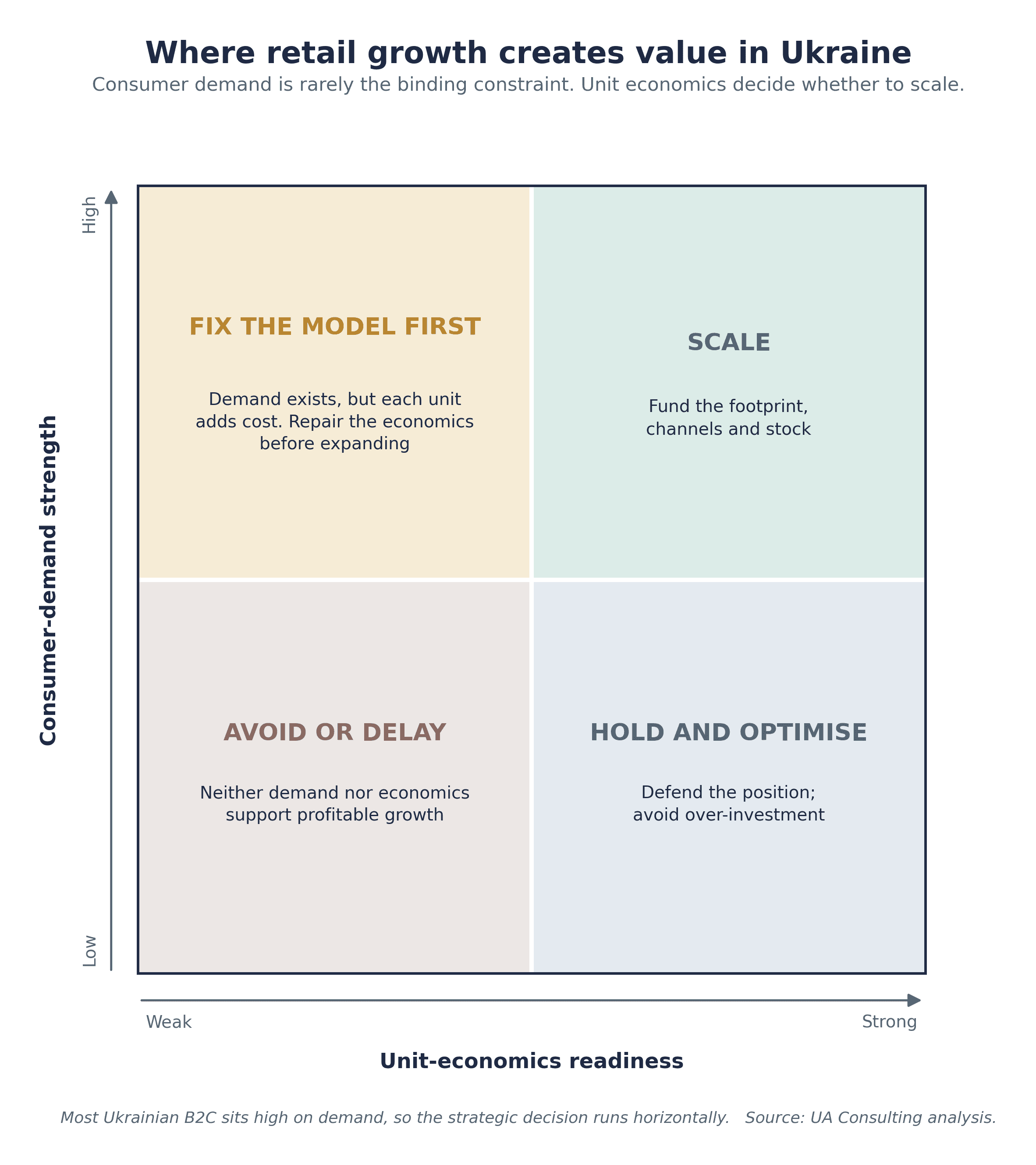
Figure: Where retail growth creates value in Ukraine, mapping consumer-demand strength against unit-economics readiness. Source: UA Consulting analysis.
Each quadrant implies a different capital decision. Expansion is justified where strong demand is matched by scalable unit economics. Where demand is strong but the economics are not yet ready, the priority is to repair the model before committing to scale, because growth in that position simply enlarges a loss. Where the economics are sound but demand is weaker, the sensible course is to defend and optimise the existing position rather than push for more footprint. And where both demand and economics remain weak, capital is better delayed, or confined to controlled tests, than deployed at scale.
What reconstruction may change, and what it will not
Post-war conditions will reshape the geography, rhythm and format mix of Ukrainian retail. Rebuilding will lift demand for home improvement, appliances and furniture, while return migration will redraw the map of where demand actually sits. International brands may re-enter the market, and consumer credit and small-business finance, largely dormant as growth engines during the war, may finally begin to work as genuine accelerators.
What reconstruction will not do is rewrite the underlying principles of the business. The familiar discipline of store-level economics, assortment and space productivity, inventory turns, margin after fulfilment and cash conversion will still decide who scales profitably and who does not. Recovery may widen the addressable market, but it will also expose weak formats, and operators that grew through improvisation during the war may find they need far stronger systems to compete once conditions become more formal. The task ahead is less about looking European in form than about earning the capital, the financing tools and the operating discipline that the next cycle of growth will demand.
What a B2C growth strategy should decide before expansion
A workable retail growth strategy in Ukraine resolves a small number of questions before any capital is committed. It establishes where profitable demand actually sits, by region and by segment, and which format is best suited to serve it, whether that is a flagship, a pickup-led point or a franchise. It decides whether to lead with stores, with own e-commerce, with marketplaces or with an integrated model, and how assortment and pricing should be set for a consumer who has become markedly more price-sensitive. It settles how expansion will be financed and at what cost of capital, and how operating resilience will be built into the model from the outset. And, not least, it decides where the business should deliberately choose not to grow.
That last decision is the one most often skipped, and yet restraint, the willingness to say no to a city, a channel or an SKU that adds complexity without adding contribution, is frequently what separates growth that compounds from growth that quietly consumes cash. Where a B2C model sits inside a wider set of channel choices, it is framed by the broader route-to-market decision. Where the real question is coverage through wholesalers and distributors rather than direct sales to end consumers, that belongs to a separate discussion of B2B distribution.
The decision behind retail growth in Ukraine
Ukraine already has a modern and demanding consumer market, and that is precisely why the constraint on retail growth in Ukraine lies elsewhere. Consumer readiness, digital adoption and delivery capability are all genuinely strong. The harder part is the ability to scale profitably, which means matching format to demand, keeping unit economics under control, financing expansion through a period of uncertainty and building resilience that holds when conditions deteriorate.
Framed this way, the executive question changes shape. For owners, investors and consumer brands, the practical decision is which parts of the model can absorb growth without eroding margin or cash, and where restraint does more to protect the business than expansion would. That makes a B2C strategy for the Ukrainian market a commercial and operating decision first, and a channel or expansion decision second. The companies best placed for the next cycle will not be the ones that simply open the most stores or add the most online reach. They will be the ones that understand where growth compounds, where it quietly consumes cash, and where the discipline to hold back is itself a source of value.
If you are assessing a retail, e-commerce or B2C growth decision in Ukraine, UA Consulting can help test the economics, structure the format choice and identify the risks worth resolving before capital, time and management attention are committed.