Digital transformation in Ukraine is still commonly described as a catch-up exercise, a traditional economy gradually adopting the tools that more advanced markets already use. For most sectors that description is now out of date. Ukraine already functions as a deeply digital operating environment, one in which cashless payment, mobile-first public and commercial services, e-commerce and messaging-based customer contact are ordinary rather than exceptional, and in which war has forced a degree of operational adaptation onto companies that would otherwise have changed far more slowly.
For a company operating in this environment, the decision is no longer whether to digitalise but whether digital investment changes the economics of the business, from the cost of winning and serving a customer to the speed and reliability of management decisions, or whether it simply installs new systems on top of the way the business already runs. That distinction is where the return on digital transformation is actually decided, because the more common disappointment in Ukraine is not a technical failure but a managerial one, where a company automates its existing complexity instead of redesigning how it operates.
Ukraine is already a digital operating environment
The starting point for any serious assessment is that digitalisation in Ukraine is not an aspiration to be encouraged but a condition that already shapes how customers and institutions behave. The state has done much to set that pace, not least through the Diia platform for public services and digital identity, through which Ukraine became the first country in the world to give digital passports the same legal standing as physical documents. It now allows entrepreneurs to register as sole proprietors online in minutes rather than through a lengthy administrative process, and with more than 22 million users it has helped make digital interaction the normal expectation rather than a convenience for a minority.
The same pattern is visible in how people pay, with the National Bank of Ukraine reporting that 94.6% of card transactions by number were cashless in 2024, most of them made through contactless or mobile technology. That this share held through a year of blackouts and infrastructure attacks is itself a measure of how far the behaviour is now embedded. In consumer-facing sectors especially, mobile banking, e-commerce, delivery and marketplace purchasing are not a premium layer for early adopters but part of the ordinary way a company reaches its customers.
None of this, though, translates automatically into competitive advantage, because when digital access is the baseline that customers already expect, a company earns very little simply by being present in those channels. The more demanding question, and the one that decides whether digital investment is worth making, is what that investment changes in the underlying economics and reliability of the business rather than in its technology estate.
How war changed the meaning of digital resilience
In most markets, the case for digital investment is built around efficiency and growth. In Ukraine, war added a more immediate rationale, because the systems that improve efficiency in normal conditions became part of how companies continued to operate at all. Displacement of customers and staff, damage to physical premises, interrupted power and connectivity, and uncertainty over access to sites and assets turned continuity from a contingency on paper into a live operational concern.
The public sector offers the clearest evidence of how far this went. A Harvard Kennedy School Center for International Development analysis notes that Ukraine's investment in digital infrastructure proved critical for maintaining governance through the war, allowing displaced people to reach identity documents and support, and keeping services running on cloud systems and satellite connectivity while physical infrastructure was under attack. Private companies that kept selling, paying staff and serving customers through blackouts and relocation depended on the same underlying logic.
Resilience of this kind is not a natural consequence of moving processes online. A business that migrates to digital systems without backup power, redundant connectivity, tested cybersecurity, recoverable data and clear ownership of who keeps each process running can find that it has concentrated its risk rather than reduced it, turning a single point of failure into a company-wide interruption. In Ukrainian conditions, digital resilience is better understood as a deliberate design and management responsibility than as something the technology provides on its own.
Where digital changes the economics
Once digital behaviour is treated as the baseline and resilience as a precondition, the question that matters to a management team becomes considerably more specific. It is less about which technologies to adopt than about where digital genuinely changes the numbers that determine performance. A credible digital strategy in Ukraine is therefore assessed against revenue, cost, working capital and risk, and not against the sophistication of the systems a company has bought.
The levers that matter tend to fall into a few groups. On the commercial side, digital changes the economics when the channel is properly matched to how Ukrainian customers actually buy, improving customer acquisition cost, conversion and the margin earned across channels rather than simply adding an online storefront. Operationally, it lowers the cost of serving each customer when service, fulfilment and support are rebuilt around digital interaction instead of layered on top of existing processes. In financial terms, it releases working capital when inventory, replenishment and order-to-cash are tightened together. And in management terms, it raises the speed and quality of decisions when leaders work from reliable current data rather than reports that are already weeks out of date.
The distinction that runs through all of these is not how advanced the technology is, but whether the way the business operates actually changes. The table below sets out the same levers under two approaches, one that treats digital as a purchase and one that treats it as a change in the operating model.
Business lever | Tool-led approach | Operating-change approach | Primary economic effect |
|---|---|---|---|
Customer acquisition | Launch an app or online store and wait for demand | Match channel, pricing and range to how the segment actually buys | Lower acquisition cost, higher conversion |
Cost to serve | Add a CRM on top of existing processes | Rebuild service, fulfilment and support around digital interaction | Lower cost to serve |
Working capital | Install an ERP module | Tighten inventory, replenishment and order-to-cash together | Working capital released |
Decision speed | Build dashboards that no one acts on | Combine reliable data with clear authority to decide | Faster, better-informed decisions |
Channel economics | Treat e-commerce as a secondary channel | Redesign the route to market and the balance of direct and partner sales | Better margin by channel |
Framework developed by UA Consulting.
Across the table, the consistent pattern is that the economic gain comes from redesigning how the business works, with the technology acting as the enabler rather than the source of value. That is the practical line between technology adoption and digital transformation, and it is where most of the difference in returns is found.
Technology adoption is not digital transformation
A significant share of what is presented as transformation is, on closer inspection, procurement, and this is where technology adoption in Ukraine most often falls short of what was promised. A new ERP, CRM or business intelligence platform will automate an existing operating model rather than repair a weak one, and e-commerce will not compensate for poor logistics or an unfocused range. The same holds for artificial intelligence, which produces little of value without clean data, defined processes and the authority to act on what it reveals, a point we examine in more detail in our view on AI adoption and digital operating models for businesses in Ukraine.
None of this diminishes the importance of the technology itself, since each of these systems is necessary in many situations without being sufficient on its own. Installed over unresolved complexity, they tend to raise cost and expectation while leaving the underlying economics largely unchanged. The failure, when it comes, is rarely a failure of software but of the assumption that acquiring a capability is the same as building it into how the business runs.
What foreign companies and local incumbents tend to misread
For decision-makers, some of the most expensive mistakes come from misreading where Ukraine actually sits, and foreign entrants and local incumbents tend to get it wrong in opposite directions. Foreign companies can arrive with a playbook written for an emerging market that is still catching up, underestimating how much Ukrainian customers already expect in payment convenience, delivery speed and mobile-first service, so that an imported approach looks dated on arrival. Local incumbents can make the opposite error, treating an established stack of ERP, CRM, marketplace presence and online payments as evidence that the transformation is already complete.
Both readings miss the same distinction, which is that what matters is not the country's overall digital maturity or a company's inventory of systems, but how well the model fits the specifics of the Ukrainian market. This is the difference between digital exposure, which is now widespread, and digital discipline, which is not. Exposure shows up in the surface detail of how Ukrainians pay, which platforms and messaging channels they trust for purchases and support, and how marketplaces and delivery have reset expectations for speed. Discipline is the harder question of how far a business has genuinely built those behaviours into its commercial and operating model, and of how well that model holds up against regional differences in infrastructure and logistics. A digital strategy for the Ukrainian market that is designed around these realities will consistently outperform one that assumes they can be imported.
There is also a longer-term consideration that increasingly shapes serious planning, namely the convergence of Ukraine's digital agenda with that of the European Union. The EU has supported this integration directly, and in January 2026 it announced a further EUR 10 million for cross-border digital services, secure data exchange and alignment with EU data governance and cybersecurity standards, as part of Ukraine's integration into the EU Single Digital Market. For a company planning several years ahead, this makes interoperability, data governance and EU-facing operating standards a structural feature of digital planning rather than an optional refinement.
How to approach digital transformation in Ukraine
A disciplined approach to digital transformation for businesses in Ukraine runs in the opposite direction to a technology project. It begins with the economics and the operating constraints, and only then moves to the choice of systems. In practice, that means starting from where the economics can realistically move, and from where the business currently loses time, money or reliability, whether in acquiring customers, in the cost of serving demand, or in keeping operations running under power and connectivity disruption. From there, the task is to select the use cases whose economic value is large enough to justify the operating change they require, rather than those that simply look modern.
Two further questions decide whether the work will hold. The first is where resilience has to be designed in from the outset, given Ukrainian conditions, rather than added once something breaks. The second is ownership, meaning who is accountable for the process, the data, the decision and the result once the technology is in place. Only when those are settled does sequencing become a real question, so that each step delivers a measurable improvement in the economics or the operating model before the next is started. Approached in this way, digitalising operations in Ukraine is a sequence of business decisions rather than a list of systems to buy.
Prioritisation is the point at which this discipline is most often tested. Where management attention and capital are limited, and where execution reliability cannot be taken for granted, the choice of what to do first matters as much as the ambition behind it. The matrix below is a simple way to keep that choice honest, plotting each candidate initiative by the economic impact it can deliver against the depth of operating change it demands.
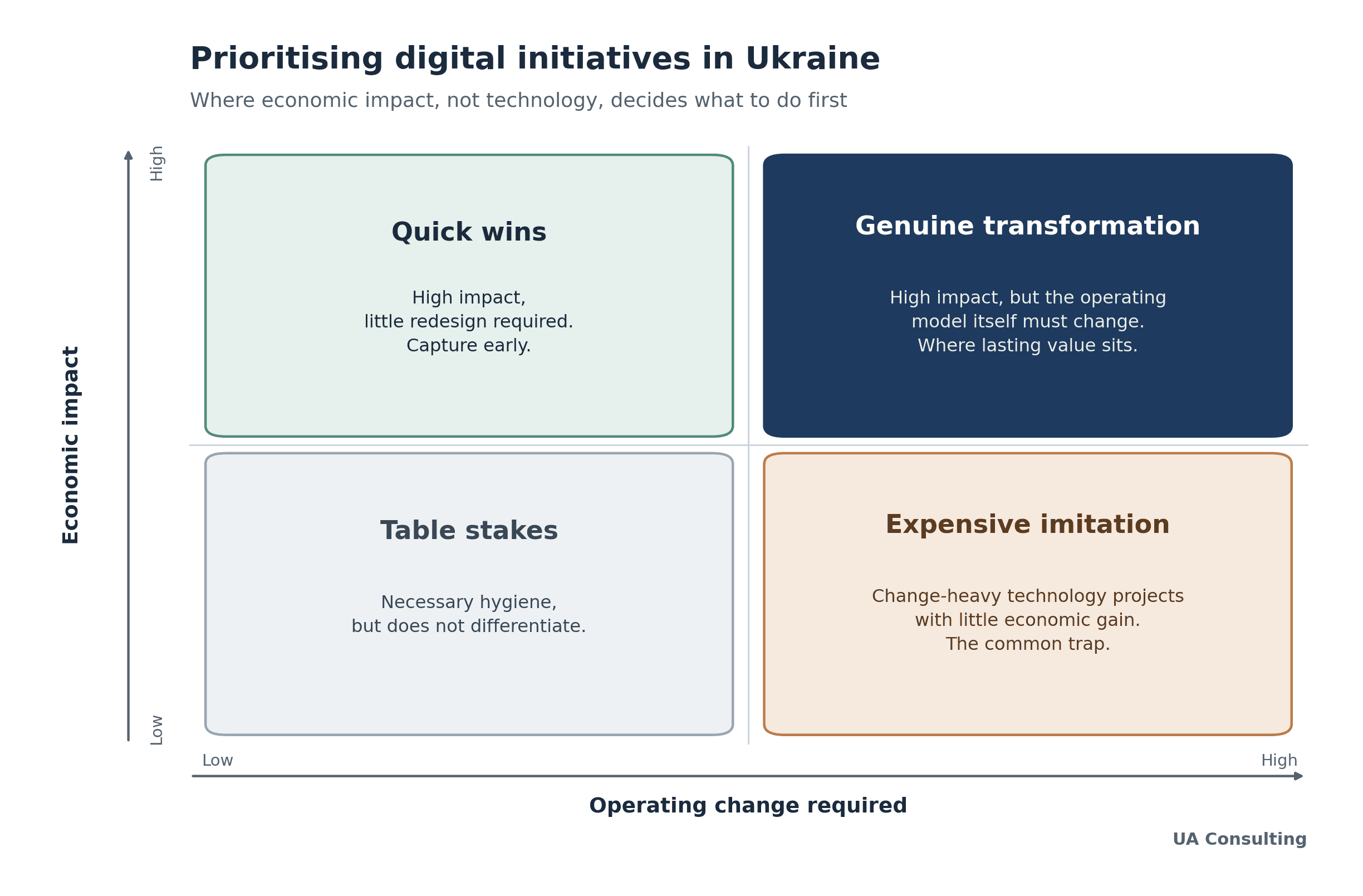
In the upper left sit the quick wins, initiatives that offer high impact for limited operating change and are worth taking early. The upper right holds genuine transformation, where the impact is high but the business has to operate differently to capture it, and where the largest and most durable gains are concentrated. The lower left is hygiene, the necessary baseline work that keeps a company credible without setting it apart. The lower right is the quadrant to watch, where large and change-heavy programmes can look modern while absorbing capital and management time without moving the economics enough to justify them. This is the expensive imitation that, in a market short of both capital and management bandwidth, most often traps otherwise capable companies. Handling this well is less an IT exercise than a question of strategy and operating design, which is why it sits more naturally at the meeting point of Strategy & Management Consulting and Technology & Digital Business than inside a technology function alone.
The management decision
Seen in this way, digital transformation in Ukraine is not the modernisation of a market that has fallen behind. It is the discipline of competing in one where digital behaviour is already the norm, where resilience has become a condition of operating rather than a refinement, and where technology earns its place only when it changes the economics, the control, the speed or the adaptability of the business. Companies that treat it as a question of the operating model tend to do well in these conditions, while those that treat it as a procurement exercise tend to spend without changing very much.
For a chief executive, owner, board or investor, that turns the decision into a small set of concrete questions. Where can digital realistically move the economics of this business, and which changes to the operating model are needed to capture that value? Where does resilience have to be built into the process from the start, given how the company actually operates in Ukraine? What should be sequenced first, and where would a technology purchase simply make the current way of working faster and more expensive without improving it? Answered honestly, those questions define a digital operating model in Ukraine that is built around where value actually sits, and that is a far more reliable guide to spending than the appeal of any individual system.
Where a digital transformation, digital strategy or operating-model decision in Ukraine is under consideration, UA Consulting can help structure the business case, test where the economics can move, and define the execution and resilience path before technology spend and management attention are committed.