AI adoption in Ukraine is best understood as a redesign of the operating model under constraint, rather than as an exercise in licensing new tools. For most companies the decision that matters is not which software to buy, but where the business is losing time, judgement, margin or control because its operating model cannot process complexity quickly enough. That question is sharper in Ukraine than in calmer markets, because companies here rarely face one pressure at a time. They contend at once with a shortage of experienced people, with infrastructure and logistics that cannot be relied upon, with demand that shifts without warning, and with data spread across disconnected systems, all while European partners and lenders expect a credible standard of governance. Against that background, AI earns its place only where it changes how the company actually runs, improving how information is read, how exceptions are caught and how scarce management attention is spent. The more tools a company adds without changing those things, the less it has to show for the effort.
Why AI adoption in Ukraine is an operating-model question
Most AI initiatives underdeliver because they are managed as technology projects. A tool is selected, a pilot is launched and a dashboard appears, yet the way decisions are actually made remains unchanged. The more productive framing treats AI as a change to the operating model, meaning the structure through which a company converts information into action, rather than as a procurement exercise.
The distinction from broader digitalisation is worth drawing precisely, since digital transformation tends to reshape the interface and operating backbone of a business, whereas AI acts on the decision layer, changing how information is interpreted, how work is prioritised, how exceptions are handled and where management attention is spent. Because that decision layer is where value and risk concentrate, the case for adoption depends less on the technology itself than on the conditions in which the company operates, and in Ukraine those conditions are unusually demanding.
The Ukrainian constraints that should shape AI decisions
The starting point is the labour market, where the OECD's 2025 assessment of Ukraine notes that labour shortages, together with attacks on energy supply, logistics and businesses, are slowing economic activity. For management, the more consequential reading is that the binding scarcity is not labour in general but experienced managerial capacity, since fewer people are available to absorb complexity, interpret signals, handle exceptions and keep operating decisions moving under pressure. This is why the strongest case for AI in Ukraine is rarely the replacement of staff but rather leverage on scarce judgement, achieved by removing routine load, standardising analysis and freeing senior people for the decisions only they can take.
Two further constraints concern the quality and speed of information. Volatility is the first, and it sets a natural limit on what AI can be expected to do, because no system can reliably forecast war, demand or regulation. What AI can do is shorten the time between a signal and a response, helping a company notice a change in demand, a shift in supplier risk or an operational fault earlier and prepare a considered reaction. The second constraint is fragmented data, which works in the opposite direction. Where information is scattered across systems, sites and functions, weak inputs tend to produce confident and well-formatted errors, so data readiness has to be treated as a precondition for useful AI rather than a detail to be resolved later.
The remaining constraints concern control, and resilience matters here because power interruptions, logistics disruption and security exposure mean that systems must keep working, or fail safely, when conditions deteriorate. That requirement is what makes human override and fallback procedures part of the design rather than optional refinements. Governance matters for a related reason, because closer work with European partners, lenders and donors turns the use of AI into a question of data control, accountability and transparency, and not only of efficiency. Taken together, these conditions define the environment that any credible approach to AI in Ukraine has to fit.
Where AI for business in Ukraine creates real value
Value becomes easier to locate when use cases are grouped by what they change in the business rather than by the department that happens to own them, and four pools recur across sectors in Ukraine. Commercial value comes from sharper customer and pricing decisions, and it matters most where margins are under pressure and sales teams are thin, so that qualifying leads, adjusting prices and holding service quality no longer rest entirely on scarce experienced staff. Operational value comes from running the business with fewer surprises, which counts for a great deal when supply is volatile and infrastructure unreliable, because earlier signals on demand, inventory, procurement and maintenance give managers time to act before a disruption turns into a loss. Management value comes from faster and better-supported decisions, and it is felt most acutely where a small leadership team is overloaded, since quicker reporting, scenario preparation and the retrieval of scattered internal knowledge free senior attention for the judgement that cannot be delegated. Risk and governance value comes from tighter control, which carries particular weight for companies exposed to fraud, contract disputes, cybersecurity threats and the compliance expectations of European partners, where anomaly detection, contract review and counterparty screening strengthen oversight rather than simply add reports.
The discipline that separates genuine adoption from mere accumulation is to tie every use case to a real improvement in economics, control, resilience or decision quality. An application that produces more content, more dashboards or more automated steps without moving a margin, a decision or a risk position is activity rather than value, and where management attention is itself the scarce resource, that difference carries direct commercial weight. Choosing where to begin therefore becomes a structured decision, and the criteria below give owners and boards a way to rank candidate use cases before budget, data and management time are committed.
Criterion | What to assess | Why it matters under Ukrainian conditions |
|---|---|---|
Economic value | Whether it moves revenue, margin, cost, working capital or control | Under margin pressure, AI effort must pay back, not simply modernise |
Operational pain | Where the process genuinely breaks or bottlenecks | Scarce management capacity should target real friction, not pilots |
Data readiness | Whether reliable, accessible data already exists | Fragmented data limits AI, and weak inputs produce confident errors |
Human oversight | Who owns the decision and reviews the output | Accountability and decision rights must stay clear, including for European compliance |
Resilience | Whether it still works under outages, poor data or changing conditions | Power and infrastructure disruption make override and fallback essential |
Scalability | Whether a proven case can extend to other functions without creating unmanaged complexity | Limited capacity favours use cases that compound over one-off tools |
Framework by UA Consulting.
From AI tools to a digital operating model
A company does not become AI-enabled because its employees use AI tools, but rather when AI is built into how work is structured, how decisions are made and how performance is managed. Building a digital operating model in Ukraine is therefore a design task more than a purchasing one. It means settling, deliberately rather than by default, who owns each process and who may act on what the system produces, how its recommendations are reviewed and recorded before they shape a decision, and what the business does when a model is wrong, unavailable or working from weak data. Without that structure, AI tends to become either a novelty or a source of unmanaged risk, which is why embedding it is as much a matter of operations and execution as of technology.
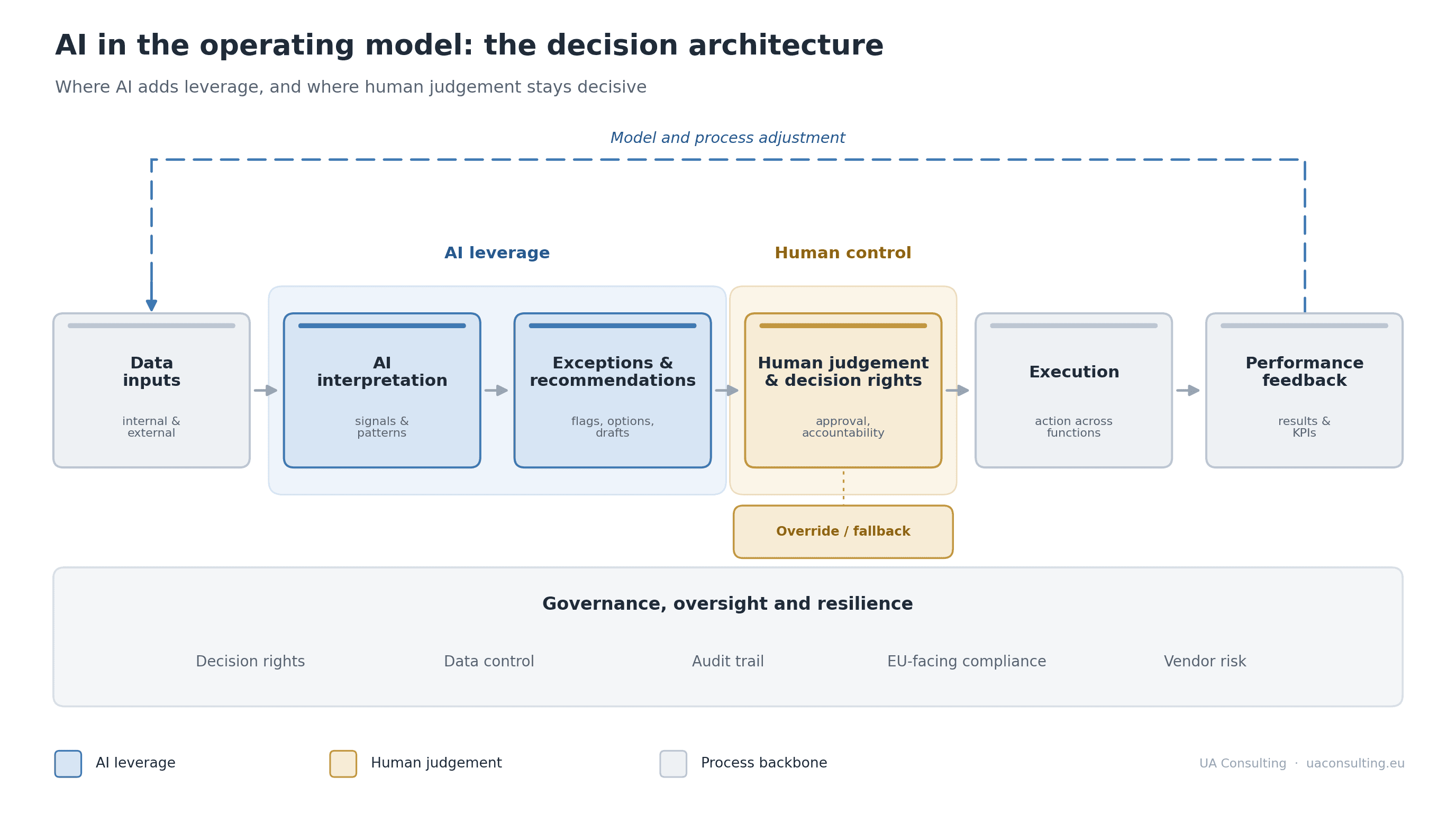
One judgement deserves particular emphasis under Ukrainian conditions, which is that more automation is not always better. A defence-manufacturing example makes the point, and it should be read as an analogy rather than as a civilian blueprint. Frontline Robotics, a Ukrainian drone producer, told Business Insider that it changes its products as often as twenty times a month, and that too much automation can become a liability because it locks the business into a single product version. For that reason the company keeps much of its assembly manual, and it treats heavy fixed machinery as a vulnerability rather than an asset when conditions can change from one week to the next. For an ordinary business the lesson is not militarisation but operating logic. Under fast-moving conditions, selective automation usually serves a company better than maximum automation, because automating the stable and repeatable work while keeping flexibility and human override where the environment shifts is what protects the ability to adapt. For companies in Ukraine, the operating model worth aiming for is therefore not the most automated one, but the one that can change without breaking.
Data, sovereignty and EU-facing governance
AI adoption is also a question of data control and vendor dependence. Where data is processed, which models a company relies on, who checks their outputs and how sensitive commercial information is protected are operating decisions that belong to the technology and digital business agenda rather than to IT preference alone. The direction of national infrastructure reflects the same concern. According to Reuters, Kyivstar signed a memorandum with Ukraine's economy ministry at the June 2026 Ukraine Recovery Conference in Gdańsk, with financial backing from its parent company VEON, to build domestic AI computing capacity that keeps sensitive processing inside the country, part of a wider effort in which the military is described as the largest current user of Ukrainian AI.
Regulation adds a further reason to treat AI as a governance matter. According to the European Commission, the EU AI Act entered into force in August 2024 and applies in phases, with most of its obligations taking effect from August 2026. Its scope can reach providers outside the European Union where their AI systems are placed on the EU market or their outputs are used within it, which brings companies serving European clients into consideration regardless of where they are based. Ukraine is aligning with this framework gradually, and the International Bar Association describes the Ministry of Digital Transformation's 2024 White Paper as setting out voluntary tools and soft-law guidance ahead of binding legislation modelled on the Act. For a board, the practical consequence is that AI has to be handled as a governance question rather than a purely technical one, with clear positions on data protection, transparency, accountability, human oversight and vendor risk. An AI strategy in Ukraine becomes credible only when it is tied to execution, governance and a change in the operating model, rather than expressed as an ambition to use more tools.
What this means for leadership
The companies that gain the most from AI in Ukraine will not be those that adopt the largest number of tools, but those that are clear about where AI belongs inside the operating model, where human judgement has to remain decisive, and how digital systems can make the business faster, better controlled and more resilient under local conditions. Before any budget is committed, leadership is better served by settling a small number of questions than by launching pilots. It needs a considered view on which parts of the operating model AI should genuinely change, which decisions must stay in human hands, who is accountable for the work, and how its effect on margin, control or resilience will be measured. Answering those questions is a matter of strategy and management before it is a matter of technology, and it bears directly on how the company is run from one day to the next.
If you are assessing how AI should change your operating model in Ukraine, UA Consulting can help test where AI creates value, what to prioritise, which risks require governance and where human control must remain, before budget, data and management attention are committed.