Agribusiness investment in Ukraine is usually framed through scale, through the land, the harvests and the country's standing in European and global food supply. That scale is real, but on its own it can mislead, because the most visible positions in the market are already held. Large producers, established exporters, international traders and vertically integrated agroholdings occupy most of primary production, and the returns from entering that layer are thin.
The more useful question is not whether Ukraine has agricultural potential, which it plainly does, but where that potential has not yet been converted into retained margin. For most investors the stronger case now lies further along the value chain than in the field itself. It sits in the processing, storage, logistics and export capabilities where Ukraine still allows too much of its agricultural value to leave the country in raw form. This article reads where that value is created, and how an investor can test whether a project is financeable and executable under current conditions.
A developed market, not an empty one
Ukraine is one of the world's major agricultural producers, and through nearly four years of war the sector has remained among its most important sources of export revenue. Analysis by the Tony Blair Institute for Global Change puts agri-food at a very large share of wartime exports, approaching roughly two-thirds of export value in some recent periods. The same analysis finds that only about a quarter of agricultural output is processed at home, and that most of it stays at the earliest stages of transformation. Oils and oilcake alone make up close to three-quarters of processed export value, while higher-value categories such as food preparations, processed dairy, packaged produce and value-added proteins remain comparatively thin.
Taken together, these figures describe a market whose base is occupied but shallow. The raw material that feeds much of the world leaves Ukraine largely unprocessed, and the margin from turning it into finished food is captured abroad rather than at home. For an investor, that moves the central question away from whether an agricultural sector exists, and towards where the sector fails to keep the value it produces. That is what makes a case investable, and it is the question this analysis follows.
Where the margin sits: from production scale to value capture
In Ukrainian agriculture the return is rarely made in the field. It is made in transforming the crop and controlling the stages between harvest and buyer, and those are the stages that remain underbuilt. Read against that reality, agribusiness opportunities in Ukraine separate into three layers, each with a different margin profile and level of competition.
The first is production and land. It is large, competitive and, across most regions, already controlled by capable operators, so simple entry rarely creates advantage on its own. Primary production becomes investable in narrower circumstances, where it secures supply for a processing operation, where an undercapitalised or distressed asset can be modernised, or where it becomes a platform for higher-value integration such as irrigation, seed production or an EU-aligned supply chain. Bought outside those circumstances, land and farming operations tend to represent exposure to the sector rather than a defensible position within it.
The second layer, value-added processing and export-ready food, is the commercial centre of the case. It runs from oilseed crushing and grain processing through feed, animal protein and food ingredients to the packaged, frozen and certified products that reach a final buyer. Here, food processing investment in Ukraine can convert existing scale into higher and more durable margins, and that advantage is strongest where a plant is built to EU standards from the outset, since certification and traceability are what open and hold Western markets. The third layer, examined below, is technology, where productivity gains remain only partly reflected in the price of Ukrainian assets.
Public finance is moving in the same direction, which signals which projects can now be built. The EU's €50 billion Ukraine Facility, and the Ukraine Investment Framework within it, treat agri-food and value-chain industries as priority sectors. The Framework carries €9.6 billion in guarantees and grants and is designed to mobilise up to €40 billion of public and private investment through blended finance, and it is beginning to determine which agribusiness cases are financeable in practice. This follows the wider pattern of foreign direct investment in Ukraine, in which capital increasingly moves through guaranteed and reconstruction-linked instruments rather than open exposure. Financeability, though, only widens what is possible, and does not by itself decide whether a given project should be built.
The three layers can be set against the questions an investor actually needs answered.
Value-chain layer | Margin profile | Who holds it now | What new capital adds | Principal risk to test |
|---|---|---|---|---|
Production and land bank | Often commoditised unless integrated | Agroholdings, farmers, traders | Scale, operating efficiency, secured supply | Overpaying for a competitive, occupied position |
Storage and logistics | Moderate, infrastructure-led | Fragmented, with damaged capacity | Modern storage, cold chain, route control | Physical and route exposure under wartime conditions |
Value-added processing | Higher and more defensible | Underdeveloped | Processing base, EU-aligned product, export access | CAPEX intensity, energy supply, compliance path |
Technology and inputs | Potentially high, but use-case specific | Thin adoption | Productivity where a defined constraint exists | Adoption risk, and technology without a real bottleneck |
Export-ready and branded food | High retained value where buyer access and certification are secured | Very thin | Branding, packaging, certification, buyer relationships | Route resilience and working-capital depth |
Framework: UA Consulting analysis, drawing on Tony Blair Institute (2026) and World Bank RDNA5 (2026) data.
Technology as the productivity layer
Ukraine is a major producer, but not yet a high-technology agri-food economy of the kind found in the Netherlands or Denmark, and for a certain type of investor that gap is part of the attraction rather than a deterrent. The distance between Ukraine's agricultural scale and its technology intensity is where productivity can still be added, and those gains are not always reflected in the price of the asset.
The applications that matter in Ukraine are practical rather than fashionable. They centre on reducing storage and post-harvest losses, improving input and irrigation efficiency, strengthening energy resilience at plant and farm level, and building the traceability that EU-bound exports increasingly require. A technology investment earns its place where it removes a specific bottleneck in the operation, and contributes little where none exists.
Institutional capital is beginning to move the same way. In early 2026 the EBRD, currently Ukraine's largest institutional investor, approved a technical cooperation programme, New Horizons, to encourage innovation-driven investment across the agri-food system, with particular attention to alternative protein and more sustainable intensive production. The signal is that technological modernisation is no longer a marginal concern, though it does nothing to lessen the obligation on any single project to solve a real problem.
Consolidation and M&A require discipline
Consolidation in Ukrainian agriculture is already under way, and part of it will reward investment. Years of war have left many assets undercapitalised, some owners fatigued and the cost of post-war reinvestment high, and this will keep bringing farming operations, grain elevators and processing plants to the market. A low entry price, though, is not in itself an investment case, since an asset acquired cheaply still adds little unless it can be integrated into a stronger operating and financing model.
What matters is what an acquisition secures in practice, whether controlled access to raw material, a functioning processing base, a usable export route, operating synergies, a capable management team or added financing capacity. Consolidation creates value when it assembles these into a more resilient business, and destroys value when it merely accumulates more of the same exposure. Due diligence here has to reach well beyond title, debt and asset condition. It has to weigh crop rotation and the working-capital cycle, access to elevators and storage, energy exposure, offtake reliability, sanctions and compliance risk, and the depth of local management. This is where a promising target becomes a question of transaction structuring, and where M&A transaction support matters more than opportunistic buying.
Export economics and logistics are part of the investment case
In Ukraine, logistics has to be treated as a first-order variable in any agribusiness investment case rather than a background assumption. The structural scale of the problem is set out in the World Bank's fifth Rapid Damage and Needs Assessment. It identifies transport as the single largest reconstruction need in the country, above USD 96 billion, and records that this need rose by roughly a quarter on the previous assessment as attacks on rail and ports intensified. Reporting by Reuters in mid-2026 sharpened the immediate picture, noting that more than 90 per cent of Ukraine's agricultural exports still move through the three ports of the Odesa hub, and that sustained strikes could cut monthly volumes by close to a third, from around six million tonnes towards four.
Because grain and vegetable oil dominate those flows, damage to a small number of terminals has an effect out of proportion to its physical scale, and the alternative corridors through the Danube and by rail can absorb only part of any shortfall, and at higher cost. The precise monthly figures will move with the course of the war, but the underlying principle is stable. Export-route concentration has to be carried in the base case rather than assumed away. In practice this means treating route resilience as part of the underwriting, building war-risk insurance and storage depth into the capital plan, and judging any processing project by how reliably its output can reach a paying buyer. A processing plant without a dependable route to export is, under current conditions, a stranded asset in the making.
What to assess before an agribusiness investment in Ukraine
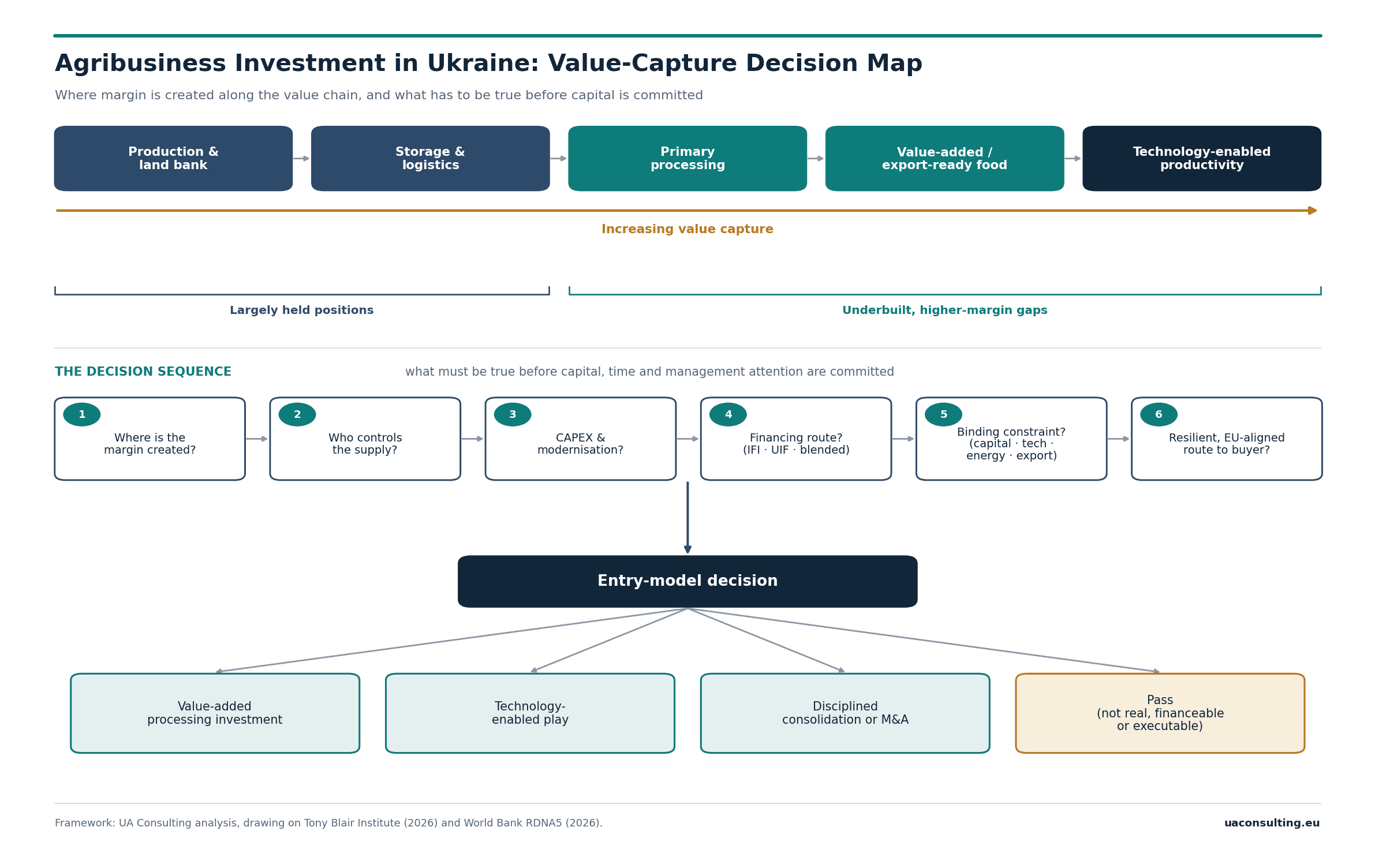
Because the market is developed but uneven, the discipline that matters is not asking whether Ukraine offers agricultural opportunity in general, but establishing whether a particular position is real, financeable and executable. The same short set of questions tends to separate a genuine case from a superficial one. It begins with where along the chain the margin is created and who controls the supply that feeds it. It moves to how much capital and modernisation the asset needs, and whether a credible financing route exists, including through the international financial institutions and the Ukraine Investment Framework. It then identifies the binding constraint on the business, whether capital, technology, management, energy or access to export markets, and asks whether the output has a resilient, EU-aligned route to the buyer. Only when these questions hold together does the choice of entry model, an organic build, a processing investment, a technology play or a disciplined acquisition, become a considered decision rather than a leap.
The decision map below traces that sequence through to the outcomes it produces. Its value is that it carries the analysis all the way to a structure, the point at which sector knowledge in agribusiness, food and agriculture has to meet disciplined investment and project advisory. An attractive-looking sector is not the same as an investable case, and the distance between the two is what a sequence of this kind is built to expose.
Figure 1. Agribusiness investment in Ukraine: value-capture decision map.
Structuring the decision
The headline case for Ukrainian agriculture is by now well understood and, for the most part, already priced in. The next investment cycle will be decided further along the chain, in the processing that keeps margin inside the country, in logistics and storage able to withstand the current environment, in technology that resolves genuine constraints, and in consolidation that builds stronger platforms instead of enlarging exposure. The direction of travel is from production scale towards value capture, and from opportunistic acquisition towards disciplined structuring.
Put simply, the investable case is not that Ukraine has agriculture, which is self-evident. It is that a specific position in the value chain can secure its supply, retain its margin, reach its buyers, withstand disruption and raise finance on terms that match its risk. Everything upstream of that test, including the country's considerable agricultural strength, is context rather than conclusion. The quality of an agriculture investment in Ukraine now depends less on recognising what the sector does well than on locating the one point where capital can create a structural advantage, and confirming it can be executed.
If you are assessing an agribusiness investment, an acquisition or a processing project in Ukraine, UA Consulting can help test the investment case, structure the route to execution and identify the risks that must be resolved before capital, time and management attention are committed.